
‘Your Appetite Is Insatiable’: PM Modi Takes India Inc to Task Over Salaries, Jobs

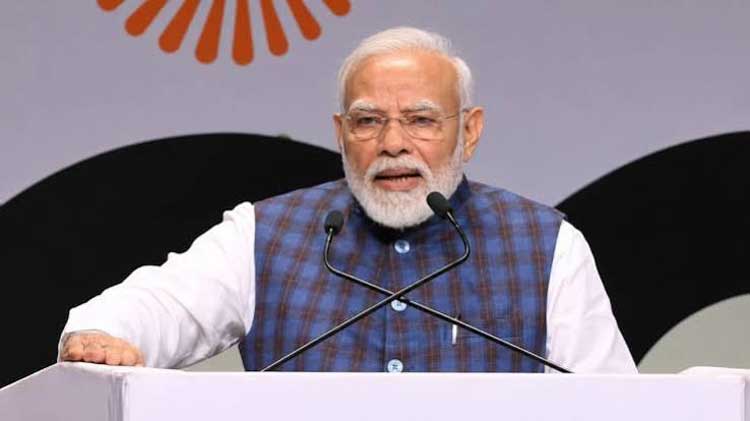
Questioning India Inc on job creation and employee salaries, Prime Minister Narendra Modi on Thursday sent a blunt message to businesses, saying they were not passing on the benefits of government efforts to improve the ease of doing business and cut taxes to their employees through higher salaries.
He also criticised industry for failing to produce quality goods for Indian consumers, saying he was “ashamed” of the attitude among manufacturers who appeared to take the domestic market for granted.
Addressing the Federation of Indian Chambers of Commerce and Industry’s (FICCI) Annual General Meeting and Annual Convention in New Delhi, the industry body’s centenary year celebrations, Modi said, “In 2014, the corporate tax rate was 30%. We reduced it to 22%. Today, in India, there is no tax on earnings up to Rs 12 lakh… I know you won’t clap. I know this very well. Kyonki aap ki bhookh itni hai, kitna hi khilao pet bharta nahin hai (Because your appetite is so insatiable, no matter how much you are given, it is never enough). But have you increased the salaries of your employees? Have you increased the number of employees in your organisations? No. You say, ‘Modi ji, you do your part, we will see.’ It will continue like this.”
The Prime Minister said tax concessions and reforms had increased purchasing power and created opportunities for businesses, but industry needed to respond by expanding employment and improving employee compensation.
He also cited improvements in tax administration, saying the government had simplified tax returns and refunds. While refunds earlier took around eight months, they were now being processed within a week, he said.
Referring to the Goods and Services Tax (GST) reforms, Modi said tax reductions on several products had boosted demand and directly benefited industries and business houses.
He questioned whether companies were making adequate use of the opportunities created by India’s free trade agreements (FTAs) with major economies.
“When free trade agreements are signed with major economies of the world, it means doors have opened for you. Have you made any plans to seize those opportunities, or will I have to come here and explain that as well?” he asked.
Modi urged businesses to adopt an India-first approach in their long-term investment decisions over the next 20 years, saying industry must prepare for emerging domestic and global demands.
He also called for reducing India’s dependence on imports in strategically important sectors, particularly pharmaceuticals and metals such as steel and aluminium. Businesses, he said, should identify opportunities to manufacture domestically and strengthen the country’s self-reliance.
The Prime Minister also emphasised the need for greater investment in agriculture and food processing, alongside engineering goods, to build capabilities that would strengthen India’s economic security.
‘My countrymen deserve quality products’
Taking particular aim at manufacturers for offering Indian consumers products of inferior quality while reserving better standards for exports, Modi said the country’s large domestic market should not become an excuse for complacency.
He said businesses appeared confident that whatever they manufactured would find buyers among India’s 140 crore people, whether in large cities, smaller towns or villages.
“This mindset cannot continue. You will have to improve your quality. Do not consider 140 crore Indians merely as an assured market,” he said.
The Prime Minister said he was embarrassed by the practice of manufacturers promoting certain products as “export quality”, suggesting that this created the impression that goods intended for foreign consumers were superior to those sold domestically.
“Are our own people not entitled to good-quality products? This mindset must change. My countrymen deserve quality,” he said.
He urged Indian companies to invest in understanding the preferences of international consumers, developing products suited to different markets and building distribution networks to expand their global presence.
Modi also invoked Mahatma Gandhi’s emphasis on Swadeshi and self-reliance, observing that Indian industry was still being asked to address issues raised nearly a century ago.
He challenged FICCI members to assess what the industry could contribute to India’s development over the next decade rather than waiting for another century to make significant progress.
Modi invites industry to suggest reforms
In a message to business leaders, Modi described his government as industry-friendly and invited companies to communicate their concerns and suggestions for further reforms directly to him.
He said the business community’s experience with previous governments had been difficult, but maintained that his administration was willing to listen to industry and address its requirements.
“Without hesitation and without inhibition, write to me openly and tell me what reforms are still needed,” he said, adding that even if the government could implement only a few of the suggestions, it would continue working towards improving the business environment.
He also stressed that the domestic market should serve as a source of confidence for Indian businesses to compete internationally rather than become a comfort zone that discourages innovation and quality improvements.
Concluding his address, Modi said India’s goal of becoming a developed nation was a commitment rather than merely a slogan, and called on industry to play a greater role in achieving the target.
“Developed India is not a slogan; it is a commitment. This commitment must be lived by all 140 crore Indians,” he said.
Comments are closed, but trackbacks and pingbacks are open.