
Rahul Gandhi to Pakistani Student: Dialogue Possible Only If Islamabad Ends Terror Support

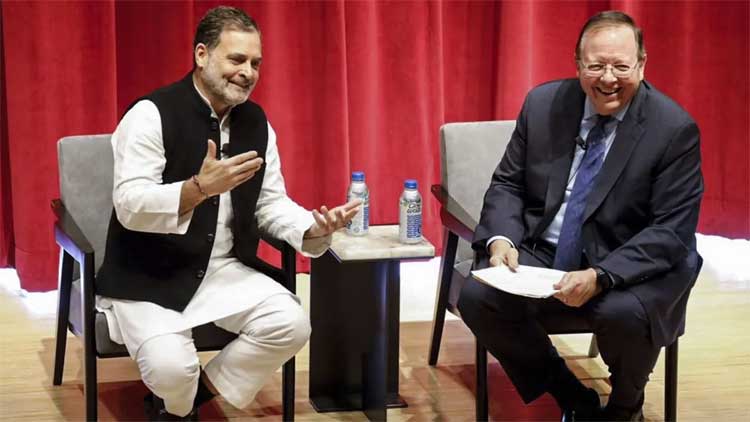
Congress leader and Leader of Opposition in the Lok Sabha Rahul Gandhi has said India and Pakistan can work together, but meaningful dialogue between the two countries is possible only if Islamabad stops supporting and encouraging terrorism on Indian soil.
Speaking to students at the University of Chicago on Wednesday, Gandhi said India could not engage in talks with its neighbour while innocent people continued to lose their lives in terrorist attacks.
He was responding to a question from a participant who identified himself as a Pakistani national. The participant asked whether India and Pakistan could move beyond mutual accusations and cooperate for their shared interests without allowing external forces to exploit their differences.
“There is room, but there is a big problem, which is the support and encouragement of terrorism by Pakistan in our country,” Gandhi said.
“And it is impossible for us to accept our innocent people being murdered and having a conversation with Pakistan. So the moment that stops, then a conversation can potentially begin,” he added.
Rahul Gandhi says India has become a ‘side player’ in global affairs
During the interaction, Gandhi also criticised the Narendra Modi government’s foreign policy, arguing that India had lost its influence in important international discussions despite its size, history and diplomatic relationships.
Referring to Pakistan’s reported role in facilitating negotiations between the United States and Iran, the Congress leader questioned why India was not playing a more prominent role in global diplomacy.
“India, by its size, naturally has a global voice and India should be actively involved in global conversations. But frankly, India has become a side player,” he said.
“I’m pretty shocked that Pakistan is busy negotiating with the Iranians and the Americans, and India’s just looking,” he added.
The BJP strongly criticised Gandhi’s remarks. Party national spokesperson CR Kesavan said: “Rahul Gandhi comes across as a cheerleader and a shameless propagandist for Pakistan.”
Gandhi argued that India needed to reclaim its historical position in international affairs, recalling the country’s role in the Non-Aligned Movement (NAM).
Founded in 1961, the NAM brought together countries that wanted to maintain an independent foreign policy rather than align themselves with either the US-led or Soviet-led blocs during the Cold War. India’s first Prime Minister, Jawaharlal Nehru, was among its founding leaders.
‘India has stepped back from the global stage’
In a post on X on Thursday, Gandhi reiterated his criticism of India’s diplomatic position, saying he was surprised that Pakistan was involved in negotiations between Washington and Tehran while New Delhi appeared to be watching from the sidelines.
He said India had historically maintained an independent and sophisticated understanding of geopolitics and should once again take an active role in shaping international discussions.
“India has always had a sophisticated geopolitical understanding, right from independence. We had a mind of our own. Our foreign policy was guided by what benefits India,” he said.
“By our size, our history and our relationships, we should be involved in these global conversations. But frankly, India has become a side player. We have stepped back from the stage. We have a voice and a view, but that view is missing,” he added.
Gandhi also referred to the wider economic and social consequences of international conflicts, arguing that developments outside India’s borders could not be ignored.
“There was already pain in India. The Iran war magnified it, pushing people over the edge. We cannot sit in India and remain unconcerned about what is happening in the rest of the world,” he said.
Rahul Gandhi questions Modi’s approach to foreign policy
The Congress leader also questioned Prime Minister Narendra Modi’s approach to international relations, arguing that personal friendships between political leaders should not be confused with effective diplomacy.
“Friendship is not the point. Who gives a damn about friendship? Do you really think that geopolitics is going to work because the guy is your friend? He’s leading a structure. He’s got a whole economic system under him. He’s not going to make decisions based on whether he likes you or doesn’t like you. So these are some of the things that disturb me,” Gandhi said.
He clarified that he had no objection to political leaders maintaining cordial personal relationships. However, he maintained that a country’s foreign policy must be guided by a clear understanding of geopolitical realities and national interests.
“I don’t have a problem with being friends with Mr Modi or being friends with leaders. Friendship is not that important. What’s important is that you understand what’s going on, who you are, and where you fit,” he said.
Gandhi says emerging global order will involve multiple powers
Speaking about the changing international security environment, Gandhi said the emerging global order would not be dominated by a single country or civilisation.
Instead, he argued, several major powers and regions would have to shape the next phase of global politics.
“The next global architecture will not be built by one civilisation alone. It will be shaped by multiple civilisations, with America, China, India, the Middle East and Russia all having a role to play,” he said.
His remarks underline the Congress leader’s broader criticism of the Modi government’s foreign policy, particularly India’s perceived absence from important diplomatic negotiations and discussions on international conflicts.
Comments are closed, but trackbacks and pingbacks are open.