
Modi Calls Civilisational Dialogue Key to Global Peace at First SCO Forum in Delhi

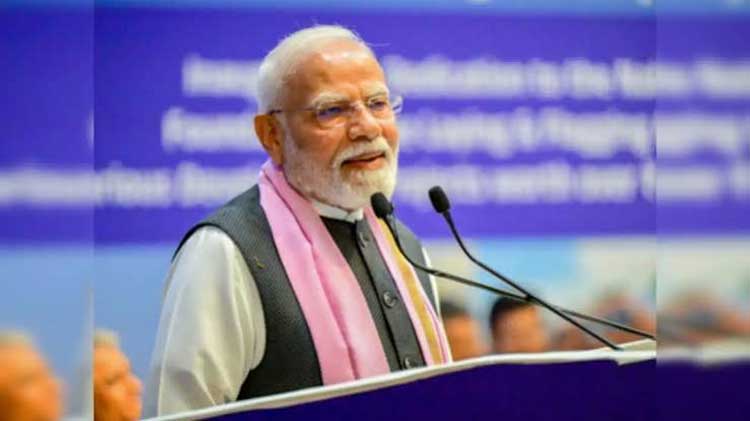
Underlining the importance of civilisational dialogue for global peace, Prime Minister Narendra Modi said Friday India was engaging in dialogue on cultural and civilisational connections at a time when discussions around the world are focused on wars and unrest.
Addressing the first Shanghai Cooperation Organisation (SCO) Civilisational Dialogue Forum at Purana Qila in New Delhi, Modi said cultural connections are the strongest guarantee for global peace.
“This is the first SCO Civilisational Dialogue Forum. At a time when discussions across the world are dominated by war and unrest, we in India are engaging in a dialogue on civilisational connections. This is significant because cultural connection serves as the strongest guarantee for global peace,” he said.
Modi said civilisational exchanges had historically shaped societies and enriched global thought, adding that empires might have changed geographical boundaries, but cultural dialogues had transformed the way the world thinks.
“Empires may have redrawn the maps of the world, but civilisational dialogues have transformed and enriched global thought,” he said, describing the forum as more than a ceremonial gathering and an opportunity to provide direction to the world.
The Prime Minister noted that the SCO had strengthened cooperation among its member countries in security, economic development and connectivity over the past 25 years. He said cultural and civilisational cooperation would further deepen relations between participating nations.
“Our shared civilisational experiences will play an important role in uniting the world,” he said.
Modi highlights India’s historical cultural links
Highlighting India’s historical connections with other civilisations, Modi referred to trade relations between the Indus Valley Civilisation and Mesopotamia dating back nearly 5,000 years.
He also recalled the ancient trade and cultural routes connecting India, China, Central Asia and other parts of Eurasia, through which merchants, scholars, travellers and Buddhist monks facilitated the exchange of knowledge, languages, literature and religious traditions.
Referring to the journeys of Chinese Buddhist pilgrims Faxian, Xuanzang and Yijing, as well as the contributions of Kumarajiva, Modi highlighted how these exchanges strengthened intellectual and cultural connections across Asia.
He also cited the influence of Indian literature and knowledge on other societies, pointing to the Panchatantra, which travelled to Persian and Arabic traditions as Kalila wa Dimna, and the Ramayana, which influenced literature and performing arts across Southeast Asia, including Cambodia.
The Prime Minister further highlighted India’s contribution to mathematics, noting that the mathematical ideas of Indian scholar Brahmagupta travelled to Baghdad and contributed to the development of mathematical knowledge through scholars such as Al-Khwarizmi.
He also referred to shared cultural influences in music, architecture and artistic traditions, including connections between Central Asian Maqam and Indian Raga traditions, the influence of Sufi traditions on Qawwali, and the contribution of Central Asian garden designs to India’s Charbagh architecture.
Calls for greater use of technology and AI
Emphasising the role of technology in strengthening cultural connections, Modi said developments in the 21st century had created unprecedented opportunities for people across countries to interact and exchange knowledge.
He observed that journeys which once took months could now be completed through digital communication in seconds.
“Digital platforms have made knowledge sharing, cultural exchange, and international collaboration easier than ever before,” he said, urging SCO member countries to make full use of these opportunities.
The Prime Minister proposed greater cooperation among member nations in digitising and translating ancient manuscripts, rare texts, historical documents and other cultural materials preserved in museums, libraries and archives.
He also called for joint research projects to uncover new dimensions of shared history and help younger generations understand the cultural heritage of other countries.
Highlighting the potential of artificial intelligence, Modi suggested using AI-based translation tools to make important literary and intellectual works available in more languages.
He also proposed joint exhibitions, academic exchanges between universities, collaborative research, cultural festivals and exchanges involving artists and researchers.
Other areas of cooperation could include developing heritage circuits connecting Silk Route and Buddhist heritage sites, promoting cultural tourism and strengthening institutional partnerships between museums and cultural organisations.
Youth can strengthen civilisational connections
Modi said younger generations would have a crucial role in taking civilisational dialogue forward, noting that young people were increasingly connected through technology and interested in understanding different cultures.
He encouraged SCO countries to create greater opportunities for young people to engage with different languages, literature, artistic traditions and cultural practices.
The Prime Minister also stressed the importance of involving local artists, writers, filmmakers and artisans in promoting shared heritage through digital media and other creative platforms.
Referring to India’s traditional philosophy of Vasudhaiva Kutumbakam, meaning the world is one family, Modi said the country’s cultural values emphasised the connection between national well-being and global welfare.
“Our culture has taught us ‘Vasudhaiva Kutumbakam’, meaning this entire world is our family. Therefore, the aspiration for our own welfare is deeply intertwined in the spirit of global welfare. We consider mutual harmony to be the basis of global wellbeing,” he said.
He added that mutual goodwill and trust were essential for global harmony and that diversity should be viewed as a source of unity rather than division.
Pakistan among participants at the multilateral forum
The inaugural forum brought together ministers, ambassadors, high commissioners, scholars, academics, artists and cultural representatives from SCO member countries.
Pakistan was also invited to participate in the multilateral event. Pakistan’s Minister of State for Interior Musadik Masood Malik attended the gathering.
Speaking to reporters on the sidelines, Malik said Pakistan was participating in a multilateral forum and that discussions would remain within its broader framework. He added that India’s remarks were consistent with the multilateral theme and that no bilateral issue had been raised.
Earlier, Ministry of External Affairs spokesperson Randhir Jaiswal said invitations had been extended to all SCO member states, including Pakistan, as well as the organisation’s observers and dialogue partners.
The three-day forum, being held from November 20 to 22, builds on a proposal made by Modi at the SCO Summit in Tianjin, China, in 2025 to establish a dedicated platform for civilisational dialogue under the organisation’s framework. The proposal was subsequently welcomed in the SCO’s Bishkek Declaration.
The event also features exhibitions showcasing India’s archaeological, artistic and literary heritage. Modi inaugurated an exhibition titled Astitva, which presents Delhi’s history through archaeological evidence, artefacts, architectural fragments and discoveries dating from 1200 BCE to 1200 CE.
Over the next two days, thematic sessions will explore cultural expressions such as music, performing arts, textiles, cuisine and traditional games, alongside shared traditions in art and architecture, languages, literary heritage, manuscripts, monastic routes and philosophical traditions.
The inaugural ceremony featured cultural performances combining music, dance, visual storytelling, Vedic recitations and presentations on Buddhist philosophy, reflecting India’s diverse cultural traditions.
Concluding his address, Modi invoked the Vedic message, “Sangachchhadhwam Samvadadhwam Sam Vo Manansi Janatam,” which calls upon people to walk together, communicate together and develop a shared understanding.
He congratulated participants on the inaugural forum and expressed hope that their deliberations would lay the foundation for stronger cultural cooperation and lasting civilisational connections among SCO nations.
Comments are closed, but trackbacks and pingbacks are open.