PT Usha, Tirkey, Chaubey: Why Indian Sports Governance Remains Mired in Power Struggles

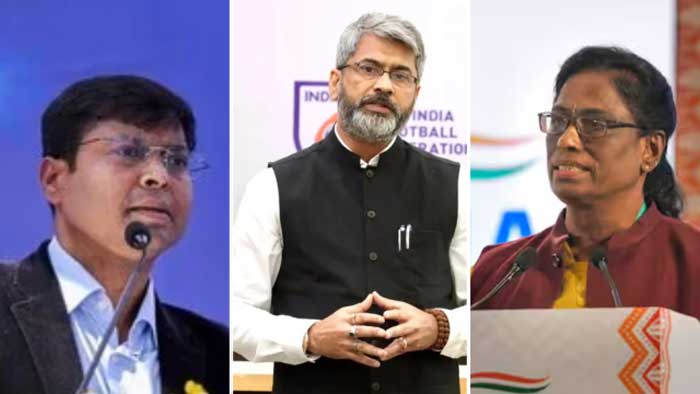
Indian sport is facing some of its most pressing questions, but few seem to be asking them. As three of the country’s most powerful sporting federations prepare for leadership elections, their administrators are preoccupied with nominations, alliances, legal challenges and manoeuvring for power.
The Indian Olympic Association’s (IOA) election should have provided an opportunity to debate India’s ambition to host the 2036 Olympic Games, beginning with a fundamental question: Why should India host the Olympics? At Hockey India, the focus should be on understanding why a league credited with transforming men’s hockey over the past decade is struggling to regain its momentum. At the All India Football Federation (AIFF), the discussion perhaps needs to begin with something more basic: ensuring Indian players can consistently pass and control the ball before aspiring to bigger achievements.
Instead, the presidents of all three organisations — PT Usha at the IOA, Dilip Tirkey at Hockey India and Kalyan Chaubey at the AIFF — face uncertain prospects of securing another term. Although their circumstances differ, their tenures highlight the challenges of governing Indian sport, where competing interests, political interference and internal power struggles frequently overshadow sporting priorities.
The stakes are considerable. The IOA will play a central role in organising the 2030 Commonwealth Games and steering India’s bid for the 2036 Olympics. Hockey India must build on the men’s team’s successive Olympic medals while sustaining the women’s team’s progress. For the AIFF, the immediate priority is ensuring that Indian football remains financially and administratively viable.
PT Usha’s turbulent tenure at the IOA
Usha’s elevation to the IOA presidency four years ago came as a surprise. Hand-picked by the government, the former track and field star was expected to bring credibility and authority to the country’s Olympic administration.
However, her tenure has been marked by persistent disagreements within the executive council, with several members reportedly describing her leadership style as confrontational. The absence of publicly available audit reports and growing internal discord have also raised questions about the government’s continued support for her leadership.
Yet, her tenure has not been without achievements. The IOA professionalised India’s athlete-support arrangements at major multi-sport events, providing better assistance to competitors during challenging editions of the Asian Games and Commonwealth Games.
Hockey India’s leadership struggles
Tirkey, one of India’s finest former hockey defenders, adopted a noticeably different approach. Unlike Usha, who has frequently confronted opposition within her organisation, Tirkey appeared more reluctant to engage in open confrontations.
He fulfilled his promise to revive the Hockey India League, but questions remain over the competition’s long-term financial sustainability.
His tenure has also witnessed a breakdown in the working relationship with secretary general Bhola Nath Singh, with the two often appearing to work at cross-purposes.
The controversy surrounding the men’s team’s saffron jersey further exposed the federation’s internal divisions. The kit was reportedly introduced without Tirkey’s knowledge or approval from the executive council, raising questions about coordination and decision-making within the organisation.
Disciplinary issues involving players and allegations of harassment have added to the challenges facing the federation.
The latest controversy concerns Hockey India’s action against Odisha Hockey, which has challenged the federation’s decision in court. The Orissa High Court has stayed the election process, leaving the leadership polls uncertain.
Chaubey’s fortunes mirror Indian football’s decline
Chaubey’s journey at the AIFF has followed a different trajectory. Four years ago, his influence was growing rapidly. He became joint secretary of the IOA and subsequently its acting chief executive officer amid internal disputes, while continuing to lead Indian football’s governing body.
His political and administrative fortunes have since become closely linked to the performance of Indian football.
Although one individual cannot be expected to resolve all the structural problems facing the sport, Indian football has experienced a series of setbacks during Chaubey’s tenure.
Controversial administrative decisions, uncertainty surrounding the Indian Super League (ISL), disruptions to the domestic football calendar and mounting financial liabilities have left the AIFF facing serious financial difficulties.
Having initially assumed leadership with the backing of the BJP, Chaubey is now reportedly seeking the support of Congress leader NA Haris, associated with the Karnataka football administration, to strengthen his chances of securing a second term.
Sporting achievements alone do not guarantee good administration
It would be unfair to conclude that former athletes are inherently unsuited to managing sporting organisations. Those who have competed at the highest level bring valuable insights into athletes’ needs, training demands and the functioning of their respective sports.
However, sporting achievements alone cannot prepare someone for the complexities of administration, financial management and institutional governance.
Equally, appointing someone without a sporting background does not guarantee better management.
Indian boxing provides another example. The federation, led by businessman Ajay Singh, has struggled with factionalism and governance disputes even as Indian boxers have delivered strong performances at the Commonwealth Games, Asian Games and World Championships this year.
The problem, therefore, cannot simply be reduced to whether a federation is headed by a former athlete or an administrator from outside the sporting world.
As one person involved in the IOA election process observed, Indian sport has too many stakeholders, each pulling in different directions. Administrators must navigate internal factions, political interests and external pressures, all of which can disrupt decision-making and prevent organisations from pursuing a consistent agenda.
The result is an ecosystem in which even the most straightforward priorities become buried under competing demands. At times, governing Indian sport can appear almost impossible.
Elections must bring focus back to sport
That is what makes the upcoming elections particularly important. The international sporting community will be watching whether India can achieve something that has historically proved difficult for its sporting federations: a smooth and orderly transfer of power.
But the real test will extend beyond who wins the elections and occupies the top positions.
The next leadership teams must address the issues that have remained unresolved for years. The IOA needs a credible roadmap for India’s Olympic ambitions, Hockey India must ensure the sustainability of its domestic structures and international success, and the AIFF must restore financial stability and rebuild the foundations of Indian football.
Indian sport does not lack talent, ambition or opportunities. What it needs is professional administration, accountability and leadership focused on long-term sporting development.
The country’s sporting administrators have spent far too much time fighting over who gets to run the institutions. It is time they focused on what those institutions are actually meant to achieve.
Comments are closed, but trackbacks and pingbacks are open.