
Lula Secures Historic Fourth Term in Brazil, Defying Polls and Right-Wing Momentum

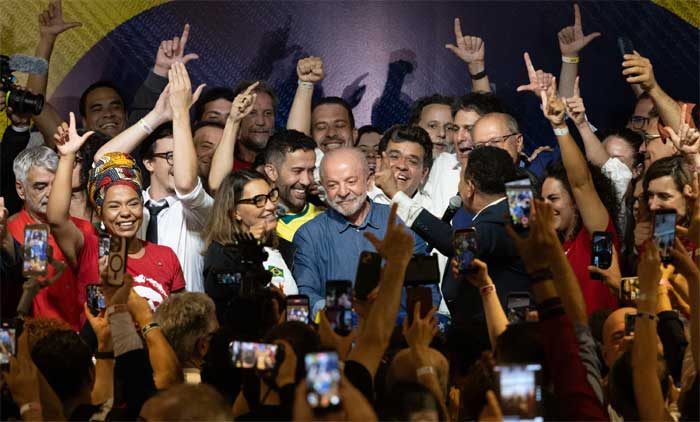
Brazilian President Luiz Inácio Lula da Silva secured an unprecedented fourth term on Sunday, according to the country’s electoral court, in a stunning result that defied polling forecasts and bucked a broader wave of right-wing electoral victories across Latin America.
Lula, a towering figure on the global left and one of Brazil’s most influential politicians of the past century, defeated Senator Flávio Bolsonaro, the eldest son of former President Jair Bolsonaro. The senator had led the first round of voting and sought to revive his father’s far-right political movement.
Lula’s path to reelection had appeared uncertain at times. Public frustration over corruption scandals and rising prices had weakened support for him and his Workers’ Party, while sweeping social and economic changes raised questions about whether the former metalworker and union leader could connect with a workforce increasingly shaped by app-based businesses and informal employment.
The victory marks another remarkable comeback in Lula’s long political career. The 80-year-old was imprisoned from 2018 to 2019 on corruption charges that were later overturned, clearing the way for his successful challenge to Jair Bolsonaro in the 2022 election.
“He is a statesman, a giant,” leftist federal lawmaker Erika Hilton, who was with Lula in São Paulo as votes were counted, told Reuters.
An Unexpected Path to Victory
Pollsters attributed Lula’s victory partly to stronger-than-expected voter turnout. Leonardo Barreto, co-founder of the consultancy Think Policy, said voters had opted for familiarity over the uncertainty associated with Bolsonaro.
“People today are choosing between change, with some apprehension, and a known path, which guarantees certain rights,” he said.
Throughout the campaign, Lula highlighted his record on poverty and inequality, pointing to improvements during his third term, alongside lower unemployment, illiteracy and deforestation.
He warned that a Bolsonaro presidency would threaten welfare programs, reverse social progress and weaken Brazil’s sovereignty in its dealings with US President Donald Trump. The Trump administration had supported efforts to return the Bolsonaro family to power.
Lula’s victory also denies Trump another influential ally in Latin America, where a growing number of right-wing governments have aligned themselves with Washington’s priorities on security and migration.
Celso Amorim, a former foreign minister under Lula, told Reuters that the president would play an important role in maintaining regional stability.
“Lula is that balance,” Amorim said.
The Comeback King
Lula becomes the first candidate since Brazil’s return to democracy in the 1980s to win the presidency after finishing second in the first round of voting.
President from 2003 to 2011, he has spent roughly half a century in national politics, building his appeal through a combination of pragmatism and populism. His campaign focused on reforms intended to improve living standards for workers and low-income Brazilians.
His platform gained momentum in the closing stages of the campaign, with pledges that included free public transportation nationwide on weekends and a 15% increase in his flagship welfare program, which was already being implemented.
The proposed transport initiative would require formal submission to Congress. Lula also championed a constitutional amendment that became Brazil’s most significant labor reform in decades and passed with broad congressional support.
A Difficult Legislative Landscape
Despite his victory, Lula could face his most challenging term yet. Brazil has elected its most conservative Congress since the restoration of democracy in the 1980s, leaving the president with limited room to advance his agenda.
Bolsonaro’s Liberal Party and its allies could control more than 280 seats in the lower house and as many as 50 seats in the Senate, giving the right-wing bloc substantial influence over legislation.
“He is likely to be a lame duck from the start,” said Oliver Stuenkel, a professor of international relations at the Getulio Vargas Foundation in São Paulo.
Stuenkel expects Congress to continue gaining influence at the expense of the presidency. Lula could face difficulties securing Supreme Court nominations, managing fragmented political coalitions and resisting potential impeachment efforts.
Economic Headwinds
Lula will also confront significant economic challenges. His government forecasts growth of just 2.3% next year, while high interest rates and mounting public debt continue to weigh on the outlook. Public debt has climbed above 82% of gross domestic product, its highest level since the pandemic.
Critics blame government spending for the deterioration in public finances, although rising interest payments have accounted for most of the increase in debt.
Goldman Sachs expects Lula to make only limited progress in restraining expenditure during his fourth term, as he remains committed to a state-led model of economic growth.
Rising household debt presents another challenge. In response, Lula introduced a provisional ban on online betting and announced a new debt-relief program during the campaign.
Meanwhile, the incoming conservative Congress is expected to push structural reforms favorable to businesses. Such measures could involve spending cuts, potentially triggering social unrest if they undermine public services or household support.
Lula’s historic victory therefore presents a paradox: he has secured another mandate from voters, but his ability to deliver on his promises will depend on navigating a more conservative legislature, constrained public finances and a changing Brazilian economy.
Comments are closed, but trackbacks and pingbacks are open.