
How Ukraine’s strike on Iranian ship in Caspian Sea blurred the lines between two global conflicts

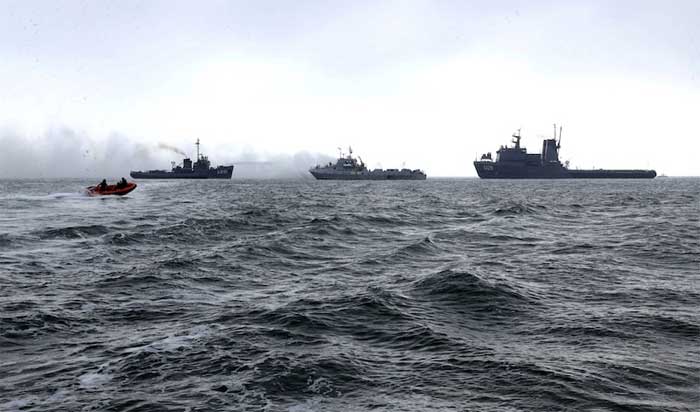
With the attack by Ukraine on an Iranian ship in the Caspian Sea on Saturday, the boundaries between the world’s two largest ongoing wars are blurring, threatening to complicate already mired efforts to bring either to a peaceful conclusion.
Hours after the early morning attack, Ukrainian President Volodymyr Zelensky posted a message on X, celebrating his military having achieved “very strong results with long‑range strikes in the Caspian Sea — including vessels used in military cargo shipments involving Iran, as well as a warship.”
The timing of the attack, in which Ukraine targeted and sank an Iranian cargo ship in transit to Russia, appears to have been no accident. Ukraine claimed the ship was carrying “military cargo,” almost certainly Iranian drones, swarms of which have been unleashed against Ukraine since Russia launched its full-scale invasion in 2022.
But although Ukraine has repeatedly attacked Russian ships in the Black Sea and Caspian Sea, this is thought to be the first time it has directly targeted an Iranian-flagged vessel.
The attack came just days before Zelensky was due to meet US President Donald Trump at the White House on Tuesday, when he will seek to reinvigorate the administration’s support for Ukraine and implicate Russia as an ally of Iran in its war against America in the Gulf.
Brett McGurk, a former White House coordinator for the Middle East and ex-special presidential envoy to the anti-Daesh coalition, highlighted the evolving dynamics ahead of the visit during an interview with CNN on Monday.
“Iran has been supporting Russia in its war against Ukraine directly,” he said. “They provide Shahed drones, they provide technology. Russia now has a factory producing these Iranian Shahed drones, which allows Iran to prosecute its war.
“This has been going on for years. And Zelensky, about three days ago, said that Ukraine had struck a ship in the Caspian Sea carrying military materiel between Russia and Iran … So this is how these two storylines are coming together.”
McGurk said that the upcoming meeting between Zelensky and Trump presented a stark contrast to their past diplomatic encounters.
“A totally different dynamic than that infamous meeting about 18 months ago. Now Ukraine arguably has the upper hand, there’s a sanctions bill pending still in the Senate and Zelensky is coming with some cards and he’s saying he’s going to lay out for the president his information on what Russia’s doing to actually support Iran in its conflict against us.
“The cooperation between Russia, Iran and China is a larger backdrop to everything we’re talking about day by day here. It will be a very important meeting in the Oval Office this week.”
Indeed, the day before the attack, Trump had taken to social media to express his confidence that neither China nor Russia were helping Iran in its conflict with America. If they were, he wrote, “it would be very bad for them.”
On Saturday Zelensky posted another message on X, also likely designed to grab Trump’s attention and that of America’s allies in the Gulf.
“I will instruct our intelligence to share with our partners the information we have regarding Russia’s new assistance to the Iranian regime,” he said.
“Since the beginning of July we have recorded active Russian satellite surveillance of the Gulf states and US military facilities located there. These images subsequently appear in Iran.”
At the same time, “there is a clear correlation between Russia’s satellite imagery of these sites and Iranian strikes — both before the attacks, in preparation for them, and afterward, to assess the damage inflicted.”
Zelensky said that on July 19 and 20 alone Russian satellites had focused on four air bases in particular, two in Bahrain, one in Jordan and one in Kuwait.
On July 18 Iranian drones and missiles struck a US base in Jordan, killing two Americans, while “repeated Iranian attacks” on the same day damaged oil facilities in Kuwait, he said.
While condemning the Iranian aggression that has followed the Feb. 28 joint US-Israeli attacks on Iran, the Gulf states have preferred to pursue diplomacy to find a peaceful resolution to the conflict.
For Zelensky, the attack on the Iranian ship may have been a gamble, likely designed to provoke a US reaction but which also risks escalating tensions between Kyiv and Tehran, raising the specter of direct confrontation between the two.
With each passing day, the war is evolving into an increasingly complex, multidimensional, and international conflict,” Hamidreza Azizi, author of the Iran Analytica platform and a scholar of Iran and Middle Eastern geopolitics focusing on Iran-Russia relations, said on X.
The episode had prompted a range of interpretations among analysts, he said.
“Some believe that Ukraine’s action was part of an effort by Zelensky to demonstrate both his capabilities and his value as a partner to the US. The prevailing view, however, is that the operation could not have taken place without at least a green light — if not direct guidance — from the US and Ukraine’s other Western partners.”
Another take, Azizi said, focused on the military constraints facing the US and Israel “as they seek to expand their operations against Iran.”
According to this interpretation, concerns about Iran’s response to attacks on its infrastructure — and the possibility that Tehran could retaliate by targeting regional economic infrastructure — have prompted Israel and the US to ask Ukraine to increase military pressure on Iran from the north on their behalf.
Looking ahead, Azizi suggested that Ukraine’s next step “could involve using drones or missiles to strike Iranian infrastructure directly, similar to the attacks it has carried out inside Russia in recent weeks.”
Alex Vatanka, senior fellow at the Middle East Institute specializing in regional security affairs with a focus on Iran, agreed that Western coordination was almost certainly involved, though he said that he saw the move as a constrained, tactical signal rather than the start of a broader Ukrainian campaign.
Speaking to Arab News, Vatanka said he suspected that the attack was “more likely to have been coordinated with the West, given what Western intelligence services have done for Ukraine over the course of this war.
“For the Ukrainians to do something like that without coordination with Washington and the Western capitals, I find hard to believe.
“I don’t see any evidence to suggest Ukraine wants to open a multi-front war, which is why I take what has happened as a one-off signal, at least for now, and not a sign of anything bigger in terms of a strategy on the part of Kyiv.
“There is this reading in Iran that this isn’t about Ukraine trying to impact any type of particular trade between Russia and Iran but that it’s part of an effort to essentially drag the West into this war against Iran more than it already has been.
“But I’m not sure that this big plot that some in Iran are talking about is actually what’s going on.
“I would be surprised if Zelensky and the Ukrainians were to take a shot at a vessel in the Caspian Sea without coordinating with the West, so I think it’s much more likely to be a short-term tactical signaling from the US to Iran, in terms of the associated cost of not reaching a diplomatic solution on the US-Iran conflict.”
Vatanka said also that with the US maritime blockade in force in the south, Iran had become overly reliant on the northern corridor through the Caspian for its exports and imports.
“The message to Iran, in that case, would be: ‘Don’t assume that your ties with the Russians and alternate trade routes are safe, because they’re not.’”
Echoing the view that Ukraine is unlikely to sustain an ongoing campaign in the region, Arman Mahmoudian, a research fellow at the University of South Florida’s Global and National Security Institute, told Arab News: “If the question is whether Ukraine can continue striking cargo vessels in the Caspian Sea, then the answer is yes, but only on a limited basis.
“Ukraine is capable of conducting intermittent, on-and-off attacks rather than sustaining a continuous campaign … While Ukraine can carry out these strikes, they are more likely to remain occasional, opportunistic operations.”
He cited major political, environmental and operational constraints for Kyiv, and said that drone and missile strikes required overflying southwestern Russia or South Caucasus nations like Georgia, Armenia or Azerbaijan — significantly increasing interception risks if attempted regularly.
On whether this action could drag Western backers deeper into a conflict with Iran, Mahmoudian said much depended on Tehran’s reaction.
“If Iran retaliates against Ukraine’s recent attacks by directly targeting Ukraine or Ukrainian interests … or by substantially increasing its support for Russian attacks against Ukraine, European governments may begin to view the conflict involving Iran as a more direct threat to European security than they currently do.
“However, it remains unclear whether Iran presently has the capability or willingness to respond in this way. Iran’s military capabilities are currently limited … I doubt that they would be willing to expend those limited capabilities against Ukraine or open another front at this time.”
So far, at least, the incident has triggered only a war of words. Iranian Foreign Minister Abbas Araghchi accused Ukraine on social media of “a blatant UN Charter violation done at Israel’s behest to drag Europe into its war.”
Tehran said also that it considered the strike a hostile act.
“Iran is now claiming that this is basically an act of war and Iran is now threatening to attack Ukraine,” McGurk said.
Azizi said that, “there is a degree of consensus … that Iran’s response will determine the trajectory of the confrontation and that a decisive response is required. There is considerably less agreement, however, over the precise nature of that response.”
The response of Ukrainian Foreign Minister Andrii Sybiha to initial Iranian protests was swift and dismissive.
“The regime in Tehran is a direct accomplice to Russian aggression against Ukraine, fueling Moscow’s criminal war with weapons that have killed Ukrainians since 2022,” he said on X.
“Iran has no standing to pretend to be a victim, let alone justify its threats with absurd references to the UN Charter.”
The attack highlights another element of the increasingly symbiotic relationship between Moscow and Tehran: the exchange of weapons technology between Iran and Russia.
In June 2025 an investigation by the Washington-based Institute for Science and International Security think tank, using documents hacked from a front company of the Islamic Revolutionary Guard Corps, revealed details of “a dangerous new weapons technology partnership between Iran and Russia,” in which the two countries were exchanging “military hardware and the technology to replicate and produce it.”
One high-profile result of the collaboration was the $1.75 billion purchase by Russia of Iranian Shahed 136 kamikaze drones and the production know-how necessary to build the weapons in Russia.
Russian drone manufacturers have improved the Shahed technology, and “based on the extensive interactions in Iran and in Russia between Iranian experts and the (Russian) drone manufacturer … there are grounds to believe that Russian improvements in the drone’s design and production have filtered back to Iran.”
The think tank’s investigation appeared to confirm a March report by The Associated Press, based on briefings by EU and US officials, that Russia was “sending a shipment of drones to Iran including upgraded versions of the drone technology that Tehran originally supplied to Moscow after its invasion of Ukraine.”
It was “unclear if the shipment is a one-time delivery or part of a series.”
These improved drones are thought to have been used against US allies in the Gulf. Kyiv has in turn offered its drone interception expertise to Middle East countries that have been targeted by Iran.
However, Mahmoudian urges caution regarding the tangible impact of Kyiv’s assistance in the Middle East.
“Ukraine has reportedly offered its interception technologies and operational experience to Saudi Arabia and the Arab states of the Gulf. However, there is currently no publicly available evidence demonstrating that Ukraine has transferred significant technology or expertise that has substantially altered these countries’ defensive capabilities.”
Mahmoudian said that Gulf interception rates had remained fairly consistent and that while Ukraine relied heavily on Western-made air defense systems that it had cleverly adapted under combat conditions, the Gulf states operated many of the same, and sometimes more advanced, Western systems with decades of US military cooperation behind them.
Still, he said: “Ukraine possesses a different kind of advantage: extensive real-world combat experience … practical lessons that cannot easily be replicated through training exercises alone.”
Comments are closed.