
Batting from the Future: Abhishek, Vaibhav Make a Mockery of 199-Run Chase to Seal Series

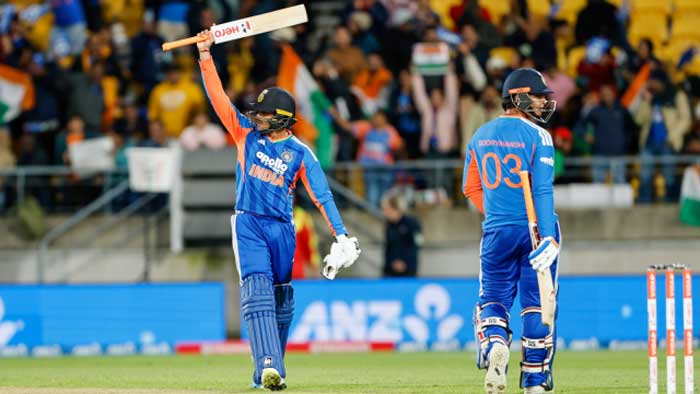
Cricket’s future gleamed in the spectacle at Wellington’s Hnry Stadium, where Abhishek Sharma and Vaibhav Sooryavanshi plundered 133 runs in just 7.1 overs. India chased down 199 with 40 balls and six wickets to spare, sealing the five-match T20I series at the first opportunity. A batsman reached 50 in 15 balls and 100 in 35. A 15-year-old dismantled men twice his age. A free-spirited phenomenon left bowlers cursing their luck and questioning their existence.
The match offered a glimpse of what the sport might become over the next decade, perhaps even the one after: a future in which T20 cricket has severed its umbilical cord to its parent game and evolved into a singular, autonomous sport.
It was a script straight out of fiction. The contest was effectively over after three searing overs, in which India plundered 64 runs off 18 deliveries. Runs came in a blur of limbs, bat-swing and brutal precision.
Sooryavanshi set the tone, thumping the first ball of the chase from Jacob Duffy over mid-on and into the boundary. The teenager was playing only his seventh international game; Duffy, until recently, had been the highest-ranked T20I bowler. But when adults run out of words to describe a youngster’s audacity, they resort to a familiar refrain: “Well, kids these days!”
Bowlers, however, would soon stop looking at the fresh-faced batsman as a teenager. They would spare no tactic, no variation and no trickery in their attempts to dismiss him.
On the third ball, Sooryavanshi slapped Duffy over point. The shot was as much a triumph of game awareness as of execution. Having faced a succession of full and good-length deliveries, he anticipated that Duffy would go short or back of a length. He waited, then unleashed his hands at the ball.
Duffy let out an audible sigh of relief as Abhishek took guard for the final delivery of the over. Neither he nor New Zealand’s other bowlers could have imagined that they were moving from hellfire into an inferno.
Abhishek backed away and swung the ball over extra cover, producing a trademark stroke built on lightning-quick hands, an imperious bat-swing and exquisite balance at the crease. He smiled at Sooryavanshi, the knowing smile of a man who sensed that the night belonged to him.
With Abhishek, the first shot often reveals his mood and touch. He likes to charge or back away from the outset and has made a habit of launching first-ball sixes. Yet this was arguably the sweetest of them all. Everything clicked: the fleetness of his feet, the lightness of his hands, the clarity of his thought, the strength of his belief and the instinctive agility of his movements.
The bowlers could only watch, wilt and wonder.
Adam Milne tried to set a trap in his first encounter with Abhishek. He stationed a deep point and packed the off-side ring, then delivered a full ball angling away. There was barely enough width for the batsman to free his arms. Most would have settled for a dab towards third man, or perhaps left the delivery alone. An aerial stroke carried obvious risk.
Abhishek was undeterred. He swung through the line and sent the ball soaring over the fielder’s left shoulder.
Milne went back of a length next ball and was dispatched over cover. The following delivery was smeared through cover point. Milne and his teammates must have wished for someone to halt the game and spare them further embarrassment. What they were enduring was approaching outright humiliation.
No one intervened. Abhishek pushed them deeper into the abyss of despair.
New Zealand captain Mitchell Santner turned to a match-up that had troubled Abhishek in the past, bringing on off-spinner Michael Bracewell. It was a sensible move, but the execution was flawed. Abhishek manufactured room by backing away and carved the ball through cover, his favourite piece of real estate on a cricket ground. He followed it with a six and four more boundaries, leaving two deliveries for Sooryavanshi to flog an already lifeless contest.
The Bracewell ploy made sense; the length did not. Abhishek feasts on deliveries that are short or land on a good length. It is the full-length off-break, drifting and dipping towards him, that has the potential to torment him.
No Contest
A whiff of resignation hung over the New Zealand camp. Their total of 198 appeared competitive, though perhaps 20 runs short, after India’s bowlers managed to squeeze in a couple of disciplined overs through the middle and at the death.
Prince Yadav delivered a miserly final over, conceding just nine runs without a boundary. Bhuvneshwar Kumar had also given away only nine in the 18th over, matching Arshdeep Singh’s effort in the preceding one. Despite having wickets in hand and two well-set batsmen in Daryl Mitchell (89 not out) and Bevon Jacobs (39 not out), New Zealand managed only 42 runs in the final four overs.
Axar Patel, meanwhile, recovered impressively after conceding 14 in his first over, giving away just 22 across his next three.
Even so, New Zealand could scarcely have anticipated carnage of such savage proportions.
Abhishek and Sooryavanshi brought up their century partnership in the fifth over. By the end of the Powerplay, India had raced to 118 without loss, the highest Powerplay total recorded by any team in the format, including Associate nations. The match had become a procession, with only individual milestones and formalities left to settle.
Sooryavanshi fell five runs short of his half-century. Abhishek, meanwhile, transformed his 15-ball fifty into a 35-ball hundred, his fourth century in the format.
He eventually departed for a scarcely believable 113 off 38 balls. Soon afterwards, the ball began to misbehave ever so slightly. Shreyas Iyer and Sanju Samson discovered a different surface altogether, struggling to find their rhythm.
“When Sanju and I went to bat, the ball was swinging and seaming, and I was like, ‘How did they manage this!’” the Indian skipper wondered.
It was a fair question. When Sooryavanshi and Abhishek were at the crease, the only swing that seemed to matter was the one generated by their bats.
That was the defining image of the night: two young batsmen operating at a speed and with a freedom that made the familiar boundaries of T20 cricket seem suddenly inadequate. The bowlers tried pace, spin, angles and match-ups. None could interrupt the delirium for long.
Perhaps this was a glimpse of cricket’s next evolution, a format increasingly detached from the rhythms and restraints of the game from which it emerged. Perhaps it was simply two extraordinary talents having the night of their lives.
Either way, Wellington witnessed something that felt less like a match in the present than a dispatch from the future.
And in that future, there was only one unmistakable swing: the sweet, savage swing of the bat.
Comments are closed, but trackbacks and pingbacks are open.