
China Confirms Talks on Historic Xi-Trump-Putin Trilateral Meeting

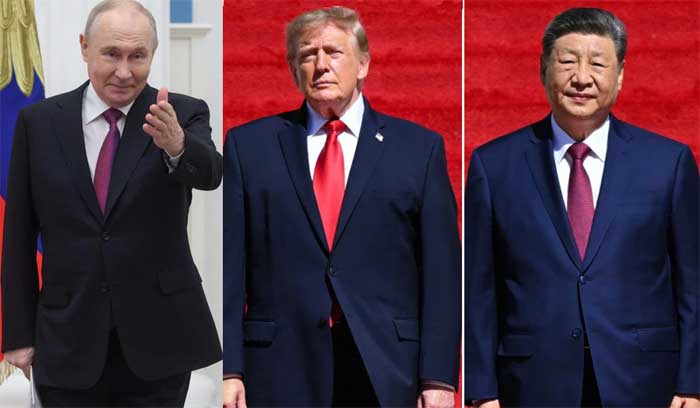
China has confirmed for the first time that it is discussing the possibility of a historic meeting between Chinese President Xi Jinping, US President Donald Trump and Russian President Vladimir Putin.
Chinese Foreign Ministry spokesperson Mao Ning said at a press briefing in Beijing that China “is in communication with relevant parties regarding a meeting between the three heads of state.” Although no final decision has been made, the proposed meeting could take place this month on the sidelines of the Asia-Pacific Economic Cooperation (APEC) summit in Shenzhen, southern China.
If held, the gathering would mark an unprecedented diplomatic moment, bringing the leaders of three major global powers together. However, analysts believe the meeting is unlikely to produce substantive agreements, given the significant differences in their strategic interests. Instead, it could primarily serve as a carefully choreographed diplomatic spectacle.
“I think it will happen. The question is the format and the content,” said Sun Yun, director of the China programme at the Stimson Center, adding that Beijing wants the diplomatic image without assuming the associated costs.
China is hosting this year’s APEC leaders’ summit, which brings together 21 member economies, including the United States and Russia.
Trump is expected to travel to Shenzhen for his third meeting with Xi this year, with discussions likely to focus partly on maintaining a fragile trade truce scheduled to expire in January.
However, economic tensions remain unresolved. In a Friday video call with Chinese Vice Premier He Lifeng, US Trade Representative Jamieson Greer urged Beijing to take “concrete actions to fully implement its past commitments”, particularly regarding agricultural purchases, rare earths and other critical minerals, according to a statement from Greer’s office.
Trump has also expressed interest in meeting Xi and Putin to discuss nuclear arms control. Putin, meanwhile, is primarily interested in discussing the war in Ukraine, preferably without Ukrainian representatives participating.
“Putin has the most to gain from a leaders’ trilateral, and the Russians are clearly behind the push for a meeting, which would be a diplomatic coup,” said Danny Russel, a former senior US State Department official under President Barack Obama and now a distinguished fellow at the Asia Society Policy Institute.
Russel suggested that Trump would welcome the opportunity to appear alongside two powerful authoritarian leaders, although his advisers have likely cautioned him against allowing Ukraine to dominate the discussions.
Sun believes Moscow could use the gathering to encourage Washington and Beijing to move closer to Russia’s position on Ukraine. China, however, would face the challenge of managing Russian diplomatic manoeuvring while avoiding being drawn into Moscow’s agenda.
Beijing is also unlikely to engage in substantive negotiations on nuclear arms control or the conflicts in Ukraine and Iran, Sun said. Instead, China would probably reiterate its familiar diplomatic position that peace is essential and wars should come to an end.
For Beijing, another major challenge would be managing international perceptions of the gathering. Sun warned that the summit should not be interpreted as an attempt by three major powers to divide the world among themselves.
Craig Singleton, senior director of the China programme at the Foundation for Defense of Democracies, similarly cautioned against exaggerating the meeting’s significance.
He said the gathering could amount to little more than a photo opportunity, allowing Putin to be seen alongside the American and Chinese presidents.
“But these photo opportunities have diminishing diplomatic returns,” Singleton said. “The spectacle may be historic without producing anything particularly consequential.”
Comments are closed, but trackbacks and pingbacks are open.