
Israel Elections 2026: Five Possible Scenarios That Could Decide Netanyahu’s Political Future

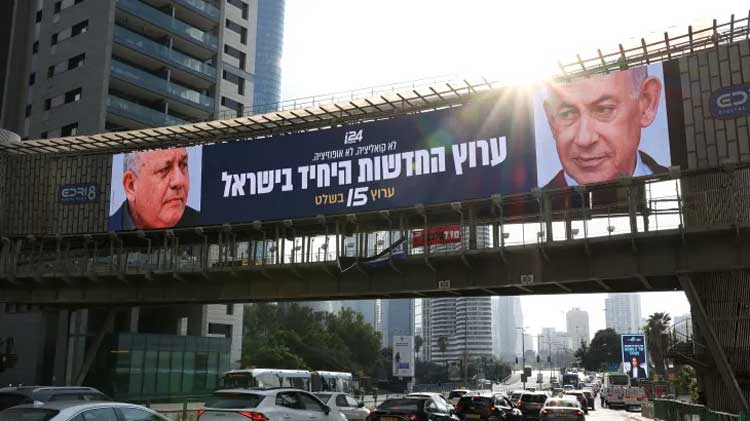
Israel heads into a crucial general election on Tuesday, with all 120 seats in the Knesset up for grabs. The results could shape the political future of Prime Minister Benjamin Netanyahu, whose leadership has come under intense scrutiny following the October 7, 2023, Hamas attack and the subsequent wars in Gaza, Lebanon and Iran.
The incumbent government, backed by far-right and ultra-Orthodox parties, has pushed Israel towards more nationalist and religious policies. Opinion polls suggest a closely contested race between Netanyahu’s right-wing bloc and an opposition alliance dominated by Jewish-led parties.
However, losing the election would not automatically force Netanyahu from office. The decisive battle will be over coalition formation, as a government needs the support of at least 61 members of the 120-seat Knesset.
How Israel’s electoral system works
Israel follows a proportional representation system in which voters choose party lists rather than individual candidates. Parties must secure at least 3.25% of the national vote to qualify for parliamentary representation.
Polls suggest that between 11 and 13 parties could cross the threshold, making coalition negotiations critical to determining who becomes prime minister.
Two parties are at the centre of the contest: Netanyahu’s right-wing Likud and Yashar, a new centrist party led by former military chief Gadi Eisenkot.
According to CNN, citing Channel 12 polling, Eisenkot’s party was projected to win 23 seats, compared with 21 for Likud. Channel 14, a media outlet considered supportive of Netanyahu, projected 30 seats for Likud and around 20 for Eisenkot’s party.
The contrasting projections highlight the uncertainty surrounding the race. Even if one party emerges as the largest, its leader will still need to assemble a viable parliamentary majority.
Here are five possible scenarios that could determine Israel’s next government.
1. Netanyahu returns to power
Netanyahu could remain prime minister even if Likud finishes behind its main rivals, provided he can secure the backing of enough lawmakers to form a majority.
His traditional partners include Jewish Power, led by far-right National Security Minister Itamar Ben-Gvir, and Religious Zionism, led by Finance Minister Bezalel Smotrich.
Ultra-Orthodox parties Shas and United Torah Judaism could also prove decisive. Both have repeatedly joined Netanyahu-led coalitions, although their support has not always been permanent.
If these parties collectively provide enough seats, Netanyahu could return to power despite a weaker electoral performance for Likud.
2. An opposition-led coalition takes office
The opposition has sought to coordinate its efforts to end Netanyahu’s long tenure, with four parties reportedly signing a non-aggression pact to avoid undermining one another.
Eisenkot’s Yashar is positioned between parties led by former prime minister Naftali Bennett and former defence minister Avigdor Liberman on the right, and the Democrats party, led by Yair Golan, on the left.
However, the opposition faces its own challenge: agreeing on a prime minister.
Bennett and Liberman have not publicly endorsed Eisenkot for the position, and both have ambitions of their own. Even if the opposition bloc wins enough seats collectively, disagreements over leadership and policy could complicate government formation.
3. A coalition backed by Arab-led parties
Arab-led parties representing Palestinian citizens of Israel could emerge as important power brokers if neither major bloc secures a majority.
The Joint List and Ra’am are projected to win a combined total of around 13 seats, according to the estimates cited in the report. Palestinian citizens make up approximately one-fifth of Israel’s population.
Eisenkot and other opposition figures have dismissed the prospect of a formal alliance with these parties. However, Ra’am leader Mansour Abbas has remained open to cooperation if circumstances require it.
Their support could help an opposition-led government reach the 61-seat threshold, although political objections within the opposition could make such an arrangement difficult.
4. A national unity government
Another possibility is a national unity government that brings together rival political blocs.
Israel’s parliamentary system allows governments to be formed through broad coalitions that include representatives of competing parties. Such arrangements can become attractive during periods of war, economic instability or other national emergencies.
A unity government could provide a route out of the current political deadlock if neither Netanyahu’s bloc nor the opposition can assemble a workable majority independently.
However, significant disagreements over security policy, the war and the role of religious parties could make a broad coalition difficult to sustain.
5. A rotating premiership, an alternative leader or another election
If negotiations fail to produce a clear majority, several less conventional outcomes remain possible.
One option is a rotating premiership, under which two leaders agree to serve as prime minister at different stages of the government’s term. Netanyahu and Benny Gantz agreed to such an arrangement in 2020, but their coalition eventually collapsed before Gantz could take over as planned.
Alternatively, lawmakers could rally behind a compromise candidate from either the incumbent bloc or the opposition if that person can secure sufficient parliamentary support.
If all coalition-building efforts fail, Israel could face another election. Netanyahu would remain caretaker prime minister until a new government was formed.
The country experienced five elections between 2019 and 2022 amid repeated difficulties in building stable governing coalitions, illustrating how prolonged political deadlock can lead to another trip to the polls.
Coalition arithmetic will decide the outcome
The election is not simply a contest between Netanyahu and his challengers. It is a test of whether either side can bring together the diverse political interests needed to govern.
Netanyahu’s established partnerships could help him retain office, while an opposition victory would depend on overcoming internal leadership rivalries and deciding whether cooperation with Arab-led parties is acceptable.
Ultimately, the number of seats won by individual parties will matter less than their ability to assemble a majority. The negotiations after the vote could therefore prove just as consequential as election night itself.
Comments are closed, but trackbacks and pingbacks are open.