
UN Security Council Renews Yemen Sanctions, Targets Houthi Drone and Missile Supplies

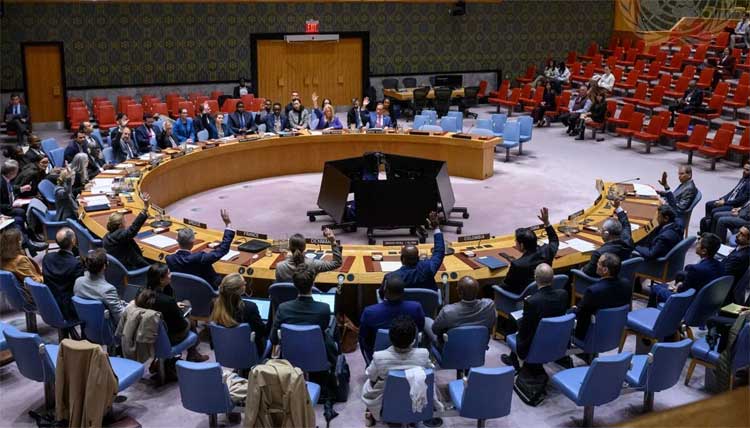
The UN Security Council on Thursday renewed sanctions against Yemen’s Houthi militia and moved to restrict its access to dual-use components and chemicals that can be used to manufacture drones and missiles.
The resolution, adopted unanimously by consensus, strongly condemned the Houthis’ military escalation inside Yemen, cross-border attacks on Saudi Arabia and threats to international commercial shipping.
It demanded that the militia halt its military offensive in Yemen, stop attacks against Saudi Arabia and end threats to maritime traffic.
The resolution extended targeted asset freezes and travel bans on designated Houthi members until November 14, 2027. It also renewed the mandate of the panel of experts monitoring the sanctions until December 15, 2027. The arms embargo imposed on the Houthis under Resolution 2216 in April 2015 remains in force without a specified expiration date.
“Today’s adoption by consensus demonstrates this council’s determination to take decisive action against reckless attacks by the Houthis in Yemen and against the Kingdom of Saudi Arabia and the broader region,” said Sarah MacIntosh, the United Kingdom’s permanent representative to the UN.
Britain serves as the Security Council’s penholder on Yemen, giving it primary responsibility for leading the council’s work on the issue.
MacIntosh expressed solidarity with Yemen’s internationally recognized government and Saudi Arabia, reaffirming their right to defend their security and sovereignty under international law.
UN Targets Houthi Access to Weapons Components
The resolution seeks to address the Houthis’ growing ability to manufacture weapons locally by restricting access to dual-use components and precursor chemicals.
MacIntosh said the updated sanctions framework would ensure that the international measures “keep pace with the evolving threat from the Houthis.”
Dual-use materials have legitimate civilian applications but can also be diverted for military purposes. The UN has found that the militia increasingly relies on smuggling networks and commercially available components to maintain and expand its weapons arsenal.
This has gradually reduced its dependence on external supplies while strengthening its capacity to manufacture attack drones locally.
The Security Council said it would decide by January 11 what measures member states should adopt to prevent the Houthis from acquiring specified materials, based on a list prepared by the expert panel.
MacIntosh said the UK would work with other council members in the coming months to agree on a list of dual-use items subject to restrictions.
The resolution also tasked the expert panel with examining revenues generated by the Houthis through their control of key economic sectors in Yemen. The investigation is intended to identify how these funds undermine the effectiveness of existing asset freezes and recommend measures to prevent the money from being diverted towards military activities.
UN Detentions Could Trigger Further Sanctions
The Security Council also warned that the arbitrary detention of UN employees, diplomats and humanitarian workers by the Houthis could provide grounds for additional sanctions.
The provision was proposed by Bahrain with US support following the death in Houthi custody of Mohammad El-Shami, a Yemeni employee of the UN Human Rights Office.
El-Shami had reportedly been detained since June 6, 2024. His family was informed only recently that he had died more than a month earlier.
MacIntosh condemned the continued detention of UN personnel, humanitarian workers, civil society members and diplomats, reiterating the UK’s demand for their immediate and unconditional release.
Negotiations Expose Divisions Among Security Council Members
Although the resolution was ultimately adopted by consensus, negotiations revealed significant differences among council members.
The UK initially sought to restore language describing the Houthis as a terrorist group, terminology included in earlier sanctions resolutions dating back to 2022. However, London dropped the proposal after Russia objected, arguing that such wording could undermine political negotiations.
Bahrain, supported by the United States, subsequently attempted to reintroduce the designation, but the proposal was not included in the final text.
China, with Russian support, also opposed provisions concerning the list of dual-use materials and the expansion of the expert panel.
References to alleged links between the Houthis and Somalia-based Al-Shabaab militants were removed following objections from African council members, as well as China and Russia.
Yemen’s ambassador to the UN, Abdullah Al-Saadi, welcomed the Security Council’s condemnation of the militia but expressed disappointment that members had failed to explicitly identify the group in stronger terms.
He referred to what he described as the Houthis’ extensive record of attacks against civilians, cross-border strikes and threats to international shipping.
“Not mentioning all this in the resolution does not absolve the supporters of the Houthis from their responsibilities,” Al-Saadi said.
He also accused the militia of using starvation as a weapon of war and called for an end to its prolonged siege of the city of Taiz.
Renewed Fighting Deepens Yemen’s Humanitarian Crisis
The resolution comes amid renewed fighting in Yemen, where the conflict has intensified in recent weeks.
According to the account presented in the report, the Iran-backed Houthis launched an offensive in early September and seized the strategic Red Sea port of Mokha following several days of clashes with government forces. The developments reportedly gave the militia control over Yemen’s entire Red Sea coastline and strengthened its position near the strategically important Bab al-Mandeb Strait.
The Houthis also launched a series of missile and drone attacks against Saudi territory, targeting civilian airports and oil infrastructure, including facilities at Yanbu on the Red Sea coast.
Yanbu has become an increasingly important export route for Saudi Arabia following Iran’s blockade of the Strait of Hormuz during the conflict involving Iran, the United States and Israel that began in February.
MacIntosh highlighted the worsening humanitarian situation, noting that more than 22.3 million people in Yemen require humanitarian assistance and that the latest fighting alone has displaced more than 330,000 people.
“Sanctions are not an end in themselves,” she said. “They are a tool to constrain those who threaten Yemen’s peace and security.”
Al-Saadi, meanwhile, stressed that the resolution’s significance would ultimately depend on its implementation and the Security Council’s ability to translate its provisions into concrete measures that curb the flow of weapons to the Houthis.
Comments are closed.