
PM Modi: In farmer interest, Government hiked diesel price by just Rs 7, not Rs 50

The Prime Minister said the decision was taken to protect farmers from the impact of rising fuel costs, particularly at a time when the agricultural sector was already facing pressure from higher input expenses.
Modi’s remarks came amid concerns over the economic consequences of the West Asia conflict, which has pushed up international crude oil prices and increased the burden on oil-importing countries such as India.
Addressing farmers and agricultural stakeholders, he sought to highlight the government’s efforts to shield domestic consumers from the full impact of the global energy crisis.
Modi Targets Congress, Defends His Government’s Record
In an apparent dig at the Congress, Modi accused some opposition leaders of believing that democracy and the Constitution belonged to them.
Taking a swipe at the party’s record during the Congress-led United Progressive Alliance (UPA) government, he recalled his tenure as Gujarat Chief Minister and alleged that the state had faced resistance even when it received favourable rankings.
Modi said Gujarat had topped a media agency’s ranking during his tenure, but those in power at the Centre were unhappy with the recognition. He alleged that researchers were asked to seek permission before publishing reports praising the state.
“Those very people preach tolerance today,” he said.
Farmers Must Be Empowered, Not Just Agricultural Production Increased
The Prime Minister said achieving the goal of a developed India by 2047 would require smart farming, technological innovation and greater economic empowerment of farmers.
He argued that previous governments had focused primarily on increasing agricultural production and filling food grain storage facilities, without doing enough to improve farmers’ incomes.
Citing a recent World Bank study, Modi claimed that approximately 50 crore people had escaped poverty in India over the past 12-13 years, with small farmers among those who benefited.
He also highlighted agricultural growth, stating that the sector had recorded average growth of 4% for the first time in a decade since Independence.
According to the Prime Minister, expanding agricultural exports had contributed to higher farmer incomes. He said India was the world’s largest producer of milk, rice and jute, ranked second in wheat and fish production, and led global millet production.
Modi also highlighted growth in allied agricultural sectors, claiming that milk production had increased by 70%, egg production by 90% and fish production had doubled over the past decade.
Push for Technology, Crop Diversification and Natural Farming
The Prime Minister said the government was encouraging crop diversification and greater adoption of technology to reduce agricultural costs and improve productivity.
Recalling his experience as Gujarat Chief Minister, he said efforts to improve farming practices and expand soil-testing facilities had helped shape his approach to agricultural policy at the national level.
He cited the Namo Drone Didi initiative as an example of how technology was transforming rural agriculture and challenging the perception that modern technology could not be effectively deployed in villages.
Modi also urged manufacturers to develop more solar-powered agricultural equipment, saying farmers should be encouraged to become entrepreneurs rather than remain dependent solely on conventional farming.
He called on farmers to adopt natural farming practices and reduce excessive chemical use to protect soil health and the environment.
The Prime Minister said preserving agricultural land and natural resources was a collective responsibility towards future generations.
Modi Calls for Focus on India’s Development Goals
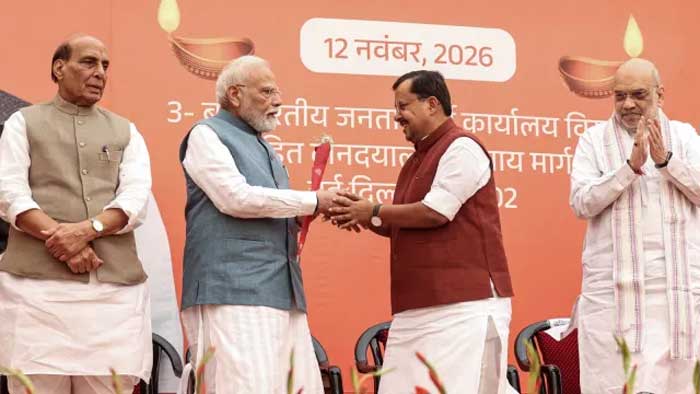
Earlier in the day, while addressing a Diwali Milan programme at the BJP headquarters, Modi urged the media to highlight India’s achievements internationally and strengthen the country’s global image.
Referring to the importance of deadlines, he said India was working towards a clear national target — becoming a developed country by 2047, when it completes 100 years of Independence.
He called for collective efforts to achieve the Viksit Bharat vision within the stipulated timeframe.
The Prime Minister’s remarks at the farmers’ conference came months ahead of Assembly elections in Uttar Pradesh and Punjab, two states where agriculture and rural economic concerns are likely to remain significant political issues.
Comments are closed.