
Operation Sindoor: Inside India’s covert air campaign that reshaped deterrence against Pakistan

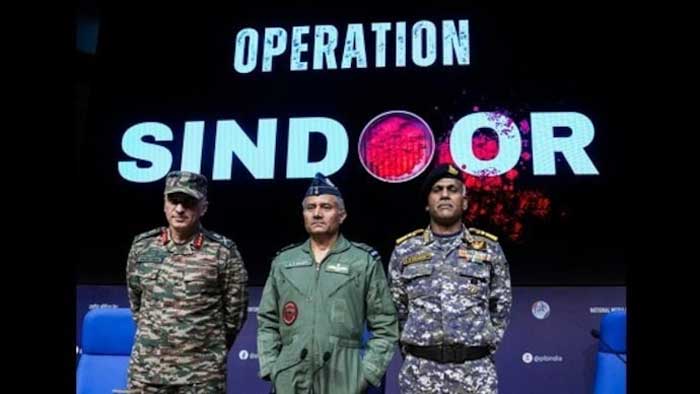
India’s aerial offensive over Pakistan last summer was neither the nuclear near-miss later projected by Washington nor the limited skirmish Pakistan portrayed online.
According to journalist Shishir Gupta, Operation Sindoor was a carefully calibrated military campaign aimed at punishing Pakistan-backed terror infrastructure while avoiding full-scale war — and it left Pakistan’s military scrambling to recover operationally and politically.
Triggered by the Baisaran massacre
The operation was launched in response to the April 22 massacre at Baisaran Valley near Pahalgam, where Pakistan-backed terrorists reportedly separated victims by religion before killing 26 civilians.
India’s retaliation centred on long-range precision strikes deep inside Pakistan and Pakistan-occupied Kashmir.
On May 7, India struck Jaish-e-Mohammed’s Bahawalpur headquarters using a BrahMos cruise missile launched from a Su-30MKI, paired with a French SCALP missile fired from a Rafale. Both aircraft remained within Indian airspace.
The same night, Lashkar-e-Taiba’s Muridke headquarters was targeted using SCALP and Israeli Crystal Maze missiles, while loitering munitions including Warmate, Harop and Harpy drones hit additional terror camps.
The strike that blinded Pakistan
The defining moment came in the early hours of May 10 when India launched a volley of BrahMos missiles at Rawalpindi’s Chaklala/Noor Khan air base, home to Pakistan’s Northern Air Command.
Gupta says the strike crippled Pakistan’s command-and-control systems, effectively blinding its northern air defence network.
By midday, India had carried out 11 BrahMos strikes targeting multiple Pakistani air bases, including Jacobabad and Bhanoti.
India also deployed its S-400 air defence systems, while heavy Excalibur precision artillery strikes in Pakistan-occupied Kashmir forced Pakistani troops to vacate positions up to 10 kilometres from the Line of Control.
According to Gupta’s account, 11 Pakistani air bases sustained major damage, with several aircraft destroyed on the ground.
How the ceasefire was reached
US President Donald Trump has claimed credit for halting the conflict, describing it as averted nuclear escalation.
Gupta disputes that account.
He says that on May 9, US Vice-President J.D. Vance warned Prime Minister Narendra Modi of impending Pakistani retaliation. Modi’s response was reportedly firm: India would escalate proportionately.
The following morning, as Indian strikes unfolded, US Secretary of State Marco Rubio attempted to contact External Affairs Minister S. Jaishankar.
When contact was finally established, Jaishankar reportedly made clear that any ceasefire discussions would only occur through military channels between the Directors General of Military Operations (DGMO) of both countries.
Pakistan’s DGMO initiated that call at 3:35 pm on May 10 after India had already achieved its objectives.
India accepted the ceasefire because its operational goals had been met.
Gupta says Trump’s public claim came only after Islamabad informed Washington of the agreement.
The battle for narrative
While India may have held the military advantage, Pakistan moved quickly to shape international perception.
Claims circulated that India’s S-400 systems had been destroyed at Adampur and Bhuj.
Gupta says these were false, noting Prime Minister Modi later visited Adampur, where the system remained intact.
He argues India chose an evidence-based information strategy, while Pakistan aggressively amplified unverifiable claims.
Ceasefire violations and strategic restraint
Despite requesting the ceasefire, Pakistani forces allegedly violated it through drone incursions, artillery fire and shelling across Jammu and Rajasthan later that night.
India chose not to retaliate, adhering to the agreement.
This reportedly angered sections of India’s political establishment, who believed Pakistan should have faced immediate consequences.
A deterrence doctrine hardened
Gupta says terror camps at Muridke and Bahawalpur have since been rebuilt, underscoring that Pakistan’s terror infrastructure remains intact.
What has changed, he argues, is deterrence.
Operation Sindoor established that any major terror strike on Indian civilians will invite direct retaliation inside Pakistan.
Accelerated military modernisation
The operation has also triggered major upgrades in India’s military capabilities.
Since then, India has:
- Ordered roughly ₹30,000 crore worth of drones and counter-drone systems
- Advanced plans for 114 Rafale fighters under Make in India
- Acquired Israel’s PULS rocket artillery system
- Expanded loitering munition stocks
- Inducted longer-range Barak air defence systems
- Explored extended-range BrahMos variants
At sea, India launched its third nuclear-powered ballistic missile submarine, INS Aridhaman, with a fourth, INS Arisudan, expected next year.
An unfinished campaign
Gupta’s final assessment is stark: Operation Sindoor was not a one-off punitive strike but part of a longer strategic shift.
As he puts it, the operation “is still not complete” — signalling that India’s doctrine of cross-border deterrence remains active and evolving.
Comments are closed.