
Mohan Bhagwat Warns Against Divisive Protests, Hints At Global Conspiracy To Destabilise India

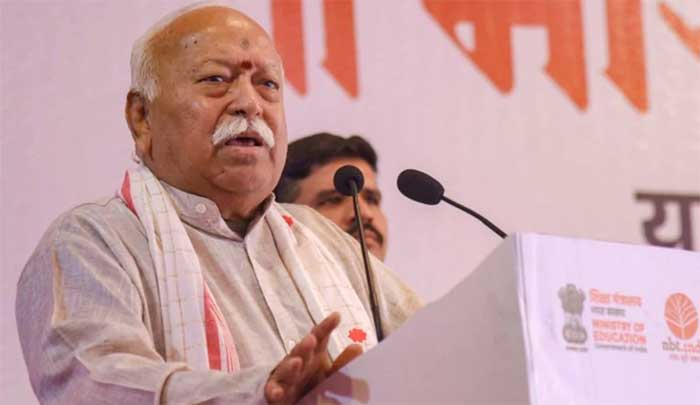
Rashtriya Swayamsevak Sangh (RSS) chief Mohan Bhagwat on Tuesday urged people to remain vigilant against movements that, he alleged, seek to spread hatred and undermine India’s institutions, ideologies and individuals. Addressing volunteers and guests at the Sangh’s 101st foundation day, Bhagwat also suggested that global powers seeking to weaken India could be playing a role in fuelling unrest.
His remarks came amid youth-led protests and demonstrations in different parts of the country, including the national capital. Without naming any specific movement, Bhagwat warned that protests driven by hostility towards individuals, groups or ideologies could be exploited by forces seeking to destabilise the country.
“When a movement becomes a tool of politics, driven by hostility and antagonism towards an individual, a group, or an ideology, forces seeking to undermine Bharat take advantage of the situation,” he said.
Bhagwat alleged that such forces deepen differences of opinion, encourage a sense of victimhood and erode public trust in the country’s institutions, ultimately creating an atmosphere of discord, discontent, separatism and disorder.
He called for vigilance against divisive tendencies and urged people to preserve mutual goodwill while continuing to work towards India’s aspiration of becoming a Vishwaguru, or a global leader.
Bhagwat Hints At Global Role In Protests
Bhagwat suggested that international forces could be contributing to unrest in India.
“Global powers that wish to keep India subdued also occasionally play their part in this process,” he said.
He also referred to recent uprisings and protests in France, Albania, Bangladesh and Nepal, citing them as examples of movements that can lead to instability.
While he did not identify any specific foreign power or provide evidence for the alleged involvement, Bhagwat cautioned against attempts to exploit public discontent and deepen divisions within the country.
Vande Mataram As A Symbol Of National Unity
A significant part of Bhagwat’s address focused on Vande Mataram and its role in India’s freedom struggle. He recalled the opposition to the British proposal to partition Bengal under Lord Curzon, arguing that the national song became a symbol of unity and patriotism during the movement.
“When Lord Curzon sought to partition Bengal along communal lines, to drive apart Muslims from Hindus, the society firmly opposed the division of one land – one people on communal grounds. The British government was compelled to withdraw their proposal for partition,” Bhagwat said.
He contrasted that episode with the Partition of India in 1947, arguing that communal and extremist ideologies, political ambitions and a desire for dominance had weakened the sense of national unity.
According to Bhagwat, the belief that people who appear different must be separate from one another contributed to divisions that ultimately led to Partition.
He said the country continued to face the consequences through border tensions, internal unrest, mutual distrust and insecurity.
Calling Vande Mataram a continuing source of national unity, Bhagwat said there should be no hesitation or objection to singing the national song in its entirety, with pride.
India Must Learn From The World, Says RSS Chief
Bhagwat argued that many problems confronting the world stemmed from what he described as an incomplete understanding of life. At the same time, he said India had much to learn from other countries in terms of human effort and endeavour.
He urged Indians to understand and preserve their national identity, maintain unity and work collectively towards the country’s progress.
“India’s supreme glory and its emergence as Vishwaguru will be realized only through the dedicated hard work of each one of us. There is no alternative, nor is there any shortcut to achieving this goal,” he said.
Bhagwat added that individuals could contribute through small, constructive actions in their personal, family, social and professional lives.
Bhagwat Defends RSS Against Criticism
The RSS chief also defended the organisation against what he described as attempts to question its intentions and goodwill by linking it to undesirable or unexpected incidents.
He said the Sangh had no connection with, or support for, incidents that were being used to cast doubt on its work.
“The work of the Sangh is founded on pure, selfless, and virtuous love,” Bhagwat said, adding that the organisation sought nothing for itself and that its volunteers would continue working towards their goals with faith and confidence.
He also said his foreign visits over the past year were intended to present an accurate picture of India and the RSS to audiences abroad.
RSS Chief Recalls Foreign Rule, Calls For Unity
Bhagwat referred to the Constitution’s Preamble while describing India as a society bound together by emotional unity despite its considerable diversity.
He argued that the country’s failure to live up to this principle had contributed to centuries of foreign subjugation.
He said India had regained its freedom through sustained efforts and sacrifices and must now strengthen unity, understand its foundational values and reflect them in everyday life.
The address began with tributes to Sant Ravidas, the medieval saint revered by many Dalit communities, and Swami Shraddhanand, an Arya Samaj leader associated with the Shuddhi movement who was assassinated in 1926.
The references brought together themes of Hindu identity, social harmony, national unity and the RSS’s stated vision for India.
Comments are closed, but trackbacks and pingbacks are open.