
Kushner Says Russia Open to NATO-Style Security Guarantees for Ukraine

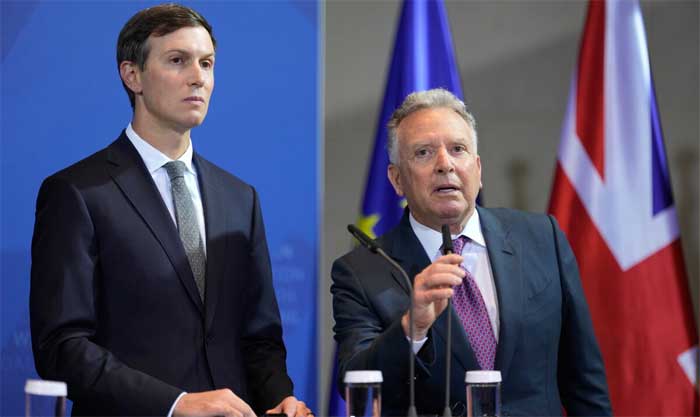
US envoy Jared Kushner said Thursday that Russia appeared comfortable with the idea of providing Ukraine with NATO-style security guarantees after the war, as European leaders sought assurances over President Donald Trump’s discussions with Russian President Vladimir Putin in China.
Kushner made the remarks in Berlin, where he and fellow US envoy Steve Witkoff met nearly 40 European leaders to discuss Ukraine’s postwar security arrangements and brief them on Trump’s diplomatic efforts to end the nearly five-year conflict.
“I think we’ve gotten the Russians comfortable with that concept where any security guarantee for Ukraine would be based on Article 5,” Kushner said, referring to NATO’s collective defence provision, under which an attack on one member is treated as an attack on all.
He added that Trump was open to an Article 5-style security guarantee for Ukraine, provided it served US interests and formed part of a broader security arrangement.
“Obviously it has to be in America’s interest to do that. And we also have to make sure that it’s part of a broader security package,” Kushner said.
He stressed that Trump wanted to reach an agreement alongside European allies rather than impose a unilateral settlement. Any deal, he said, would be negotiated in close consultation with Ukraine and Europe.
Ukrainian President Volodymyr Zelensky has long sought NATO membership and binding security assurances to prevent another Russian invasion. Moscow, however, opposes NATO’s military presence near its borders. The precise nature of any proposed guarantees and whether both sides would accept them remain unclear.
Trump reportedly joined the Berlin discussions by phone following his meeting with Putin in China. Kushner said the US president had conveyed a strong message to both Putin and Chinese President Xi Jinping about his desire to secure peace.
Putin threatens retaliation over Kerch Bridge attacks
Meanwhile, Putin vowed to retaliate against Ukraine following three aerial attacks this week that reportedly caused serious damage to the Kerch Bridge, which connects occupied Crimea with mainland Russia.
“We will respond to these attacks, and I want everyone to be clear about that,” Putin told reporters in Shenzhen, China, where he was attending the Asia-Pacific Economic Cooperation summit.
The 19-kilometre (12-mile) bridge across the Kerch Strait is a crucial transport link for Russia’s military operations and a prominent symbol of Moscow’s control over Crimea, which Russia illegally annexed in 2014.
Putin said the road section had been seriously damaged but pledged to rebuild it. He also maintained that the bridge was a civilian facility and said he had ordered that it not be used to transport military equipment or ammunition.
Train services were temporarily suspended following the overnight attack but resumed later Thursday, according to Russian state news agency RIA Novosti.
Ukraine’s Defense Ministry said Russia would have to redirect fuel and ammunition supplies overland, where Ukrainian drones could target them.
Civilian casualties reported in Russia and Ukraine
The Russian Defense Ministry said its air defences intercepted 53 Ukrainian drones across 10 Russian regions overnight.
An attack in Russia’s Saratov region killed three people and wounded two others, according to regional Governor Roman Busargin. In the Bryansk region, a drone killed a woman riding a bicycle with her eight-year-old grandson, regional Governor Egor Kovalchuk said.
Meanwhile, Ukrainian officials said Russia launched anti-ship missiles and 98 drones at the country, with strikes recorded at 18 locations.
Explosions and air raid sirens were reported across Kyiv, while the Dutch and Austrian embassies sustained minor damage.
Russian attacks killed two people, including a 44-year-old woman, and wounded at least 23 others across 12 Ukrainian regions, according to local authorities. A 12-year-old boy was among the injured.
Russia has continued using its numerical advantage in troops, armour and weapons to pressure Ukrainian forces along the front line. Kyiv has relied heavily on drones to disrupt Russian advances and strike military and logistical targets.
Moscow has also intensified attacks on Ukraine’s energy infrastructure ahead of winter, while Ukrainian long-range drones and missiles have targeted facilities deep inside Russia, including oil refineries.
Kyiv fears being sidelined in negotiations
Trump’s direct engagement with Putin has raised concerns among European governments and Ukrainian officials that Washington and Moscow could reach an agreement over Ukraine’s future without Kyiv’s meaningful involvement.
Trump referred to Putin as “my friend” during their China meeting, while his relationship with Zelensky has become increasingly strained.
European leaders have sought to maintain diplomatic pressure on Moscow through sanctions and other measures, while expressing concern that Trump’s direct negotiations with the Kremlin could weaken their influence over the peace process.
Kushner said Trump had delivered a strong message to Putin and Xi about Washington’s commitment to ending the conflict.
“I believe he also came away believing that peace is achievable and we need to all work together to try and achieve it,” Kushner said.
Putin, meanwhile, said Moscow was not opposed to European participation in future negotiations but questioned what position European governments would bring to the discussions.
He said the Kremlin had invited European officials through diplomatic channels to visit Moscow to discuss their position, although no date had been set.
Kremlin spokesman Dmitry Peskov declined to identify the officials invited or say whether Moscow had received a response, according to Russian state news agency Tass.
Comments are closed, but trackbacks and pingbacks are open.