
EU Chief Heads to Greenland to Strengthen Arctic Ties

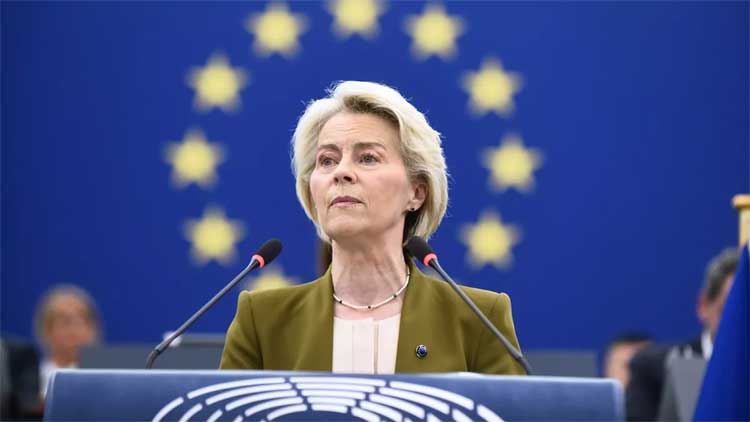
European Commission President Ursula von der Leyen will travel to Greenland on Sunday for a two-day visit aimed at reaffirming the European Union’s support for the Danish autonomous territory, which has been sought by US President Donald Trump.
Von der Leyen is expected to sign a joint declaration between the EU and Greenland on Monday, underscoring closer cooperation amid growing geopolitical interest in the Arctic island.
“Greenland is becoming increasingly important to the EU as a gateway to the Arctic and because of its geopolitical location, critical raw materials and role in Arctic security,” Marc Jacobsen, a researcher at the Royal Danish Defence College, told AFP.
Trump earlier this year repeatedly argued that the United States needed control of Greenland for national security reasons, although he ultimately ruled out taking the territory by force.
A Danish-Greenlandic-US working group has since held regular meetings to explore future cooperation.
European countries largely rallied behind Denmark and Greenland following Trump’s threats. In January, von der Leyen pledged “massive” EU investment in Greenland as the bloc sought to strengthen security in the Arctic.
Although Greenland is not part of the EU, it remains constitutionally linked to Denmark, which is a member of the bloc.
Brussels has proposed more than doubling direct EU assistance to Greenland to 530 million euros ($616 million) under its next budget covering 2028-2034. The Financial Times reported that von der Leyen could announce an additional 200 million euros in support during her visit.
Her trip comes as NATO begins its Arctic Shield military exercise, involving troops from 10 countries.
Mikaa Blugeon-Mered, a geopolitics researcher at the University of Quebec, described the timing as a “not insignificant coincidence”.
The Trump administration has repeatedly accused Denmark of failing to adequately protect Greenland and the wider Arctic region. Copenhagen has responded by increasing its investment in the region, while NATO has also stepped up its presence through its Arctic Sentry mission, launched earlier this year.
“The EU cannot provide Greenland with a military security guarantee in the way NATO can, but it can provide something politically important: a clear signal that Greenland is not standing alone,” Jacobsen said.
US Pressure Continues
The EU’s message comes as Washington continues to maintain pressure on Greenland, although Trump has been less vocal since a May visit by his special envoy Jeff Landry.
“We’ve been getting ‘postcards’ from Trump or those close to him about Greenland every month, showing that they haven’t forgotten,” Blugeon-Mered said.
In May, Trump posted an image on Truth Social showing him looking over Greenland under the headline, “Hello, Greenland!”
Concerns resurfaced in August following reports of preparatory work by a US oil company in a remote part of eastern Greenland.
The project is being operated by a Texas-based company holding licences issued before Greenland imposed a 2021 moratorium on oil and gas exploration and extraction. The activity has raised concerns among local residents and authorities.
Authorities have not yet approved exploratory drilling, citing procedural issues.
At the same time, Greenland is seeking to expand its mining industry, which could play an important role in financing its ambitions for greater independence from Denmark.
Greenland’s interests in attracting investment and developing infrastructure align closely with Europe’s search for reliable supplies of critical minerals, Jacobsen said.
“Greenland needs investment, infrastructure and markets if it is to realise its mining ambitions, while the EU is looking for more secure and diversified access to critical raw materials,” he said.
However, converting Greenland’s vast mineral potential into active mining projects has proved challenging. More than 60 companies hold around 135 mining permits, but only two mines are currently operational.
“The question is whether the current geopolitical momentum will ultimately be a game-changer,” Jacobsen said.
Blugeon-Mered said von der Leyen’s visit, her second to Greenland in two years, sends a strong signal that European investment in the territory is intended to be long-term.
During the trip, von der Leyen is scheduled to meet Greenland Prime Minister Jens-Frederik Nielsen, Danish Prime Minister Mette Frederiksen and the head of government of Denmark’s other self-governing territory, the Faroe Islands.
Comments are closed, but trackbacks and pingbacks are open.