
EU and Canada seek closer ties amid global rivalries

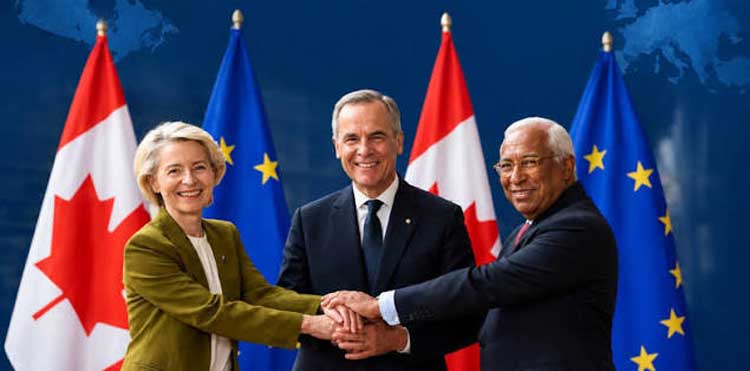
The European Union and Canada are seeking to elevate their relationship to the “highest level possible” as both face growing economic and geopolitical pressures from the United States and China.
European Commission President Ursula von der Leyen made the remarks on Thursday ahead of a two-day summit in Montreal with Canadian Prime Minister Mark Carney, where the two sides are expected to lay the groundwork for a deeper strategic partnership.
“We both want to bring our relationship to the highest level possible,” von der Leyen said, reiterating her proposal for Canada to become the EU’s first “associate member.”
She described the concept as an “association without accession,” but the proposal has sparked disagreements within the bloc because the term does not exist in EU treaties. Germany and other member states pushed successfully to remove the designation from a joint summit statement, raising questions about the terminology ahead of the talks.
Shared concerns over US and China
Relations with Washington have come under strain during US President Donald Trump’s second term. American tariffs have affected Canada’s economy, while Trump’s repeated threats to annex Canada have provoked widespread outrage.
Carney has warned that relations with the United States will not return to their pre-Trump state, making the reduction of Canadian dependence on its southern neighbour an urgent priority. Ahead of the summit, he pledged to establish a “new, ambitious alliance” with the EU.
European countries have also faced US tariffs and criticism from Trump and his allies.
Meanwhile, the EU is increasingly concerned about China’s economic influence and what it considers unfair competition from Chinese industries supported by state subsidies. Brussels has taken steps to protect European manufacturers and reduce reliance on Chinese goods and raw materials.
“In a world of growing rivalries, sovereignty and independence are no longer just the freedom to act alone. It is the capacity to act together,” von der Leyen said.
She added that when trade becomes a tool of economic pressure, ordinary households bear the costs, from supermarket prices to the cost of buying a car.
The EU and Canada must decide whether to act independently or adopt a coordinated approach with trusted partners facing similar challenges, she said.
What could the partnership deliver?
The EU and Canada already have a free-trade agreement, although it has not been fully implemented. Canadian businesses are also exploring opportunities in Europe to offset losses associated with US tariffs.
According to an EU official speaking anonymously, the proposed partnership would seek to align policies in areas such as climate, energy and artificial intelligence, while potentially allowing Canada to participate in selected EU programmes.
Several areas of cooperation are under discussion:
-
Critical minerals: Canada holds substantial reserves of minerals needed for batteries, wind turbines and other green technologies. The European Investment Bank could support Canadian mining projects, helping address the infrastructure investment required to expand production.
-
Digital trade: A digital trade agreement aimed at making online transactions faster and cheaper is expected to be unveiled at the Montreal summit.
-
Education and youth exchanges: The two sides are working on arrangements for Canada to participate in the EU’s Erasmus programme, which enables university students to study abroad.
-
Climate, energy and AI: Greater policy coordination could strengthen cooperation on strategic industries and emerging technologies.
Reducing dependence on China for critical minerals could be particularly important for Europe’s energy transition, while European investment could help Canada develop its mining capacity.
Carney plays down the membership label
Despite the disagreement over the term “associate member,” Carney has indicated that the precise designation is not his main concern.
Speaking earlier this week, the Canadian prime minister said he was not worried about the status or the “specific names” used to describe the proposed alliance.
“What matters is the difference that it will make to the lives of Canadians,” Carney said.
The Montreal summit will therefore focus on whether closer cooperation can produce practical benefits for both sides, even as the question of how to formally describe the relationship remains unresolved.
Comments are closed, but trackbacks and pingbacks are open.