
Netanyahu Rules Out Arab-Party Alliance as Election Results Leave Israel Facing Coalition Deadlock

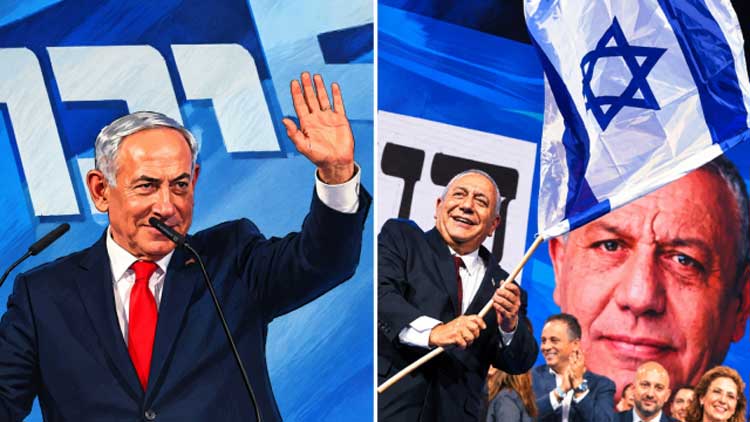
Israeli Prime Minister Benjamin Netanyahu has ruled out forming a coalition with Arab-led parties after their projected gains in the October 27 parliamentary election left them potentially decisive in determining the country’s next government.
Netanyahu’s right-wing bloc is projected to fall short of the 61 seats needed for a majority in the 120-member Knesset. Meanwhile, the opposition bloc led by former military chief Gadi Eisenkot could reach a parliamentary majority with the support of the Arab-led Ra’am and Joint List parties, whose combined projected tally stands at 19 seats.
According to partial results reported by The Times of Israel, Netanyahu’s bloc holds 53 seats, compared with 48 for Eisenkot’s bloc. Adding the Arab parties’ projected seats would give a potential opposition grouping 67 seats. The figures remain provisional as counting continues.
However, the numbers do not guarantee a change of government. Netanyahu has rejected cooperation with the Arab parties, while Eisenkot and some of his potential allies have yet to commit to relying on their support.
Netanyahu alleges election fraud
On Thursday, Netanyahu escalated allegations of electoral wrongdoing involving Arab-led parties, describing suspected foreign interference as an “earthquake” and demanding an investigation by the police and Shin Bet, Israel’s domestic security agency.
In a social media post, Netanyahu referred to a request by Central Elections Committee chief Justice Noam Sohlberg for Shin Bet chief David Zini to investigate suspicions of foreign funding and improper influence during Tuesday’s election.
“The Ra’amgate affair is an earthquake. They stole the elections in Israel!” Netanyahu wrote, referring to Ra’am, also known as the United Arab List, and the Joint List alliance.
He alleged that foreign entities had funded voter mobilisation efforts and bribed voters in support of Arab-led parties. Netanyahu further claimed that the alleged interference sought to undermine right-wing rule and promote what he described as the “Islamisation of Israel”.
The prime minister called on Zionist parties to reject cooperation with Ra’am and the Joint List, arguing that such an alliance would endanger Israel.
Sohlberg’s letter requested an investigation into suspicions of improper influence involving foreign entities allegedly acting against Israeli interests. He said he could not verify the allegations but considered a thorough inquiry necessary, asking for findings within a week.
The letter did not identify the countries allegedly involved or provide further details. Hebrew-language media reports said Likud suspected Qatar and Turkiye could have been sources of funds allegedly sent to organisations involved in mobilising Arab voters.
Police, however, dismissed Likud’s broader claim that Arab parties had stolen the election, saying there was “no supporting evidence”, according to news agency PTI.
Eisenkot faces pressure over Arab-party support
The central question is whether Eisenkot and his prospective allies will cooperate with Arab-led parties to assemble a government capable of ending Netanyahu’s tenure.
Eisenkot has not made an unequivocal commitment to partner with the parties, saying that none met his conditions for potential allies, according to reporting cited in the supplied material.
Yet their projected gains could make their support difficult for the opposition to ignore. Arab citizens account for roughly one-fifth of Israel’s population, and increased turnout appears to have helped Ra’am and the Joint List secure their strongest combined representation in generations. Together, they hold 10 seats in the outgoing Knesset.
Without their support, Eisenkot’s bloc would remain well short of the 61 seats required for a majority.
Yousef Jabareen, leader of the Joint List alliance, accused Netanyahu of using the fraud allegations to obstruct political change.
“Netanyahu knows that without the Arab parties, there’s no majority to unseat him. That’s why he incites against us,” Jabareen told The New York Times.
He added that the Joint List was prepared to cooperate with those seeking to remove Netanyahu and change his policies.
Political analysts cited by the newspaper suggested that the Joint List might support an Eisenkot-led government from outside the formal coalition, including by helping it survive no-confidence votes.
Democrats leader Yair Golan has also called for cooperation with Arab parties.
On Thursday, Eisenkot said he was receiving updates from the relevant authorities about suspected foreign interference. He called for every complaint to be investigated thoroughly while warning against political actors exploiting the allegations to influence the inauguration of the 26th Knesset, PTI reported.
Ra’am and Joint List differ on coalition politics
Although both parties represent Arab citizens of Israel, Ra’am and the Joint List have different political backgrounds and approaches to working with Jewish-led governments.
Ra’am, led by Mansour Abbas, has roots in Islamist politics and has pursued greater acceptance among Jewish political parties. The party joined the coalition formed by Naftali Bennett and Yair Lapid in 2021, marking a significant moment for Arab representation in Israeli coalition politics. The government collapsed in 2022, prompting another election.
Abbas has since sought to make Ra’am more acceptable to potential coalition partners, recognising Israel’s Jewish character as a political reality and advocating greater integration of Arab citizens into national service.
The Joint List, by contrast, brings together smaller parties, including left-wing groups and Palestinian nationalists. It has generally taken a more critical stance towards Zionism and historically been reluctant to join Zionist-led governments.
Nevertheless, Joint List leaders have indicated a willingness to support efforts to replace Netanyahu, potentially without formally joining a coalition.
Three possible scenarios
The election results leave Israel facing several possible political outcomes.
- An Arab-backed opposition government: Eisenkot and his allies could negotiate an agreement with Ra’am and the Joint List, either bringing them into a coalition or securing their support from outside. Such an arrangement would require compromises from opposition leaders who have expressed reservations about working with Arab parties.
- Prolonged political deadlock: If neither Netanyahu’s bloc nor the opposition can assemble a viable majority, negotiations could stall, leaving the government-formation process unresolved.
- A unity government or fresh election: Political leaders could explore a broader coalition involving Netanyahu, or Israel could head towards another election if no workable agreement emerges. Neither outcome is guaranteed.
The Central Elections Committee is expected to publish the final results by November 4. President Isaac Herzog will then consult political factions before assigning a lawmaker the task of forming a government, PTI reported.
For now, the decisive question is whether Eisenkot’s bloc is willing to rely on Arab lawmakers to secure a majority. Their projected 19 seats could prove pivotal, but disagreements over political principles and coalition arrangements may prevent the opposition from translating its numerical advantage into power.
Comments are closed, but trackbacks and pingbacks are open.