
Census 2027: 11 more questions, caste, Aadhaar, mobile number, Covid vaccine status — What’s new?

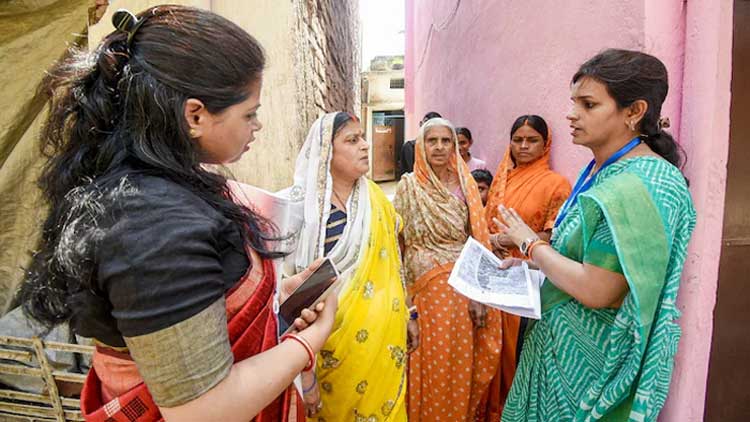
India’s Census will, for the first time since Independence, ask citizens to state their caste and record it exactly as declared, without requiring them to choose from a pre-set list.
The Registrar General of India (RGI) on Friday notified 40 questions for population enumeration, the second and final phase of Census 2027.
Self-enumeration for this phase will begin on August 17 in Ladakh and the snowbound areas of Jammu and Kashmir, Himachal Pradesh and Uttarakhand, where the exercise is being advanced because of winter conditions. Enumerators will conduct door-to-door verification from September 1 to 30. The rest of the country will be enumerated in February 2027.
Caste to be recorded as declared
Caste is question 10 in the household schedule and is grouped with questions on Scheduled Caste and Scheduled Tribe status. Census officials have been instructed to record the caste exactly as stated by respondents rather than select it from a prepared list.
The approach was also used in the 2011 Socio-Economic Caste Census (SECC). It differs from the caste surveys conducted in Bihar and Telangana, where respondents selected their caste from pre-prepared, state-specific lists.
The number of questions in the population enumeration has increased over the decades — from 22 in 1981 to 23 in 1991 and 2001, and 29 in 2011. Census 2027 will have 40 questions, 11 more than the previous exercise.
The decision to include caste was taken by the Cabinet Committee on Political Affairs on April 30 last year, ahead of the Bihar Assembly election, when the Opposition had made a caste census a major political demand. Bihar’s state-run caste survey had found that backward communities constituted nearly two-thirds of the state’s population, adding to demands for a nationwide caste count.
Aadhaar, mobile number and Covid vaccination details
Census 2027 will introduce several questions that have never previously been part of the population enumeration.
Enumerators will seek a respondent’s mobile number, Aadhaar number and Voter ID, where available. They will also record passport details, driving licence status, the place where a person received their Covid-19 vaccination and the number of bank accounts they hold.
The questionnaire will continue to cover basic demographic details such as name, sex, date of birth, marital status, religion, mother tongue, disability status, migration history and permanent address.
Questions on education and employment will cover literacy, including digital literacy, school attendance, highest educational qualification, occupation, industry and whether a person worked during the previous year.
Married, widowed, divorced and separated women will additionally be asked about the number of children they have had and how many were born during the previous year.
Census 2027 will also be India’s first Census to rely on a dedicated mobile application rather than paper forms alone. However, the traditional door-to-door enumeration system will continue for those who do not complete self-enumeration online.
How Census 2027 will be conducted
The Census is being carried out in two stages.
The first stage, House Listing and Housing Operations (HLO), runs from April 1 to September 30. It covers every structure, house and household and includes 33 questions on living conditions, including drinking water, toilet facilities, cooking fuel, internet access and vehicle ownership.
By late June, HLO had been completed in 23 states and Union territories, while field operations were continuing in Kerala, Nagaland, Himachal Pradesh, Gujarat, Jammu and Kashmir, Ladakh, Puducherry and Uttar Pradesh.
Delhi’s HLO began on April 16 and was divided into separate 30-day windows covering areas under the New Delhi Municipal Council and Delhi Cantonment, and those under the Municipal Corporation of Delhi.
Both stages provide a self-enumeration option. Residents can log on to the dedicated Census website, answer the questions themselves and generate a code, which is then provided to the enumerator during the verification visit. The system is intended to reduce the time spent at households.
For HLO, states and Union territories were allotted a 15-day self-enumeration period followed by a 30-day field-visit period.
The reference date for most of the country is March 1, 2027. However, Ladakh and the snowbound, non-synchronous areas of Jammu and Kashmir, Himachal Pradesh and Uttarakhand will use October 1, 2026, as their reference date because they are being counted earlier due to winter conditions.
Why Census 2027 is taking place after 16 years
Census 2027 was originally scheduled for 2021 but was postponed because of the Covid-19 pandemic. The last Census was conducted in 2011, making the upcoming exercise the first population count in 16 years.
India’s administrative map has also changed substantially since the last Census. Telangana was carved out of Andhra Pradesh in 2014, Jammu and Kashmir and Ladakh became separate Union territories in 2019, and Dadra and Nagar Haveli was merged with Daman and Diu.
The government has allocated ₹11,718 crore for the country’s eighth Census since Independence.
Although field data collection is scheduled to conclude by March 1, 2027, the Registrar General’s office has indicated that compilation and publication of the final results could take another two to three years.
Comments are closed, but trackbacks and pingbacks are open.