
Australia To Bid For UN Security Council Seat For 2029-30 Term: PM Albanese
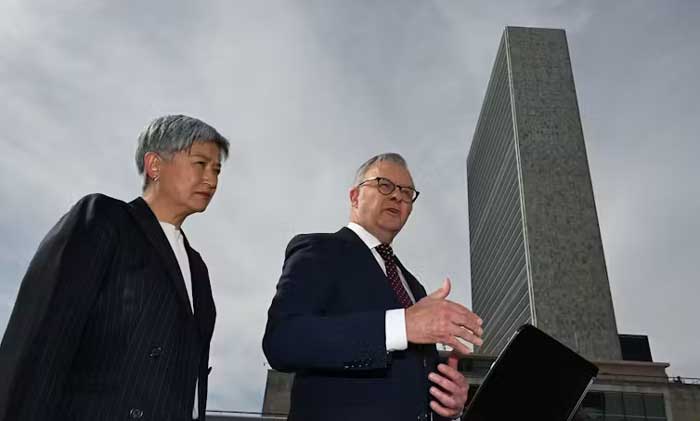
Australia will bid for a non-permanent seat on the United Nations Security Council for the 2029-30 term, Prime Minister Anthony Albanese announced on Monday, launching the country’s campaign for one of the two seats allocated to its regional group.
Albanese said Australia, which last served a two-year term on the Security Council that ended in 2014, could play an important role in shaping international responses to issues affecting Australians if elected.
“Australia punches above our weight … and we can have an impact on the world, and that’s what I want to see Australia do,” Albanese told reporters in New York on the sidelines of the UN General Assembly.
The Australian prime minister said he expected “very strong support” from Pacific island nations and Southeast Asian countries. He also pointed to his relationships with other world leaders as an asset for Australia’s campaign.
The announcement came as a closely watched Newspoll conducted for The Australian showed Albanese’s approval rating had fallen to its lowest level since he won his first term in 2022.
AI, Climate Change Key Challenges
Albanese said rapid advances in artificial intelligence and the impact of climate change would be among the major global challenges by the end of the decade.
He argued that Australia’s national interests would be better served by having a seat at the Security Council during that period.
The UN Security Council has 15 members, including five permanent members and 10 non-permanent members. Five of the non-permanent seats are elected each year for two-year terms.
Australia and Finland are the nominees for the 2029-30 seat from the Western European and Others Group. The Asia-Pacific, African, and Latin American and Caribbean groups will also nominate candidates for the remaining seats.
Elections for the 2029-30 non-permanent members are expected to be held by secret ballot at the UN General Assembly in 2028.
The five permanent members of the Security Council are the United States, China, France, Russia and the United Kingdom.
Comments are closed, but trackbacks and pingbacks are open.