
UK and EU Seal Post-Brexit Deals to Rebuild Ties at Brussels Summit

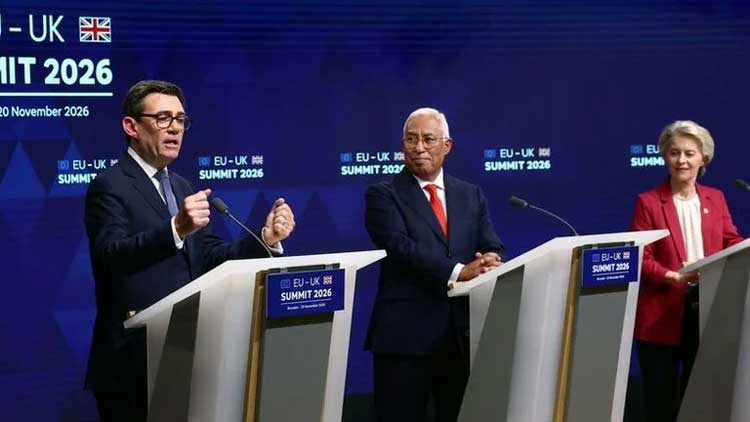
UK Prime Minister Andy Burnham and senior European Union officials on Friday reached agreements aimed at easing trade barriers and expanding youth mobility, marking what both sides described as a fresh start in relations nearly a decade after Brexit.
The summit in Brussels, featuring a string quintet performing the British and European anthems, saw Burnham exchange handshakes with European Commission President Ursula von der Leyen and European Council President Antonio Costa.
Both sides struck an optimistic tone, although disagreements over university tuition fees for EU students in Britain threatened to complicate the final implementation of the agreements.
“This is a good day for Britain. This is a good day for Europe,” Burnham said, describing the agreements as landmark achievements. Von der Leyen called the summit a “turning point” in UK-EU relations.
The negotiations focused on three major agreements: reducing bureaucratic barriers to food exports, linking the UK and EU emissions-trading systems, and establishing a new youth mobility arrangement.
Under the proposed youth scheme, up to 100,000 people aged under 30 from each side would be able to live in the other’s territory for up to three years for work, education or travel.
Burnham said the agreements, many of which had been under discussion before he became prime minister, would help reverse some of the economic damage caused by Brexit and make it easier for British businesses to trade with Europe.
However, negotiations remained contentious until the final hours, particularly over whether the UK would commit to reducing university tuition fees for EU students to the same level charged to British students.
The British government maintained that the agreements had been concluded, although discussions on tuition fees would continue over the next six months. An EU statement seen by AFP, however, indicated that member states would delay ratification until an agreement on the fees was reached.
Bigger questions over Britain’s future in Europe
Since taking office this summer, Burnham has challenged longstanding political sensitivities surrounding Britain’s relationship with the EU, even suggesting that rejoining the bloc could be possible in the future.
Although Friday’s summit concentrated on practical cooperation, the prime minister has indicated that broader discussions about Britain’s long-term relationship with Europe will follow.
Ahead of the meeting, Burnham said London would seek to “initiate a discussion with our EU partners about options for our long-term relationship.”
Those options could range from maintaining the current arrangements to joining the EU customs union or eventually seeking full EU membership.
The shift comes amid growing public dissatisfaction with Brexit. Opinion polls have increasingly suggested that a majority of Britons believe leaving the EU was a mistake and would support rejoining if given the opportunity to vote again.
Britain’s economic difficulties and changing geopolitical circumstances, particularly Europe’s support for Ukraine amid Russia’s invasion, have also strengthened arguments for closer cooperation.
Burnham hopes improved relations with Brussels will help build a broad centre-left political coalition ahead of the next general election, which is not expected before 2029.
Political divisions threaten Burnham’s strategy
Despite the diplomatic progress, the prime minister faces significant domestic political challenges. His own party remains divided over how far Britain should move towards closer European integration, while the wider public remains politically split on the issue.
His approach also provides ammunition to opposition parties, particularly the Conservatives and Nigel Farage’s hard-right Reform UK, which have accused him of undermining the outcome of the 2016 Brexit referendum.
Farage, who was also scheduled to hold a press conference in Brussels on Friday, criticised the prime minister’s approach.
“Naive Andy Burnham has gone to Brussels and been hit by the stark reality I’ve warned about for decades. Flexibility is a fantasy,” Farage wrote on X.
While Friday’s agreements represent a significant diplomatic step towards repairing UK-EU relations, the unresolved tuition-fee dispute and Britain’s domestic political divisions underline the challenges ahead.
For Burnham, the immediate task is to turn improved diplomatic relations into tangible economic benefits without reigniting the political divisions that have shaped Britain’s relationship with Europe since the Brexit referendum.
Comments are closed, but trackbacks and pingbacks are open.