
France Bans Protests in Parts of Paris Amid Renewed Unrest

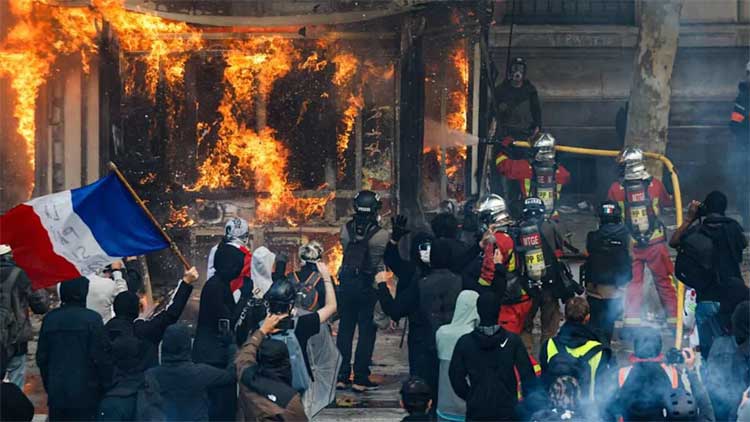
French police announced on Wednesday that demonstrations would be prohibited in parts of Paris on Thursday, as the country braced for fresh protests following some of the worst street violence in years.
The announcement came after President Emmanuel Macron appeared to criticise US President Donald Trump for using France’s unrest to gain political advantage ahead of the US midterm elections.
The ban will be in effect from 8 a.m. to 8 p.m. (0600–1800 GMT) and cover key locations in the French capital, including the Élysée Palace, both chambers of parliament, the Louvre Museum and the Champs-Élysées.
Other restricted areas include Bastille and République squares, as well as the Châtelet–Les Halles shopping district, which was heavily targeted by looters over the weekend.
Government Struggles to Contain Violence
The French government has acknowledged that it “lost control” during the wave of violence that erupted last weekend, when masked youths clashed with police, looted shops and vandalised public buildings.
With the unrest damaging France’s international image and unsettling financial markets just six months before the presidential election, Macron appeared to accuse foreign leaders of exploiting the crisis for political purposes.
Speaking during a visit to Qatar, the French president suggested that Trump and possibly Israeli Prime Minister Benjamin Netanyahu had made “stupid comments” about the unrest to advance their political interests, although he did not identify either leader by name.
“There are people who campaign at France’s expense — leaders who are in campaign mode, whether here in the region or on the other side of the Atlantic,” Macron told reporters in Doha.
Trump has sought to link the unrest to “migrants, jihadists, and communists” while campaigning for Republicans in the United States, where anti-immigration rhetoric has been a central theme of his political messaging.
On Tuesday, Trump also praised French far-right leader Marine Le Pen, who shares his political views, as opinion polls showed her leading the presidential race.
Netanyahu, who is facing a difficult election campaign of his own, claimed on Tuesday that France had been struck by an “invasion of extremist Islam.”
Several analysts, however, have rejected claims that migrants were driving the protests.
Curfews and Protest Restrictions
The unrest overshadowed demonstrations held on Saturday, when more than half a million people marched across France to protest the rising cost of living. Those rallies followed four weeks of student demonstrations that had forced the closure of numerous schools.
Following the recent riots, which were among the worst France has experienced in years, the government has warned that it will not tolerate further violence ahead of new cost-of-living demonstrations planned for Saturday.
Protests organised by high school and university students were also banned in Paris and Lyon, in southeastern France.
After meeting Prime Minister Sébastien Lecornu on Wednesday, Sophie Binet, leader of the hard-line General Confederation of Labour (CGT) union, called for a “new phase” of demonstrations, including strikes early next month.
Justice Minister Gérald Darmanin said that 174 people had been jailed out of the 2,500 taken into custody during and after the protests. A further 917 had been formally prosecuted, he added.
Financial Markets Under Pressure
The turmoil in the European Union’s second-largest economy has further unsettled financial markets, which were already concerned about France’s mounting public debt and budget deficit.
France’s benchmark 10-year government bond yield rose above 5% on Wednesday as investors demanded higher returns amid growing concerns over the country’s public finances.
Credit ratings agency Moody’s was expected to downgrade France’s sovereign debt rating on Friday.
Le Pen Leads Presidential Race
An Ifop poll conducted following the riots suggested that Le Pen would win the first round of the presidential election by a substantial margin. Far-left candidate Jean-Luc Mélenchon emerged as her most likely opponent in a potential runoff.
Similar, though smaller-scale, unrest was also reported in neighbouring Italy and Belgium. Italy’s government ordered 500 troops to Milan to help curb street violence.
Curfews imposed in several French cities have helped ease tensions but have also disrupted late-night public transport services.
“It’s quite disconcerting,” said Louis, a Paris commuter who gave only his first name, after discovering that his train line had been closed. However, he added that if the restrictions could prevent further vandalism, “then yes, I think it’s a good thing.”
Meanwhile, the Yellow Vest movement, which was behind the previous weekend’s demonstrations, announced on Wednesday that it planned to march from Bastille Square in Paris on Saturday, followed by nationwide demonstrations on November 5.
Comments are closed, but trackbacks and pingbacks are open.