
11 Gold Medals, New Benchmarks: Indian Women Who Raised The Bar At Asian Games 2026

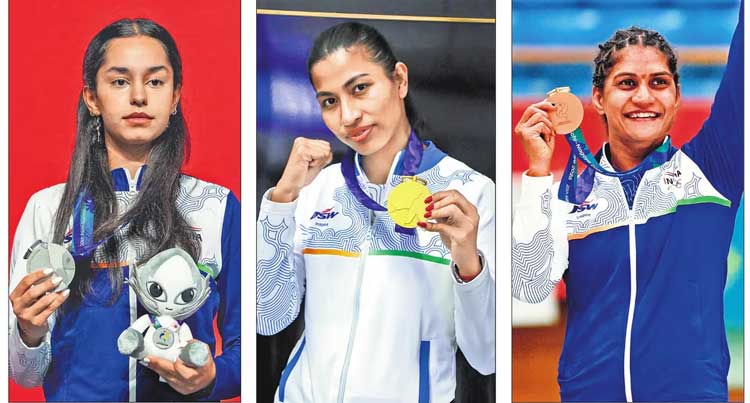
Seventeen-year-old Kumkum Mohod stood beside Korean recurve archer Oh Yejin, smiling after defeating the Olympic champion. Pranavi Urs walked away from a historic golf gold almost matter-of-factly after beating China’s Yin Ruoning, the world No. 6, a Major champion and a winner on the tour the previous week.
Both athletes displayed the confidence of competitors who knew they belonged at the highest level — a conviction forged through major upsets on the biggest stage.
At the Aichi-Nagoya Asian Games, Indian women increasingly claimed their space both on and off the field, and this time they did so in remarkable numbers on the podium.
India’s women arrived at very different stages of their careers. There were teenagers such as Anahat Singh and Kumkum Mohod, established stars including Mirabai Chanu and Lovlina Borgohain, and 36-year-old Suchika Tariyal, who refused to give up on her dream of winning an Asian Games medal.
India finished the Games with 85 medals — 21 gold, 27 silver and 37 bronze. Women’s events contributed 38 medals, matching the total from men’s events, while nine medals came from mixed competitions.
But the most striking statistic came from the top of the podium.
Of India’s 21 gold medals, 11 came from women’s events and three from mixed competitions.
At the 2023 Asian Games, Indian women had won nine gold medals, compared with 15 from men’s events and four from mixed competitions.
Women Who Ended Long Waits
Behind India’s medal haul were women who overcame long waits, broke records, returned from setbacks, battled illness and injury, and pushed through personal and systemic challenges.
The women’s cricket team set the tone by winning India’s first gold medal of the Games.
Mirabai Chanu followed with a silver that ended India’s 28-year wait for a women’s weightlifting medal at the Asian Games. India’s previous medal in the discipline had come through Karnam Malleswari at the 1998 Bangkok Games.
In athletics, Vithya Ramraj won bronze in the 400m hurdles while breaking PT Usha’s 42-year-old national record with a time of 54.75 seconds.
One of the most memorable victories came in women’s hockey, where India won gold and ended a 44-year wait for the top prize at the Asian Games.
Lovlina, Parveen Complete Redemption Stories
India’s women boxers delivered contrasting comeback stories.
Lovlina Borgohain, still carrying the disappointment of the Paris Olympics, found another level in Aichi-Nagoya. Her gold in the 75kg category made her only the second Indian woman boxer after Mary Kom in 2014 to win an Asian Games gold.
Parveen Hooda also returned to the podium after a difficult period. Three years after her 57kg bronze from Hangzhou was struck off following a whereabouts violation — a suspension that also cost her a place at the Paris Olympics — she moved up to the 65kg category and won gold.
Neeru Dhanda Overcomes Illness
Trap shooter Neeru Dhanda completed a medal treble despite serious concerns over her health before the Games.
She had been hospitalised shortly before the competition after suffering from Influenza B. She nevertheless became the first Indian woman to win an individual Asian Games trap gold.
Long jumper Ancy Sojan faced a different challenge. She has spoken about living with Polycystic Ovary Syndrome (PCOS), a condition that can make training and weight management particularly challenging for athletes competing in explosive events.
Sojan still produced a 6.53m jump to win silver, missing gold by just two centimetres.
Suchika Tariyal’s Long Road To The Podium
For Suchika Tariyal, the journey to an Asian Games medal was deeply personal.
Sport had partly become a response to childhood abuse and trauma. At 36, she finally reached the podium, winning bronze in mixed martial arts as the sport made its Asian Games debut in Japan.
Her medal was a reminder that sporting journeys do not follow a single timeline — and that success can come after years of setbacks and perseverance.
What India Can Learn From China, US
India’s progress also offers lessons from sporting powerhouses such as China and the United States, where women have become a significant part of medal-winning programmes.
China began a state-backed programme in the 1990s aimed at developing athletes capable of winning Olympic gold medals. A deliberate focus on women’s sport, including areas that were often underfunded elsewhere, became an important part of that strategy.
The results are visible today.
China topped the 2026 Asian Games medal table with 341 medals. At the Paris Olympics, women accounted for 56% of China’s medals. In the United States, women contributed 53.97% of the country’s medal tally.
India’s Opportunity In Women’s Sport
For India, Aichi-Nagoya provided a glimpse of what sport can look like when women receive sustained opportunities to compete and succeed.
The medal winners included teenagers and established stars, individual athletes and team players, competitors with smooth careers and those who had to fight their way back from setbacks.
The broader lesson is increasingly difficult to ignore: sustained investment in women’s sport can play a significant role in expanding a country’s overall medal tally.
Comments are closed, but trackbacks and pingbacks are open.