
Trump Warns Iran Of ‘Very Hard’ Response If Linked To Flydubai Cockpit Attack

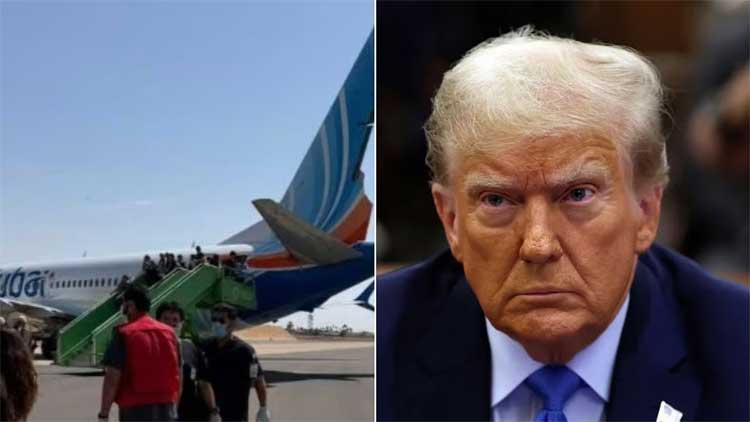
US President Donald Trump on Thursday warned that Iran would be hit “very hard” if investigators establish a link between Tehran and the Omani co-pilot accused of stabbing the captain and attempting to crash an Israel-bound Flydubai flight carrying 182 people.
Trump made the remarks as investigators from several countries worked to determine the motive behind the September 30 incident, in which the co-pilot allegedly attacked Captain Smit Machchhar in the cockpit, sending the Boeing 737 Max 8 into a steep descent before passengers and other crew members intervened. The aircraft eventually made an emergency landing in Saudi Arabia.
Asked at the White House whether he had been briefed about possible links between the co-pilot and Iran, Trump said: “We’re working on it right now.”
“I would say the answer, based on what I’m hearing, is yes, but we’re working on it right now,” he said, without providing evidence or elaborating on why he suspected Iranian involvement.
Asked whether the US would retaliate against Tehran if Iran was found to be behind the incident, Trump replied: “Oh they’ll be hit, very hard, don’t worry.”
“You just ask them,” he added. “They know what happened. They’ll be hit very hard.”
Trump’s comments went further than Israeli Prime Minister Benjamin Netanyahu, who said it was “too early to say” whether Iran was involved. Investigators are examining multiple possible motives, and no Iranian connection has been publicly established.
Passengers Entered Cockpit As Plane Plunged
The Flydubai flight from Dubai to Tel Aviv was carrying mostly Israeli passengers when the co-pilot allegedly stabbed the captain and attempted to take control of the aircraft.
Despite being seriously wounded, Machchhar managed to open the cockpit door, allowing passengers to enter and restrain the attacker. Two other pilots travelling as passengers subsequently helped stabilise the aircraft before it landed safely in Tabuk, Saudi Arabia.
Passenger Asaf Rajuan described the intervention as an instinctive effort to save lives.
“We felt helpless, suspended in midair, and I didn’t know who to turn to. But it was all instinct to survive,” he said in a statement shared by Israel’s presidency.
The aircraft had dropped dramatically in altitude during the struggle. Flight-tracking data showed it descending from about 33,000 feet to 17,000 feet in roughly a minute.
The wounded Indian captain was initially treated in Saudi Arabia and later transferred to Abu Dhabi. Indian authorities said he was in stable condition.
Investigation Examines Multiple Motives
A regional official briefed on the investigation said the suspect, an Omani national, was arrested and that authorities in Saudi Arabia were coordinating with Israel and other countries to determine a motive.
“All possible scenarios, from terrorism to mental disorders, are being looked into. Nothing is ruled out for now,” the official said.
Netanyahu has claimed that the co-pilot underwent Islamist indoctrination, but his office has not provided details supporting the assertion. Netanyahu also said it was too early to determine whether Iran had any role.
The UAE has launched its own investigation into the incident, including whether it was connected to terrorism. The aircraft is registered in the UAE, giving Emirati authorities jurisdiction over crimes committed aboard the plane.
Saudi Arabia has since handed the Omani suspect over to the UAE, according to reports.
Israel Joins Probe Into Copilot
Israeli intelligence and security officials have travelled to Saudi Arabia to assist with the investigation. Israel has also requested that the suspect be transferred to the country, although it remains unclear whether that request will be granted.
Despite the absence of formal diplomatic relations between Israel and Saudi Arabia, the two countries have cooperated on security and intelligence matters through unofficial channels.
Netanyahu said he had discussed the incident with UAE President Sheikh Mohamed bin Zayed Al Nahyan and that Israel would participate in questioning the suspect.
Flydubai has suspended flights to and from Israel while the investigation continues. Israeli authorities have also said they will conduct additional security checks on pilots operating flights into the country.
Emergency Codes Sent From Cockpit
During the incident, the aircraft transmitted two emergency codes, according to flight-tracking data.
The first, “7700”, is the standard emergency squawk code. The second, “7500”, indicates unlawful interference, including a possible hijacking.
The aircraft then made an erratic flight path near the Jordanian-Saudi border before landing in Tabuk.
Flydubai said the aircraft was secured by on-duty crew members who diverted and landed the plane safely. All passengers were subsequently taken to Tel Aviv on another flight.
The incident has heightened security concerns surrounding flights into Israel, while investigators continue to determine whether the attack was an act of terrorism, an individual act of violence or had any connection to Iran.
Comments are closed, but trackbacks and pingbacks are open.