
Bessent says 19 G20 nations agree ‘cheap exports’ are unsustainable, China dissents

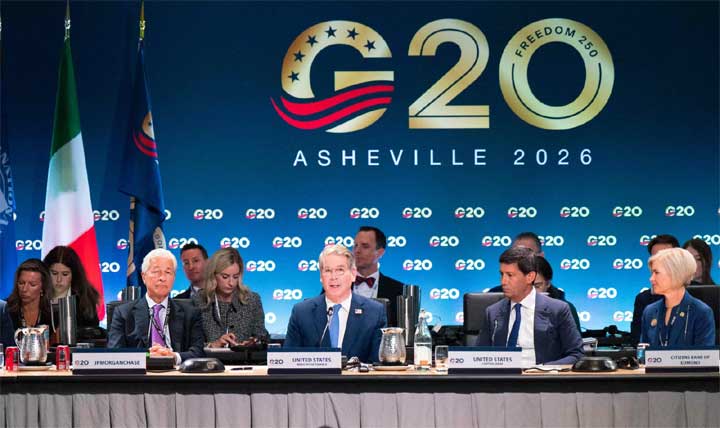
US Treasury Secretary Scott Bessent said Tuesday that 19 of the G20 members had agreed on the need to address the flow of “cheap exports” from non-market economies that he said was contributing to global economic imbalances, with China standing as the sole dissenter.
Speaking after a two-day meeting of G20 finance ministers and central bankers, Bessent said he had encouraged his counterparts to consider measures similar to those adopted by the Trump administration, including tariffs and other trade restrictions, to tackle persistent trade imbalances.
“We believe that non-market-based economies pushing out a never-ending stream of cheap exports is not sustainable,” Bessent told reporters, saying that sentiment had been shared by all but one G20 member.
“The country with the world’s largest and unsustainable current account surplus, the People’s Republic of China, was the dissenter,” he said.
The Trump administration has repeatedly accused China of contributing to global trade imbalances by maintaining a huge trade surplus while the United States runs a substantial deficit. Bessent also used the closing press conference to preview issues expected to come up when President Donald Trump meets Chinese President Xi Jinping later this month.
Bessent said he had warned other countries at the beginning of Trump’s second term that Washington’s new “tariff wall” could result in Chinese goods being redirected into their markets.
“And unfortunately, I was right,” he said. “The rest of the world probably needs to take a hard look at what they should be doing to protect their citizens’ jobs, their manufacturing base, so that everything they do doesn’t get offshored.”
Bessent calls for greater scrutiny of AI companies
Bessent also said Trump and Xi were expected to discuss artificial intelligence policy, arguing that stronger safeguards were needed to prevent “non-state actors” from developing their own AI models.
The Treasury secretary criticised the AI industry for failing to adequately explain its impact and benefits to the American public.
“AI companies, whether it is the builders of the data centers, whether it is the labs themselves, have done a horrendous job of explaining themselves to the American people,” Bessent said.
He argued that AI companies would have to accept some responsibility and convince the public that the technology’s benefits would not be concentrated among a small group of companies or individuals.
After the meeting, Trump said on his social media platform that “very productive and positive conversations were had” during the G20 discussions, adding that other countries should “follow our lead.”
Trump’s tariff strategy has faced criticism from economists and politicians who argue that the measures increase costs for American consumers and risk damaging relations with key allies. The Tax Foundation has estimated that tariffs imposed during 2025 pushed retail prices for imported consumer goods roughly 7% above pre-tariff trends.
The US Supreme Court ruled in February that Trump’s sweeping global tariffs imposed under an emergency-powers law were unconstitutional. The administration has since been reshaping its tariff strategy and is considering an additional 7.5% levy on Chinese imports following investigations into alleged excess industrial capacity and forced-labour practices.
US and China find common ground on Iran
Bessent also met Chinese officials on the sidelines of the G20 gathering and said Washington and Beijing had found some common ground on Iran.
According to Bessent, both sides agreed that Iran “cannot have a nuclear weapon” and that oil and other goods should be allowed to move freely through the Strait of Hormuz, which Iran has restricted.
Bessent has described China’s record trade surplus as a major obstacle to global economic growth, while also criticising what he considers excessive regulation.
Global debt has meanwhile climbed to a record $353 trillion, while US government debt reached $40 trillion in August. Amid concerns about a potential sell-off in US Treasury bonds, Bessent sought to reassure markets, saying he did not believe there was “any kind of dire situation” in the bond market.
Russia’s G20 presence sparks tensions
The participation of Russian Finance Minister Anton Siluanov remained a source of tension at the meeting. Siluanov met Bessent on Monday but was excluded from the traditional G20 “family photo” of finance ministers.
Canadian Finance Minister François-Philippe Champagne said Russia’s presence had caused “a lot of discomfort” among participants.
“We have made sure our discomfort is being heard by colleagues with respect to who is in attendance at the meeting,” Champagne said.
European Commissioner for the Economy Valdis Dombrovskis also said Tuesday that it was not the time to “normalize” relations with Russia.
Bessent defended Russia’s participation, arguing that dialogue was necessary to resolve conflicts.
“If the sides don’t talk, if we are not engaged, then how can it be solved?” he said.
Acknowledging European concerns, Bessent added: “If both fighters go in a corner, then there will never be a resolution to this horrible conflict.”
Comments are closed.