
2026 Nobel Prize In Medicine Goes To Three Scientists For Optogenetics Breakthrough

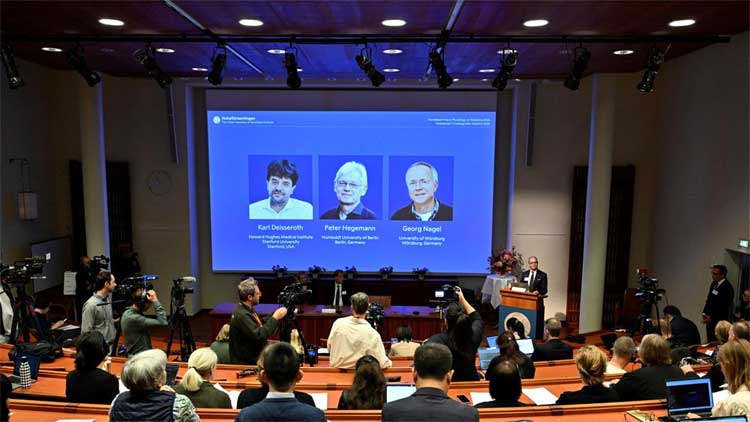
American scientist Karl Deisseroth and German researchers Peter Hegemann and Georg Nagel have won the 2026 Nobel Prize in Physiology or Medicine for their pioneering work on optogenetics, a technique that uses light to control individual nerve cells in the brain.
The Nobel Assembly at Sweden’s Karolinska Institutet announced on Monday that Deisseroth, 54, Hegemann, 71, and Nagel, 73, were honoured for their “discoveries concerning light-gated ion channels and optogenetics.”
“This method makes it possible to switch on, or off, the activity of individual nerve cells in a living brain,” Thomas Perlmann, Secretary-General of the Nobel Assembly at Karolinska Institutet, said.
Anna Wedell, a genetics professor and member of the Nobel Committee for Physiology or Medicine, said the discovery had opened a new era in neuroscience.
“For the first time we can actually start to understand how the brain processes information and how different neurons interact across the brain,” she said.
The three laureates will share a prize of 12 million Swedish kronor, worth roughly $1.2 million.
What Is Optogenetics?
Optogenetics is a technique that enables scientists to control the activity of specific nerve cells using light. The method has transformed neuroscience by allowing researchers to activate or silence individual neurons with unprecedented precision.
The breakthrough originated partly from studies of the green alga Chlamydomonas, which responds rapidly to light.
In the early 1990s, Hegemann began investigating how the alga detects light. He proposed that a single protein could both sense light and function as an ion channel, and asked Nagel to test the idea.
Nagel subsequently injected Chlamydomonas genes into frog eggs and identified channelrhodopsin-2, a light-sensitive ion channel.
In 2003, Hegemann and Nagel showed that the protein could be introduced into human cells to generate electrical impulses in response to light. Deisseroth later demonstrated the technique in rat nerve cells in 2005. The term “optogenetics” was coined in 2006.
From Algae To Brain Research
Deisseroth’s path into neuroscience was influenced by his experience treating patients at a psychiatric clinic while training to become a neurosurgeon. The suffering he witnessed prompted him to investigate why the brain functions differently across individuals.
His subsequent work helped establish optogenetics as a powerful tool for studying brain circuits.
Deisseroth used the technique to control the movements of mouse whiskers by activating specific neurons in the motor cortex. He also used light to activate nerve cells involved in wakefulness and successfully roused sleeping mice.
Potential Treatments For Brain And Eye Disorders
The Nobel-winning research is now being used to study a range of neurological and psychiatric conditions, including schizophrenia, Alzheimer’s disease, Parkinson’s disease, epilepsy and addiction.
Researchers are also exploring optogenetic approaches for restoring vision in people affected by retinitis pigmentosa, a progressive eye disorder. The technique involves introducing light-sensitive proteins into retinal cells so they can respond to light.
Scientists are also investigating whether optogenetics could improve cochlear implants by enabling more precise stimulation of the auditory nerve.
Several biotechnology companies are developing potential human therapies based on the technology, although many remain in development and are not yet widely available to patients.
Scientists Recall Nobel Calls
Deisseroth said he was still awake when he received the call from Stockholm in the early hours.
“I was not yet asleep, being a night owl, and now I don’t think I’ll be able to sleep for quite a while,” he said.
Hegemann said he was overwhelmed when he received a call from a Swedish number.
“It’s unbelievable when you get this message,” he said.
Nagel said he was sitting on a terrace in a village outside Naples when the Nobel Committee called.
“I actually thought it would not happen, but some other people always told me this will happen,” he said.
‘A Boundary Between Science And Science Fiction’
Manuel Valero, who heads the Neural Computation Laboratory at Hospital del Mar in Barcelona, said optogenetics had pushed the boundaries between science and science fiction.
Research using animal models has allowed scientists to manipulate processes linked to emotions and memory and investigate potential ways of recovering lost memories.
The broader promise of the technology, researchers say, is to translate these discoveries into treatments for human brain disorders.
The 2026 Nobel announcements will continue throughout the week, covering physics, chemistry, literature, peace and economics. The 2026 Nobel Peace Prize is scheduled to be announced on Friday.
Comments are closed, but trackbacks and pingbacks are open.