
Youth-Led Protests Sweep Europe Over Rising Living Costs, Military Spending and Climate Crisis

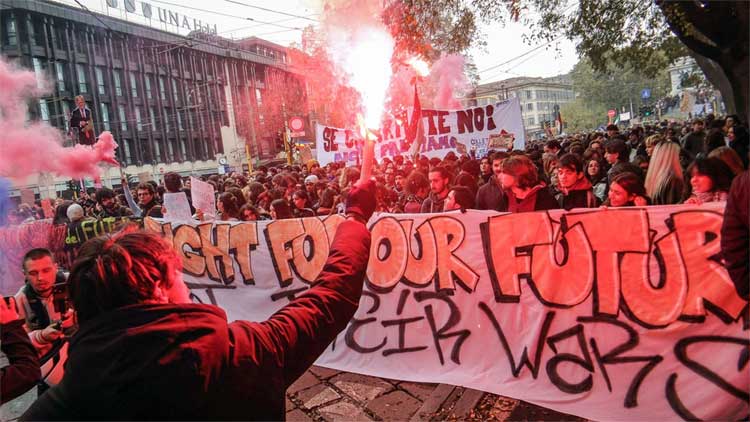
Thousands of demonstrators took to the streets across Europe on Friday to protest rising living costs, increased military spending, and the climate crisis, intensifying pressure on political leaders accused of neglecting the needs and concerns of younger generations.
Protests were held in cities across Italy, Germany, Austria and Britain, with demonstrators carrying placards reading “Fight for Our Future,” setting off flares and burning cardboard models of tanks.
Organized by a youth-led coalition comprising more than 50 groups, the demonstrations reflected a range of local grievances, including Israel’s war in Gaza, soaring housing costs, and deteriorating conditions in schools and universities.
Despite differences in their demands, protesters shared a broader concern that European governments were prioritizing geopolitical conflicts and corporate interests over investment in young people’s welfare, education and future opportunities.
Olivia Ferrario, an 18-year-old high school student who joined a demonstration in Milan, told AFP that young people were showing their “dynamism and determination” by taking to the streets.
“If the government does not listen to us, we cannot remain silent,” she said, as tens of thousands gathered for the protest.
Police deployed in large numbers amid concerns that the demonstrations could trigger violence similar to incidents witnessed during recent major protests in France and other European countries.
Young people voice fears over militarization and economic insecurity
In Berlin, approximately 1,000 university students and school pupils demonstrated against several issues, including Germany’s rapid military buildup, which has raised concerns about a possible return to compulsory military service.
“I simply think it’s indefensible… to force someone to learn how to fight and kill, and then send them to war,” said Helena Kossatz, 18, who completed high school last year, speaking to AFP.
As European governments seek to strengthen their military capabilities in response to what they consider a growing threat from Russia, protest organizers argued that resources allocated to rearmament should instead support education, youth programmes and affordable housing.
In London, several hundred demonstrators, some wearing school uniforms, gathered outside Parliament and in nearby Trafalgar Square.
They carried placards reading “Save Higher Education” and “Fight for Our Futures, Not Their Wars.”
“I’ve lost so much hope,” said Eliz, who took a day off from college to attend the demonstration and gave only her first name.
The 18-year-old expressed uncertainty about pursuing university education because of financial pressures and concerns that artificial intelligence could replace jobs.
“Because of money. Because most jobs are getting taken over by AI. Everyone’s just kind of more depressed,” she said.
Clashes also broke out between groups of right-wing and anti-fascist demonstrators in London. AFP reported several arrests following the confrontations.
Chants of “Palestine will live forever” were heard during the demonstrations, while Palestinian flags were displayed at several protests across the continent.
In Rome, high school students marched behind a banner declaring: “We will take freedom if no one gives it to us — against the government, the war and the high cost of living.”
The Italian capital also witnessed clashes, with some demonstrators throwing bottles and smoke bombs at police.
Education funding and deteriorating school conditions
In Madrid, protesters called for greater investment in education and criticized rising military expenditure.
Gabriela Gimeno Serrano, a 16-year-old high school student, highlighted overcrowded classrooms and inadequate facilities, saying her class had 33 students and only one teacher.
“Classrooms are very small, the facilities are in an absolutely dreadful state,” she told AFP, adding that some schools were also struggling with infestations of rats and cockroaches.
The demonstrations are expected to continue over the weekend, with trade unions and housing associations calling for additional rallies.
Protests recall France’s Yellow Vests movement
The demonstrations coincide with the anniversary period of France’s Yellow Vests movement, which challenged President Emmanuel Macron’s government in 2018 and 2019. Further protests are planned in France on Saturday.
The latest wave of demonstrations across Europe has been partly inspired by recent protests in France, some of which have turned violent.
The unrest initially gained momentum in mid-September, when students staged demonstrations at high schools demanding improved learning conditions. The protests subsequently developed into a broader nationwide campaign against rising prices, inadequate public services and police brutality.
The growing demonstrations highlight mounting frustration among young Europeans over economic insecurity, education standards, housing affordability, military priorities and their perceived lack of influence over political decisions affecting their future.
Comments are closed, but trackbacks and pingbacks are open.