
US, India, Japan and Australia launch Indo-Pacific maritime surveillance initiative

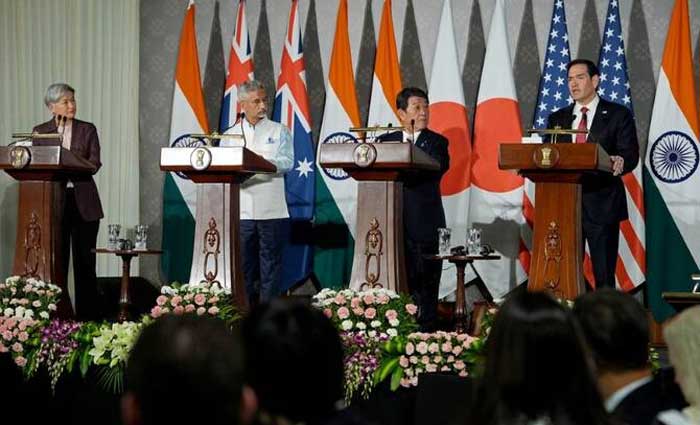
The US, India, Japan and Australia on Tuesday launched a new Indo-Pacific maritime surveillance initiative and unveiled a series of partnerships as foreign ministers from the four Quad nations met in New Delhi.
The gathering of the Quad — the strategic grouping formed in 2007 amid concerns over China’s expanding economic and military influence in Asia — brought together countries representing nearly 2 billion people and around a third of global GDP.
Under the new Indo-Pacific Maritime Surveillance Collaboration, the four nations will integrate surveillance capabilities and expand intelligence sharing across the region, US Secretary of State Marco Rubio said. The initiative aims to strengthen maritime security in a region through which about 60% of global seaborne trade passes.
The countries also agreed to deepen cooperation on maritime domain awareness, enabling the sharing of real-time information on ship movements, including commercial vessels. In addition, the bloc announced plans for greater collaboration on critical minerals and energy, along with a joint port infrastructure project in Fiji — the Quad’s first such initiative in the region.
Rubio described the partnership as a central element of US global strategy, pointing to what he called tangible progress and growing cooperation among the four countries.
The meeting came shortly after the summit between US President Donald Trump and Chinese President Xi Jinping, a development analysts say underscores Washington’s intention to use the Quad within its broader strategic competition with Beijing. Experts say the expanded initiatives could help members better track China’s long-range naval activities across the Indian Ocean and Western Pacific, while also improving monitoring of ports and undersea communication infrastructure.
The talks also took place as disruptions in West Asia and concerns over maritime chokepoints have renewed attention on trade security. Analysts say improving visibility over key sea routes such as the Malacca, Sunda and Lombok straits could become increasingly important for regional stability and supply chains.
Comments are closed.