
UN Committee Raises Concerns Over Racial Discrimination in India, Finland, Honduras and Kuwait

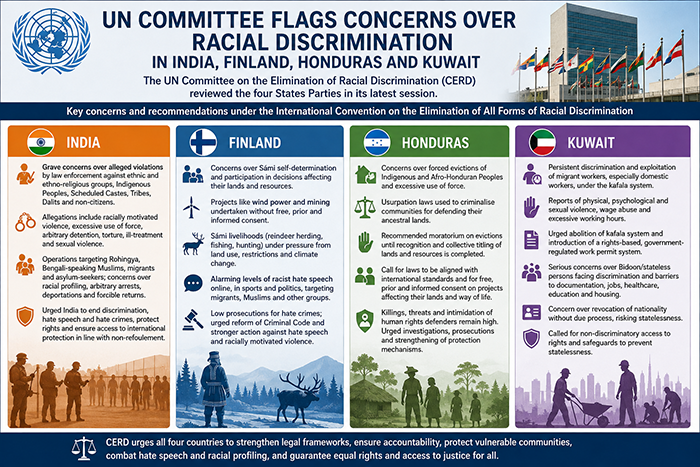
The United Nations Committee on the Elimination of Racial Discrimination (CERD) has issued its latest findings on India, Finland, Honduras and Kuwait, outlining key concerns and recommendations regarding the implementation of the International Convention on the Elimination of All Forms of Racial Discrimination.
The Committee’s concluding observations also acknowledge positive developments while highlighting areas where further action is required to protect vulnerable communities and strengthen safeguards against racial discrimination.
India: Concerns Over Alleged Rights Violations and Racial Profiling
The Committee expressed grave concern over reports of large-scale violations allegedly committed by law enforcement officials against ethnic and ethno-religious groups, Indigenous and Tribal Peoples, including Scheduled Tribes and Scheduled Castes, particularly Dalits, as well as non-citizens.
The reported violations include racially motivated violence, excessive use of force, extrajudicial killings, arbitrary and prolonged detention without due process, torture, ill-treatment and sexual violence.
CERD called on India to ensure prompt, thorough and impartial investigations into such allegations and to hold those found responsible accountable.
The Committee also highlighted reports of increased law-enforcement operations targeting Rohingya, Bengali-speaking Muslims, migrants and asylum-seekers, particularly following the 2017 Home Affairs order and the April 2025 Pahalgam attack in Kashmir.
According to the Committee, reported police stops and identity checks involving racial profiling have resulted in allegations of arbitrary arrest and detention, torture and ill-treatment.
CERD further expressed concern over deportations and forcible returns involving people in need of international protection, stressing the principle of non-refoulement, which prohibits returning individuals to places where they face serious risks of persecution or other grave harm.
The Committee urged India to urgently address discrimination, hate speech and hate crimes targeting Rohingya, Bengali-speaking Muslims, migrants and asylum-seekers, while ensuring protection of their rights and access to international protection.
Finland: Sámi Rights and Rising Hate Speech Highlighted
In Finland, the Committee raised concerns over the extent to which Sámi self-determination and participation in decision-making are guaranteed.
It said traditional Sámi lands and resources require stronger protection, particularly in relation to wind-power and mining projects undertaken without sufficient free, prior and informed consent.
The Committee also noted growing pressure on traditional Sámi livelihoods, including reindeer husbandry, fishing and hunting, as a result of competing land use, restrictions and climate change.
CERD called on Finland to ensure that projects and decisions affecting the Sámi are not approved without their free, prior and informed consent. It also recommended stronger protection for traditional lands and livelihoods and improved access to Sámi-language education, healthcare and social services.
The Committee separately expressed concern over what it described as alarming levels of racist hate speech in public discourse, particularly online, in sports and in the political sphere.
It noted that migrants, Muslims and other groups had reportedly been targeted, including through statements by public figures and members of Parliament. CERD also pointed to low prosecution and conviction rates for hate crimes and gaps in Finland’s criminal-law framework.
The Committee urged Finland to reform its Criminal Code, strengthen investigations and prosecutions involving racist hate speech and racially motivated violence, and ensure that racial motivation is properly identified and recorded.
It also recommended that racist statements by public officials and members of Parliament be promptly and unequivocally condemned.
Honduras: Indigenous and Afro-Honduran Communities Face Land Rights Concerns
For Honduras, CERD expressed concern over forced evictions of Indigenous and Afro-Honduran Peoples, including allegations of excessive use of force by law enforcement authorities.
The Committee particularly highlighted concerns that charges of usurpation and aggravated usurpation are being used to criminalise members of these communities for occupying or defending their ancestral lands.
It recommended a moratorium on evictions until the recognition, regularisation and collective titling of Indigenous and Afro-Honduran lands, territories and natural resources have been completed.
CERD also called for legislation concerning usurpation, aggravated usurpation and preventive evictions to be repealed or brought into line with international obligations so that these provisions cannot be used to criminalise communities or undermine their rights.
The Committee further recommended reviewing the Law for the Strengthening and Protection of the Agro-industrial Sector to prevent its use as a basis for evictions.
It urged Honduras to develop a legislative framework, in consultation with Indigenous and Afro-Honduran communities, guaranteeing their free, prior and informed consent on measures affecting their rights, lands, sacred sites and traditional ways of life, particularly in connection with extractive, agro-industrial, infrastructure and environmental-conservation projects.
CERD also remained concerned about killings, reprisals, threats and intimidation targeting human rights defenders, including Indigenous and Afro-Honduran leaders and community members.
It called for effective and impartial investigations, prosecution and punishment of those responsible, as well as adequate reparations for victims and their families.
The Committee also recommended strengthening Honduras’ National Protection Mechanism and the Special Prosecutor’s Office for the Protection of Human Rights Defenders, while ensuring timely implementation of precautionary measures issued by the Inter-American Commission on Human Rights.
Kuwait: Migrant Workers and Bidoon Rights Under Scrutiny
In Kuwait, the Committee focused heavily on discrimination and alleged exploitation affecting migrant workers, particularly domestic workers, under the kafala sponsorship system.
CERD cited reports of physical, psychological and sexual violence, non-payment or delayed payment of wages and excessive working hours.
The Committee urged Kuwait to abolish the kafala system and replace it with a government-regulated residency and work-permit system offering stronger protections for migrant workers.
It also called for allegations of abuse and exploitation to be investigated promptly and impartially, perpetrators to be prosecuted and victims to have access to effective remedies.
CERD additionally expressed serious concern over the situation of Bidoon or stateless persons, who it said continue to be classified as illegal residents and face discrimination in law and practice.
According to the Committee, Bidoon face major obstacles in obtaining civil documentation and accessing employment, social protection, housing, healthcare and education.
The Committee also raised concerns over reports that Kuwaiti nationality had been revoked from a significant number of individuals without adequate, transparent and due process safeguards, potentially placing them at serious risk of statelessness.
CERD called for effective measures to end discrimination against Bidoon, resolve their longstanding legal status in accordance with international human rights standards and end their classification as illegal residents.
It further recommended prompt and non-discriminatory access to civil documentation and the removal of barriers to employment, social protection, adequate housing, healthcare and education.
The Committee said decisions concerning nationality revocation should be based on clear and objective grounds, follow individual assessments with transparent due-process safeguards and should not result in statelessness.
UN Committee Calls for Stronger Protection of Vulnerable Communities
The latest CERD findings underline continuing challenges in combating racial discrimination and protecting vulnerable and marginalised communities across different regions.
While the four countries differ significantly in their legal, political and social contexts, the Committee’s recommendations share common themes: accountability for rights violations, protection of Indigenous and minority communities, stronger safeguards against hate speech and racial profiling, protection of migrant workers, and access to effective legal remedies and due process.
The concluding observations are part of CERD’s periodic review of States Parties to the International Convention on the Elimination of All Forms of Racial Discrimination.
Comments are closed, but trackbacks and pingbacks are open.