
Trump Says Oil Prices May Not Fall Until After US Midterm Elections

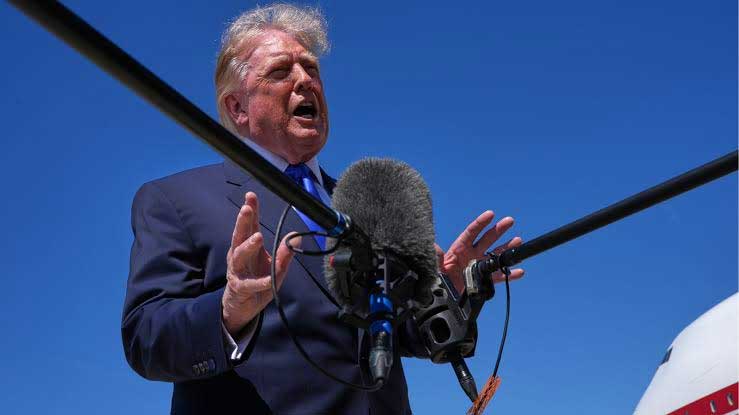
US President Donald Trump said Wednesday that oil prices, which have surged amid the war with Iran, may not fall until after the November midterm elections.
Oil prices jumped more than 3% on Wednesday, pushing international benchmark Brent crude above $100 a barrel for the first time since July as fighting between the US and Iran intensified.
“Right after the election, oil prices are going to be tumbling downward,” Trump said. “I think it’s going to take a little bit longer than the midterm.”
Trump’s remarks highlight the growing political pressure on his Republican administration to contain rising fuel prices as the conflict enters its seventh month with no clear end in sight.
Speaking to reporters before traveling to Dallas for the midterm Republican convention, Trump said he believes Iran could ultimately give in after the US elections.
“They’re desperate to try and affect the election,” Trump said, arguing that Tehran wants to influence the outcome and weaken the US government’s position on Iran’s nuclear programme. He added that he expected the war to end “immediately after the election” because Iran would no longer be able to sustain the conflict.
Trump also devoted significant attention to the Iran war during his keynote address at the convention, acknowledging that the conflict had pushed up energy prices and weighed on financial markets. He defended the military campaign as necessary to prevent Iran from acquiring a nuclear weapon.
The president asked the crowd whether anyone believed Iran should have a nuclear weapon, drawing a resounding “no” from the audience.
Trump had initially predicted that the war would last only a matter of weeks. It has now entered its seventh month. The conflict has sharply reduced the flow of Gulf oil through the Strait of Hormuz, a crucial shipping route that carried about 20% of the world’s petroleum before the war.
Trump last week dismissed the conflict as “small potatoes”, even as Republicans have grown increasingly concerned that high gasoline prices and rising inflation could hurt the party in the midterm elections.
The US has also drawn down its Strategic Petroleum Reserve. Its stockpile fell below 300 million barrels in early August, down more than 100 million barrels since the beginning of 2026.
Trump’s prediction that the war may continue beyond November 3 comes after Vice President JD Vance declined last week to set a deadline for ending the conflict.
Vance said he did not want to establish “artificial timelines” for the war, adding that the timing ultimately depended on Iran.
US benchmark crude was trading at around $96 a barrel on Wednesday, while gasoline prices rose sharply overnight.
The average price of regular gasoline increased by 7 cents to $4.22 a gallon, more than $1 above its level at the same time last year, according to AAA.
Diesel prices have also surged. The average price rose to $5.94 a gallon, up 9 cents from Friday, after hitting a record high last week. High diesel costs can have a broader impact on consumers because the fuel is widely used in freight, shipping and industrial production.
Jet fuel prices have also climbed sharply, prompting US and international airlines to reduce flights while increasing fares and fees.
The latest market volatility follows reports that the US military struck five Iranian tankers after attempted missile attacks on a US Navy warship. Separately, attacks by Iran-backed Houthi rebels reportedly triggered fires at oil facilities in Saudi Arabia.
Comments are closed.