
Supreme Court Relaxes Delhi Fireworks Ban for Diwali, Designates Time Slots for ‘Green Crackers’

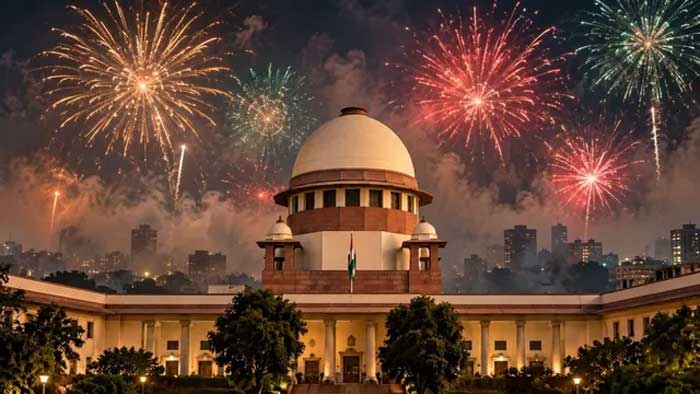
The Supreme Court of India has granted a temporary relaxation of the firecracker ban in Delhi-NCR ahead of Diwali, allowing residents to burst certified green crackers on November 7 and 8, subject to strict time restrictions and environmental safeguards.
In an order made public on Monday, a bench comprising Justices M.M. Sundresh and Prasanna B. Varale permitted the use of green firecrackers during two designated daily windows: 6 am to 7 am and 8 pm to 10 pm on both days.
Diwali will be celebrated on November 8 this year. The court clarified that the relaxation would remain limited to these two days, with the complete ban on firecrackers returning across Delhi-NCR from November 9.
The decision allows a limited opportunity for festival celebrations while retaining restrictions aimed at controlling air pollution in the national capital and surrounding areas.
Strict Restrictions on Firecracker Use
The court directed that fireworks must not be burst within a 300-metre radius of hospitals, nursing homes, primary and district health centres, old-age homes and designated silence zones. The restriction will also apply to educational institutions.
These areas must be identified and declared as ‘No-Cracker Zones’, with authorities instructed to mark their boundaries and publicise the restrictions.
The bench also prohibited conventional firecrackers, including those containing barium or lacking certification from the Council of Scientific and Industrial Research-National Environmental Engineering Research Institute (CSIR-NEERI).
Only approved green crackers will be permitted for manufacture, sale and use during the temporary relaxation.
Sale of Green Crackers Under Strict Monitoring
The Supreme Court has directed that manufacturers must possess valid certification from CSIR-NEERI and licences from the Petroleum and Explosives Safety Organisation (PESO).
Only products listed on the CSIR-NEERI website during the authorised period from November 2 to 6 can be manufactured.
The court has also prohibited the manufacture and sale of joined-series firecrackers, commonly known as ‘ladis’, and firecracker garlands.
Each packet must carry a product-specific QR code containing details of the manufacturer, registration, licences and relevant testing certificates. This measure is intended to prevent conventional firecrackers from being sold under the label of green crackers.
Online sales have also been prohibited, with authorised traders allowed to sell approved products only at designated locations identified by district authorities.
Complete Ban to Return on November 9
The Supreme Court made clear that the temporary permission should not be interpreted as a permanent relaxation of its earlier restrictions.
The complete prohibition on firecrackers across Delhi-NCR will be restored from November 9, 2026.
The court has directed pollution control authorities to monitor air quality before, during and after Diwali and submit daily reports covering the period up to November 30.
Authorities have also been instructed to strengthen inspections, prevent the transportation of illegal firecrackers into the region and take action against manufacturers and traders violating the court’s directions.
The ruling comes amid continuing concerns over worsening air quality in Delhi-NCR, particularly during the winter months when pollution levels frequently rise.
The court has emphasised the importance of public awareness and responsible celebrations, urging citizens to consider the impact of firecrackers on public health and the environment.
The temporary relaxation is therefore accompanied by strict conditions intended to regulate the sale and use of fireworks while limiting their contribution to pollution.
Comments are closed, but trackbacks and pingbacks are open.