
SpaceX Makes History as Starship Completes First-Ever Mid-Air Recovery Using Giant Mechanical Arms

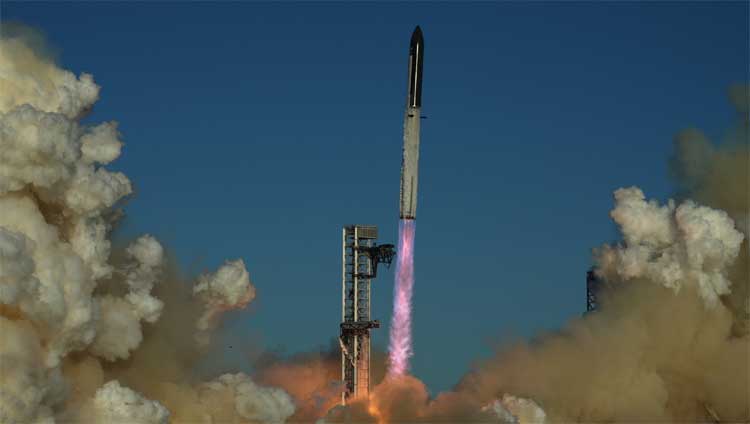
SpaceX on Saturday successfully completed the first-ever mid-air recovery of its Starship spacecraft, using giant mechanical arms to capture the returning vehicle at its Texas launch facility.
The breakthrough represents a major advance towards developing fully reusable rockets, potentially lowering the cost of space missions and enabling more frequent launches, AFP reported.
Standing 171 feet (52 metres) tall, the spacecraft emerged from the clouds, reignited its engines to turn vertically and gradually descended towards the launch tower, according to Reuters. It reappeared through thick clouds after withstanding the intense heat of its return through Earth’s atmosphere.
Its engines continued firing until the mechanical arms secured the vehicle, which then shut down its engines and remained suspended several hundred feet above the ground. The spacecraft was visibly charred from the intense heat generated during atmospheric re-entry, Reuters reported.
The successful manoeuvre marked the first time SpaceX had recovered the Starship spacecraft itself using the launch tower’s mechanical arms after an orbital flight. The system, nicknamed ‘Mechazilla’, uses two enormous robotic arms, often described as chopsticks, to catch returning rocket vehicles rather than allowing them to land on a conventional platform.
The spacecraft’s return came approximately 22.5 hours after its launch from SpaceX’s Starbase facility in Boca Chica, Texas. During the mission, Starship completed 14 orbits around Earth and successfully deployed 26 next-generation Starlink satellites.
However, the mission was not entirely successful. SpaceX had initially planned to recover both components of its massive rocket system — the Starship spacecraft and its first-stage Super Heavy booster — at the launch facility.
The booster failed to complete its return journey after experiencing engine-related problems shortly after Friday’s launch. It was diverted towards the Gulf of Mexico, where it ultimately exploded before reaching the water.
The failure prevented SpaceX from achieving its planned double recovery, although the successful capture of Starship itself represented a significant milestone for the company.
Booster Failure Overshadows Part of Historic Mission
The Super Heavy booster was supposed to return to the launch tower shortly after separating from Starship, allowing the mechanical arms to catch it in a controlled landing.
SpaceX had already demonstrated the ability to catch returning Super Heavy boosters during previous test flights. However, an issue involving engine performance and a low-fuel warning disrupted Friday’s recovery attempt.
The booster was consequently redirected away from the launch pad to protect ground infrastructure and personnel. It subsequently exploded over the Gulf of Mexico.
SpaceX founder and chief executive Elon Musk acknowledged the booster loss but indicated that it would not significantly affect the company’s plans to achieve high-frequency, fully reusable Starship operations.
The successful recovery of the upper spacecraft nevertheless demonstrated that the vehicle could withstand atmospheric re-entry, manoeuvre towards its launch site and execute a controlled landing sequence.
NASA Administrator Jared Isaacman welcomed the achievement, describing it as an important step towards future space exploration.
Major Step Towards Fully Reusable Rockets
SpaceX has been developing Starship as a fully reusable transportation system capable of carrying astronauts, satellites and other heavy cargo into space.
Unlike conventional rockets, which often discard major components after launch, Starship is designed to return both its spacecraft and booster stages for inspection, refurbishment and reuse.
The company believes this approach could substantially reduce launch costs and make space transportation more accessible. It also aims to support more frequent missions to Earth orbit, the Moon and eventually Mars.
The successful recovery is particularly significant because Starship’s upper stage must withstand extreme temperatures during atmospheric re-entry before returning to the launch site. Its heat shield, made up of protective tiles, remains one of the most important engineering challenges.
Despite Saturday’s achievement, SpaceX will need to demonstrate that the spacecraft can be inspected, refurbished and flown again reliably before establishing a routine reusable launch system.
NASA’s Moon Mission and SpaceX’s Mars Ambitions
Starship also plays a central role in NASA’s Artemis programme, which aims to return astronauts to the Moon and establish a sustained human presence there.
NASA has contracted SpaceX to develop a lunar landing version of Starship that will transport astronauts from lunar orbit to the Moon’s surface.
The spacecraft is expected to serve as a key component of future crewed lunar missions, although several technical challenges remain, including demonstrating the transfer of propellant between spacecraft in orbit.
Musk has even more ambitious plans for Starship, envisioning the vehicle as the foundation for future human missions to Mars and the eventual establishment of a settlement on the planet.
SpaceX is also preparing to expand Starship operations beyond Texas, with plans for launches from Florida in the coming months.
Saturday’s successful recovery therefore marks an important achievement in the company’s development programme. However, recovering both rocket stages during a single mission and demonstrating rapid reuse remain major milestones yet to be achieved.
Comments are closed, but trackbacks and pingbacks are open.