
Sonia Gandhi’s autobiography ‘Belonging: A Journey of Love’ offers rare glimpse into her personal life, political journey and Nehru-Gandhi family legacy

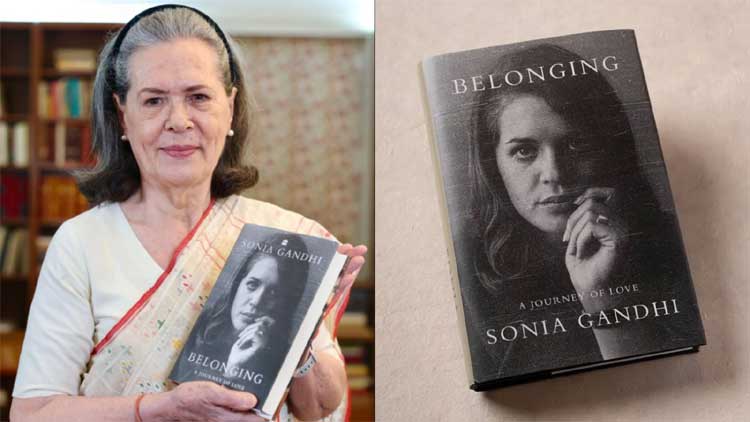
Sonia Gandhi’s recently released autobiography, Belonging: A Journey of Love, offers an unusually candid account of the personal experiences, relationships and defining moments that shaped her life. Known for maintaining a reserved public persona, the Congress leader emerges in the book as a more open narrator, sharing intimate details of her relationship with Rajiv Gandhi, her bond with the Nehru-Gandhi family and her eventual decision to make India her home.
The book was officially launched in New Delhi on Monday in the presence of several dignitaries, including serving chief ministers. What makes the autobiography particularly interesting is the balance Sonia Gandhi maintains between personal revelations and political restraint. She discusses the experiences she wants readers to understand while carefully avoiding subjects she has chosen not to address in detail.
At its heart, Belonging is a love story. Sonia’s relationship with Rajiv Gandhi forms the central narrative, but the book also explores how she gradually became part of the Nehru-Gandhi family and developed a close relationship with her mother-in-law, former Prime Minister Indira Gandhi.
Sonia recalls how she cared for Indira Gandhi and developed a special bond with her, learning about Indian politics and public life along the way. The autobiography also reflects on the family’s commitment to democratic and secular values, their sense of responsibility towards the country and the personal sacrifices that followed the assassinations of Indira and Rajiv Gandhi.
Without directly addressing the criticism frequently levelled against the Nehru-Gandhi family over alleged political entitlement and dynastic politics, Sonia presents another perspective: one of personal loss, public responsibility and the family’s long association with India’s political history.
Three emotional moments from Sonia Gandhi’s autobiography
Some of the most moving passages in the book revolve around the tragedies that transformed Sonia Gandhi’s life.
The first recounts her desperate attempt to persuade Rajiv Gandhi not to become Prime Minister following Indira Gandhi’s assassination in 1984. Fearing that her husband could also become a target, she pleaded with him to stay away from the position. Rajiv, however, reportedly responded, “I will be killed anyway.”
The second describes the trauma of losing Rajiv Gandhi in a suicide bombing in 1991. Sonia writes about the pain, shock and profound sense of loss that followed his assassination.
The third is an emotional conversation with her younger sister, Nadia, shortly after Rajiv’s death. Concerned about Sonia’s safety and that of her children, Nadia urged her to return to Italy. Sonia’s response was firm: “No. It is my country, my children’s country.”
The exchange captures the extent to which Sonia had come to identify India as her home, despite the recurring political controversy surrounding her Italian origins.
How Sonia Gandhi’s decision not to become Prime Minister shaped her public image
The autobiography also revisits Sonia Gandhi’s decision to decline the post of Prime Minister in 2004, after the Congress-led United Progressive Alliance (UPA) secured power following the general election.
Her decision came amid concerns about her safety and pressure from her children, who feared that she could face the same fate as Indira and Rajiv Gandhi.
By stepping aside and supporting Dr Manmohan Singh as Prime Minister, Sonia acquired a degree of political acceptability that might otherwise have remained difficult to achieve. Her decision also became one of the defining moments of her political career.
The book provides considerable space to her early years in Italy, a period about which relatively little was publicly known beyond her close circle. For years, Sonia had faced criticism over her foreign origins, and her public life often involved navigating questions about her Italian background and Indian identity.
In that sense, Belonging is also an attempt to explain the personal journey through which she came to regard India as her own country.
Two sides of Sonia Gandhi: The personal and the political
The tone of the autobiography changes noticeably when the narrative moves from Sonia’s personal life to her political career, particularly her appointment as Congress president in 1998.
The candid and emotionally expressive narrator gives way to a more cautious politician. While the personal chapters offer intimate recollections, the political sections leave several important questions unanswered.
Among the issues that receive limited attention are the Gandhi family’s decision to forgive Nalini, one of the convicts in Rajiv Gandhi’s assassination case; the Bofors controversy, which severely damaged Rajiv Gandhi’s government in 1989; and the political fallout between Rajiv Gandhi and his successor, V P Singh.
The book also offers little detail about Sonia’s differences with former Prime Minister P V Narasimha Rao. Their relationship remained a subject of discussion within the Congress, particularly after Rao’s death in 2004, when his body was reportedly not allowed inside the party headquarters.
Another area that receives limited attention is the working relationship between Sonia Gandhi and Dr Manmohan Singh during the UPA years. The functioning of the coalition government and the division of political responsibilities between the Prime Minister and the Congress president remain important aspects of that period.
Sonia also describes the Emergency imposed in 1975 as a mistake, while qualifying her assessment by pointing out that it was imposed constitutionally. She adds that the situation could have been different had her brother-in-law, Sanjay Gandhi, been restrained.
Should autobiographies of political leaders reveal more?
Autobiographies are inherently personal accounts, and writers have every right to decide which experiences to share and which to leave out. Sonia Gandhi herself has described Belonging as a personal rather than a political account.
However, the autobiography of a person who has occupied such an influential position in public life cannot be entirely separated from politics.
Sonia Gandhi has played an influential role in Indian politics for decades and has been associated with three Prime Ministers: Rajiv Gandhi, P V Narasimha Rao and Dr Manmohan Singh. Together, their tenures covered nearly two decades of significant political and economic change in India.
Her influence was particularly visible during the UPA years, when political power was often perceived to be concentrated around 10 Janpath, her official residence. During this period, Sonia also championed several rights-based initiatives, including the Right to Information Act (RTI) and the Mahatma Gandhi National Rural Employment Guarantee Act (MGNREGA).
She also holds the distinction of being the longest-serving Congress president, having led the party for a total of around 22 years across two tenures.
In many Western democracies, political memoirs have often served as opportunities for former leaders to examine their decisions, acknowledge mistakes and explain the workings of government. Former US President Barack Obama’s A Promised Land, which covers his first term in office, is one example of a political memoir that offers insights into the decision-making process at the highest level.
Such accounts can help citizens understand how major decisions are made and how political leaders respond to complex challenges. Transparency about the functioning of power is an important element of an informed democratic society.
For an active Indian politician such as Sonia Gandhi, however, such openness can carry political risks. In an increasingly polarised political environment, any controversial revelation could be used by opponents to target her, the Congress party or the next generation of the Nehru-Gandhi family.
A political message for the next generation of the Nehru-Gandhi family
The timing of the autobiography is also significant. With Rahul Gandhi and Priyanka Gandhi Vadra playing prominent roles in the Congress, the book offers an opportunity to present the family’s history and legacy to a new generation of readers.
Its account of personal sacrifices, political commitments and national identity could also become part of the ideological contest between the Congress-led Opposition and the BJP.
The book’s launch and promotional campaign suggest that the Congress is increasingly recognising the importance of modern communication strategies and social media in shaping public narratives. Sonia Gandhi’s decision to make her Instagram debut as part of the book’s promotional activities is an example of this approach.
The book’s reception and sales will also indicate the level of public interest in the personal history of one of India’s most influential political families.
The larger question: Do public figures owe history a fuller account?
Ultimately, Belonging: A Journey of Love raises a larger question about the responsibility of political leaders who choose to write their autobiographies.
While personal accounts naturally involve selective memories and individual perspectives, those who have occupied positions of considerable public influence arguably have a responsibility to offer a fuller account of the decisions and events that shaped their time in power.
Sonia Gandhi’s autobiography succeeds in providing a deeply personal account of love, loss, family and belonging. But its relatively cautious treatment of political controversies and important decisions leaves readers with questions about the inner workings of power during some of the most consequential years in India’s recent history.
The question, therefore, is not whether Sonia Gandhi had the right to decide what to include in her autobiography. She certainly did. It is whether the memoir of someone who has played such a significant role in public life should go beyond protecting personal and political interests to provide a more comprehensive account for citizens and future generations.
Comments are closed, but trackbacks and pingbacks are open.