
Netanyahu’s Bloc Leads Israel Election but Falls Short of Parliamentary Majority

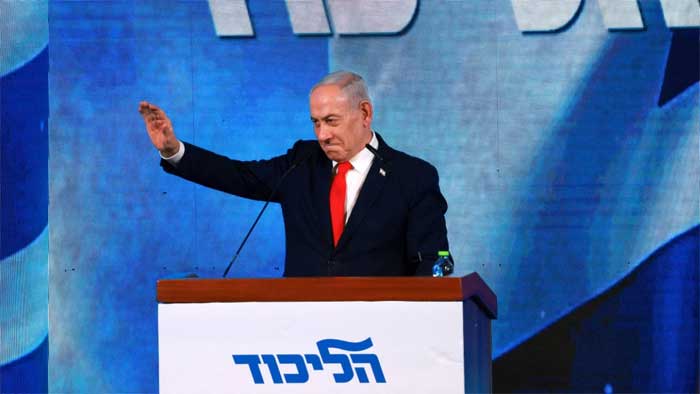
Israeli Prime Minister Benjamin Netanyahu’s right-wing and far-right alliance emerged as the largest bloc in the country’s general election but failed to secure a parliamentary majority, according to final official results released early Friday. The outcome has triggered uncertainty over the formation of the next government, alongside unsubstantiated claims by Netanyahu’s Likud party that the election was “stolen.”
The Central Elections Committee said Netanyahu’s coalition secured 53 seats in the 120-member Knesset, with Likud emerging as the largest individual party with 27 seats. The opposition bloc, led by former military chief Gadi Eisenkot, won 48 seats, while Arab-led parties secured the remaining 19.
The results mark a significant setback for Netanyahu, whose coalition had previously controlled as many as 68 seats. The fragmented outcome is expected to complicate negotiations as political parties seek to assemble the 61 seats required to form a government.
Following exit polls suggesting a setback for Netanyahu on Tuesday, Likud intensified allegations of electoral interference involving Arab-led parties. The party claimed, without presenting evidence, that foreign assistance had been used to influence the vote.
In a statement on Thursday, Likud declared, “The elections in Israel have been stolen!” It alleged that the purported interference was designed to enable foreign forces to influence parliament and undermine the right-wing government.
Among the allegations circulating in political circles and Israeli media were claims that Qatar had provided financial assistance to Arab-led parties to facilitate vote-buying. Both Qatar and the parties concerned denied the accusations.
Eisenkot accused Netanyahu’s allies of attempting to undermine the legitimacy of the election results after failing to retain their parliamentary majority.
Netanyahu remains prime minister as political parties explore potential alliances and negotiations to form the next government.
Foreign Interference Probe Deepens Political Tensions
The controversy escalated after Supreme Court Justice Noam Sohlberg, who heads the Central Elections Committee, referred suspicions of foreign interference to the Shin Bet domestic security agency for investigation.
In a letter to the agency, Sohlberg acknowledged that he could not independently verify the allegations but said their seriousness warranted further examination.
The Shin Bet confirmed that it was investigating suspected irregularities while emphasising that the inquiry was not intended to “cast aspersions or place blame on an entire sector that went out to vote in a democratic and lawful manner.”
The Central Elections Committee also sought to reassure the public about the integrity of the electoral process. In a statement accompanying the final results, it dismissed some of the information circulating about the investigation as entirely unfounded.
The committee clarified that the investigation would not affect the final results submitted to President Isaac Herzog and did not target any particular section of the population. It has requested the Shin Bet to submit its findings within a week.
Herzog described the situation as a sensitive moment for Israel and called for a comprehensive investigation. He also warned against casting suspicion on an entire community that had exercised its democratic right to vote.
The controversy has particularly heightened tensions involving Israel’s Arab citizens, who make up approximately 20 per cent of the population and are predominantly of Palestinian descent.
During the election campaign, Netanyahu and Likud repeatedly portrayed Arab-led parties as a threat to Israel, a strategy critics described as an attempt to marginalise the country’s Arab population.
The rhetoric, combined with growing public dissatisfaction with Netanyahu and his far-right government, contributed to an unusually strong turnout among Arab voters.
Arab Parties Gain Crucial Role in Government Formation
The election results have given Arab-led parties considerable influence in negotiations over the formation of Israel’s next government.
The 19 seats secured by Arab political groupings, including Ra’am and the Joint List, could prove decisive if Eisenkot’s opposition alliance attempts to reach the 61-seat threshold required for a parliamentary majority.
Eisenkot has indicated that cooperation with Arab-led parties remains possible, although such an arrangement would be politically sensitive. No Arab party had previously joined an Israeli governing coalition until Ra’am became part of a broad coalition government in 2021.
Arab parties could also influence parliamentary proceedings without formally joining the government by supporting opposition candidates for key legislative positions and shaping the parliamentary agenda.
Ahmad Tibi, a senior Joint List figure, said the opposition had approached him about replacing the Knesset speaker. He added that his party would support the opposition’s candidate.
The possibility of cooperation has drawn strong criticism from Netanyahu, who has suggested that Eisenkot’s willingness to work with Arab parties would amount to treason.
Netanyahu Faces Political and Legal Challenges
For Netanyahu, losing power could also revive scrutiny of longstanding corruption allegations against him and intensify demands for an investigation into the security failures surrounding the Hamas-led October 7, 2023, attack on Israel.
The final election results are scheduled to be formally presented to President Herzog on Wednesday. He will subsequently consult political party leaders before appointing a candidate to form the next government.
The designated candidate will face the difficult task of securing support from at least 61 lawmakers in the Knesset.
If coalition negotiations fail after repeated attempts, Israel could be forced to hold another general election early next year, prolonging the political uncertainty that has characterised the country’s repeated electoral contests in recent years.
Comments are closed, but trackbacks and pingbacks are open.