
Nepal flash floods: Death toll crosses 1,000 as families await news of missing hydropower workers

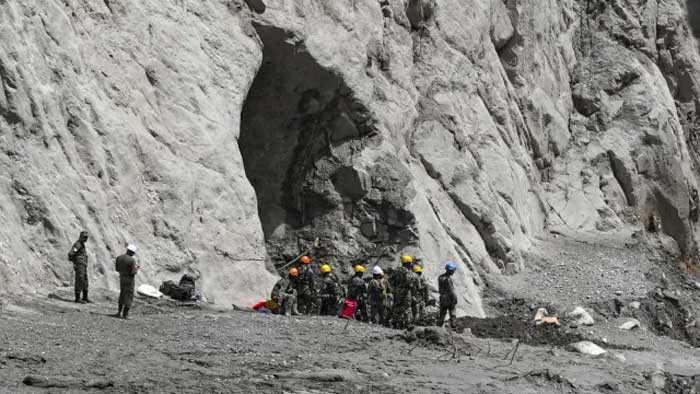
The death toll from Nepal’s devastating August 26 flash floods has climbed to 1,003, according to the National Disaster Risk Reduction and Management Authority (NDRRMA), as rescue teams continue searching for people still missing in the disaster.
Families of missing hydropower workers are growing increasingly desperate, urging authorities to speed up searches at project sites where tunnels remain buried under mud, rocks and debris.
Among those waiting for answers is 20-year-old Anush Gurung, whose 60-year-old father, Laxman, went missing after the floods struck the Upper Trishuli-1 hydropower project in Rasuwa district.
Anush last spoke to his father at around 8 am on August 26. Soon afterwards, powerful floodwaters swept through the project area, and Laxman disappeared.
The family has since received conflicting accounts from Laxman’s surviving colleagues about whether he was inside a tunnel when the flooding occurred, The Kathmandu Post reported on Tuesday.
“Whom are we supposed to believe? If the tunnel is searched, we would know for certain,” Anush told the newspaper. “Now our only hope is inside the tunnel.”
Families demand faster rescue operations
Relatives of missing workers have been pressing authorities to accelerate search operations as rescue teams struggle to clear tunnels blocked by tonnes of mud and debris.
At the Upper Trishuli-3B hydropower project in Nuwakot, Bivek Pandey is searching for his 58-year-old father, Kamal Bahadur Pandey. He is among at least 122 people reported missing from the project, according to The Kathmandu Post.
Families gathered at an Army rescue and relief centre in Bidur and called on authorities to intensify the search. Following several days of pressure from relatives, an excavator was brought to the site on Monday.
“If excavation begins, the sand covering the quarters can be removed. We still have hope,” Bivek told the newspaper.
However, it remains unclear whether Kamal Bahadur was inside a tunnel when the flash floods struck.
Blocked tunnels, damaged roads hamper rescue
Nepal Army teams, assisted by foreign specialists, are conducting searches at several hydropower projects, Nepal Army spokesperson Brig. Gen. Raja Ram Basnet told the Associated Press.
Army footage showed rescuers entering dark, debris-filled tunnels, wading through mud and climbing over rocks as they searched for missing workers.
The operation has been hampered by the remote locations of several hydropower projects and extensive damage to transport infrastructure. Steep terrain and narrow roads had already made access difficult, while the floods damaged key routes and further restricted movement.
Rescuers face additional challenges underground. Floodwaters swept huge quantities of mud, rocks and other debris into tunnels, causing sections to collapse and potentially trapping workers. Even where tunnel entrances remain accessible, teams must first remove substantial debris before they can advance deeper into the passages.
An Indian tunnel rescue team has also joined the Nepal Army in joint search-and-rescue operations at critical hydropower tunnel sites in Chilime, Rasuwa district, ANI reported.
12 hydropower projects damaged
The floods have also caused extensive damage to Nepal’s hydropower sector.
Mohan Kumar Dangi, president of the Independent Power Producers Association of Nepal, said at least 12 hydropower projects across Rasuwa and Nuwakot districts were damaged. Collectively, the projects have a generation capacity of 670 MW.
Four of the affected projects were under construction, seven were operational and one was undergoing testing.
Dangi said hydropower projects undergo risk assessments and other studies before construction, but described the scale of the August 26 flooding as “something unimaginable”.
Comments are closed, but trackbacks and pingbacks are open.