
Macron Pushes for EU Budget Agreement by Year-End Amid Deep Divisions Among Leaders

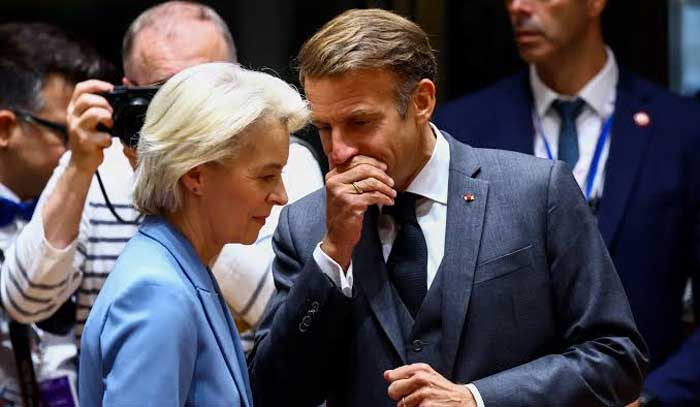
French President Emmanuel Macron has set a year-end deadline for reaching an agreement on the European Union’s next seven-year budget after EU leaders failed to make progress during their summit in Brussels on Thursday.
The proposed 2028-2034 budget, which reflects the bloc’s long-term political and economic priorities, is relatively small compared with national budgets. It is financed largely through contributions from the EU’s 27 member states, calculated according to the size of their economies, and is expected to account for between 1 per cent and 1.2 per cent of the bloc’s average gross national income.
EU leaders failed to reach a consensus after more than 12 hours of discussions on the proposed budget and a new $49 billion loan to support Ukraine’s economic and military requirements next year.
Macron ruled out the possibility of an immediate agreement, saying he would be prepared to approve “a good agreement” when European leaders meet again on December 17-18.
However, he warned that negotiations would become increasingly difficult after December 31 because of France’s upcoming presidential election in April, which could see the far-right make significant gains.
After the deadline, Macron said, he would not “be able to relaunch a discussion on the budget and to conclude it”, adding that the timing would be “much too close to the presidential elections in France”.
Hungarian Prime Minister Péter Magyar also expressed disappointment with Thursday’s discussions. In a social media post, he said he had seen “zero results” from the meeting and suggested that reaching an agreement by Christmas was unlikely.
EU Members Divided Over Budget Priorities
Although the EU’s long-term budget is relatively modest compared with the combined national spending of its members, negotiations have exposed deep divisions over how the money should be allocated.
Several member states are pushing for spending cuts and tighter financial discipline, while others want to protect traditional funding programmes and secure additional resources for emerging priorities, including defence, economic competitiveness and support for Ukraine.
German Chancellor Friedrich Merz emphasised the need for fiscal discipline while acknowledging the growing demands facing the bloc.
“Europe needs solid finances. We can’t and we mustn’t take on more debt,” Merz said, adding that the EU must also reliably fulfil a growing number of responsibilities.
Germany is among the bloc’s major net contributors, meaning it pays more into the common budget than it receives in funding. Austria, the Netherlands and Sweden are also part of this group.
Dutch Prime Minister Rob Jetten called for a smaller and more modern budget to facilitate an agreement.
“The budget needs to be modernized and needs to be downsized if we want to strike a deal,” he said, adding that he was prepared for negotiations to continue through December.
France and Italy Defend Farm Subsidies and Infrastructure Funding
A major disagreement has emerged between countries seeking to reduce spending and those determined to protect traditional EU funding programmes, particularly agricultural subsidies and regional development assistance.
France and Italy are leading a group commonly known as the “friends of cohesion”, which supports maintaining financial assistance for farmers and infrastructure projects in economically weaker EU regions.
Agriculture and cohesion policies each account for approximately one-third of the bloc’s budget, making them central to the negotiations.
Czech Prime Minister Andrej Babiš defended the importance of regional development funding, arguing that it helps ensure comparable living standards across different parts of Europe.
“Cohesion is about the same level of life in different regions,” Babiš said, pointing to the need for better infrastructure and public services in his country.
European Council President António Costa, who chaired the summit, urged member states to approach the negotiations with flexibility and a willingness to compromise.
He stressed that an agreement must be reached by the end of the year and would require unanimous support from all 27 member states.
Costa said negotiations must address three key issues: the overall size of the budget, the distribution of funds among competing priorities and ways to generate additional revenue.
Last week, he floated the possibility of introducing an EU-wide digital services tax. The proposed levy could target revenue from online advertising and companies’ earnings from user data, potentially generating around 5 billion euros ($5.5 billion) annually.
Ukraine Support Adds to EU Budget Challenges
Financial assistance for Ukraine has emerged as another major point of disagreement in the budget negotiations.
The proposed seven-year spending framework includes a 100-billion-euro ($110-billion) allocation for Kyiv. EU leaders must also decide on a separate $49 billion loan intended to meet Ukraine’s economic and military needs next year, including whether the costs of servicing the loan should be covered through the common budget.
Earlier this month, Merz warned that Germany could block an agreement on the EU budget unless all member states made a collective commitment to supporting Ukraine without exceptions.
He reiterated his position on Thursday, saying the issue would require detailed discussions with individual leaders.
However, Bulgaria, the Czech Republic, Hungary and Slovakia oppose using EU funds for military assistance to Ukraine.
Babiš argued that financial support for Kyiv should be discussed separately from the broader EU budget, insisting that Europe’s priority should be the “life of our citizens”.
Nearly a year ago, EU leaders approved a 90-billion-euro ($99-billion) loan to cover most of Ukraine’s financial requirements over a two-year period.
However, Russia’s intensified attacks on Ukrainian energy facilities and civilian infrastructure, alongside disruptions to Black Sea trade, have placed additional pressure on Kyiv’s finances.
Moscow has also criticised the EU’s plans to provide further financial assistance to Ukraine.
Kremlin spokesman Dmitry Peskov said allocating money for Kyiv through the European budget would make Ukraine “less inclined toward a peace process and more determined to continue the war”.
The disagreements over spending priorities, agricultural subsidies, regional development and Ukraine’s financing have left the EU facing a difficult negotiating process. With unanimous approval required, reaching a final agreement before the end of the year remains a significant challenge.
Comments are closed, but trackbacks and pingbacks are open.