
Lawyers Set Up Rapid Response Network Amid Mass Detentions At Delhi Protests

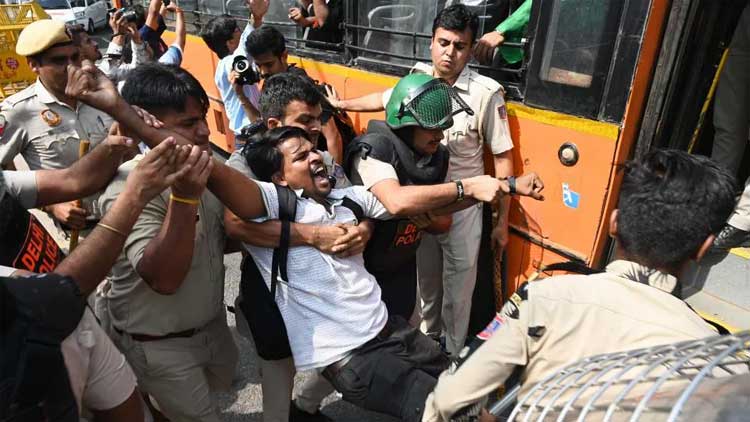
A network of independent lawyers in Delhi has mobilised to provide legal assistance to protesters detained during demonstrations against Chief Election Commissioner Gyanesh Kumar, setting up a rapid response system to locate detainees and document alleged mistreatment.
The network swung into action around 11 pm on Sunday after receiving a distress call reporting that 30 to 40 people, including five or six minors, were being held in Najafgarh in southwest Delhi. Some detainees reportedly claimed to have been injured.
Within minutes, the information was circulated among lawyer groups. Shobhit Chaudhary, a Delhi-based independent litigator, contacted the police point of contact and helped identify lawyers near Najafgarh who could respond.
“We basically worked on creating a rapid response system for the fraternity,” Chaudhary said. “It is working, but in all honesty there should not be a need for this to be working.”
The volunteer network has been working around the clock amid mass detentions linked to the protests in the national capital.
Supreme Court Orders Relief For Peaceful Protesters
On Sunday, the Supreme Court held a special sitting and directed that peaceful, unarmed protesters should not be detained except in accordance with the procedure established by law. It also ordered the restoration of normal metro and railway services and internet connectivity.
Despite the court’s intervention, detentions continued.
Around 100 people, including All India Students’ Association president Neha Bora and Communist Party of India (Marxist) lawmaker John Brittas, were detained near Connaught Place on Sunday evening.
The previous day, Delhi Police had detained thousands of people, many of whom were stopped at checkpoints while attempting to enter central Delhi. Those detained included student leaders and political party members.
A Network Of More Than 70 Lawyers
Chaudhary said his efforts to assist detainees began during protests in July, when people took to the streets demanding the resignation of then education minister Dharmendra Pradhan. He initially worked alone before other independent lawyers joined the effort.
The network now comprises more than 70 to 80 lawyers spread across Maharashtra, Madhya Pradesh, Rajasthan, Assam and the Delhi National Capital Region.
Rather than operating as a formal organisation, the group relies on the professional and personal networks of its members, including friends, former classmates and colleagues.
This allows distress messages to reach lawyers closest to the location where people have been detained.
“It is more like a message delivery mechanism, where we can find out which lawyers are near the area,” Chaudhary said.
WhatsApp Alerts And Instructions For Detainees
The network circulates contact numbers and guidance through WhatsApp and Instagram, sharing two brief sets of instructions.
One explains what people should do if they are detained, while the other advises witnesses on how to document someone else’s detention. Witnesses are encouraged to record the vehicle transporting detainees and note its registration number.
People facing detention are also advised to share their live location in protest-related WhatsApp groups, along with their name and the number of people travelling in the vehicle.
The system is intended to help lawyers quickly establish where detainees are being taken and connect them with legal assistance.
Allegations Of Injuries And Denial Of Food
Chaudhary said accounts received by the network presented a mixed picture, with many complaints concerning alleged aggression during detention and reports of people being pushed or injured at some detention centres.
One recurring complaint was that protesters had allegedly been detained before reaching the protest site or outside the area covered by prohibitory orders under Section 163 of the Bharatiya Nagarik Suraksha Sanhita.
Chaudhary questioned the legality of such detentions, saying preventive action must comply with the applicable law.
The network also received complaints about detainees going without food for extended periods.
According to Chaudhary, a group of 20 to 22 young men who had travelled to Delhi for the protest were picked up near Anand Vihar and held in a building. He alleged that they were given bananas but no other food until around 2.30 pm, and that their phones had been taken away.
The network also reported finding several minors at a detention centre in outer Delhi. Some people released from detention were allegedly injured.
These accounts reflect allegations relayed by the lawyers and have not been independently established in every case.
Lawyers Develop Protocol To Document Alleged Abuse
The volunteer network has established a protocol to ensure that complaints of mistreatment are formally documented, particularly because many allegations emerge only after detainees are released.
Under the protocol, a lawyer present at a detainee’s release must ensure that a medico-legal certificate (MLC) is prepared if injuries are reported.
If the detainee has a grievance, the lawyer is instructed to submit a handwritten complaint to the station house officer (SHO) and obtain an acknowledgement.
If the SHO refuses to accept the complaint, the lawyer is advised to photograph it on the officer’s desk and email it to the police station, copying Delhi Police headquarters.
The objective, Chaudhary said, is to create a record of the allegations and the steps taken to report them.
Legal Access Remains A Key Concern
Chaudhary said access to detainees was the biggest challenge until the Supreme Court held its special sitting on Sunday morning.
According to him, lawyers were initially prevented from meeting detainees, and some who attempted to do so were themselves detained.
“Yesterday it was a battle,” he said, adding that the situation became comparatively smoother on Sunday.
Senior lawyers have since joined the effort, and the matter could be taken to court to seek answers from Delhi Police and the Union home ministry over the detentions and allegations of mistreatment.
“This cannot be forgotten,” Chaudhary said. “If this is a problem today, it will be a problem tomorrow or the day after.”
Comments are closed, but trackbacks and pingbacks are open.