
Latvia’s 2026 Parliamentary Election: A Contest That Could Reshape the Baltic Political Landscape

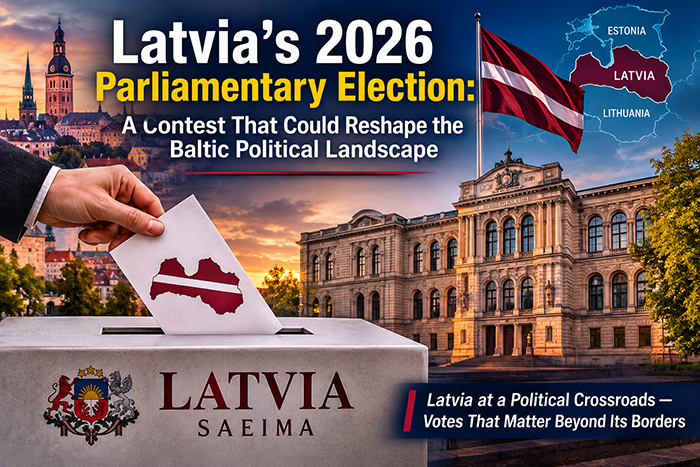
Latvia is heading toward a closely watched parliamentary election on 3 October 2026, with voters set to elect all 100 members of the Saeima. The election comes at a particularly consequential moment for the Baltic state, as domestic political fragmentation coincides with heightened security concerns across Europe and the continuing war in Ukraine.
Rather than a straightforward contest between government and opposition, the election is increasingly developing into a fragmented race in which several political forces are competing for relatively small shares of the electorate. The central question may therefore not be simply which party finishes first, but which combination of parties can assemble a governing majority after the votes are counted.
A New Government Just Months Before the Election
Latvia’s political landscape was shaken in May when Prime Minister Evika Siliņa of New Unity resigned. President Edgars Rinkēvičs subsequently asked Andris Kulbergs of the United List to form a new government.
Kulbergs succeeded in forming a four-party coalition involving the United List, New Unity, National Alliance and Union of Greens and Farmers. The Saeima approved the new administration on 28 May by 66 votes to 25.
The timing is unusual. The new government has only a short period in office before the October election, leaving limited time for it to demonstrate results or establish a strong political mandate.
For Kulbergs and the United List, however, the change of government has already produced a measurable electoral benefit.
United List Moves to the Top
The latest SKDS poll, conducted in July for Latvian Television, showed United List at 12.2%, up from 9.8% in June, making it the most popular political force in the survey. Sovereign Power/Union of New Latvians followed at 11.4%.
The figures nevertheless underline how uncertain the election remains. No party is commanding anything close to a majority, while several parties remain clustered around the crucial five-percent threshold.
Earlier polling in June had placed United List and Latvia First together at 9.8%, illustrating how rapidly the political rankings have been changing.
The five-percent threshold is particularly important because Latvia uses proportional representation to elect its 100-member parliament. Parties that fail to reach the threshold are excluded from the distribution of parliamentary seats, making even small changes in support potentially significant.
Latvia First and the Populist Challenge
One of the most closely watched forces is Latvia First, led by Ainārs Šlesers.
The party has consistently performed strongly in polling this year and has positioned itself as an alternative to Latvia’s established political parties. In a May SKDS poll, Latvia First led with 9.3%, ahead of the Progressives at 7.8% and United List at 6.8%.
Its rise reflects a broader European political trend: voters dissatisfied with established parties are increasingly attracted to movements presenting themselves as outsiders or challengers to the political establishment.
However, converting a strong opposition vote into government power is another matter. Latvia’s proportional electoral system makes coalition-building essential, and the willingness of other parties to cooperate with Latvia First could ultimately determine its influence.
The Battle Around the Five-Percent Threshold
The election may also be decided by parties fighting simply to remain politically relevant.
The National Alliance, New Unity, Progressives and Union of Greens and Farmers all have established parliamentary bases, but their relative strength is changing. In the latest July polling, New Unity showed some improvement, while the Greens and Farmers’ Union fell below the five-percent threshold.
This creates an important strategic problem. A party polling just above five percent can win parliamentary representation, while a party slightly below the threshold could receive no seats at all. Consequently, the final weeks of campaigning could produce substantial tactical voting.
Security Is Central to the Election
Domestic economic and social issues will matter, but Latvia’s geopolitical position gives the 2026 election an importance extending well beyond Riga.
Latvia is a member of both the European Union and NATO, borders Russia and Belarus, and is directly exposed to the security consequences of Russia’s war against Ukraine.
The new Kulbergs government has placed national security high on its agenda. Defence spending and the strengthening of Latvia’s military capabilities are therefore likely to remain prominent campaign issues.
For Latvia, questions surrounding NATO’s eastern flank, support for Ukraine, relations with Russia and Belarus, border security and European defence cooperation are not abstract foreign-policy debates. They are closely connected to the country’s national security.
The Coalition Question
The election’s most important political arithmetic will begin after the polls close.
With 100 seats in the Saeima, a governing coalition needs 51 seats for a parliamentary majority. Given the fragmented polling picture, a single-party government appears highly unlikely.
The most plausible outcome is therefore another coalition government, potentially involving several parties with differing ideological priorities.
The key questions will be:
- Can United List convert its current polling lead into the largest parliamentary bloc?
- Can Latvia First maintain its momentum and become a central force in coalition negotiations?
- Will New Unity recover sufficiently to remain a major governing player?
- Can the Progressives consolidate the centre-left vote?
- Will the National Alliance remain above the parliamentary threshold?
- Can the Greens and Farmers’ Union recover before election day?
- Which parties are prepared to cooperate with Latvia First?
These questions may ultimately matter more than the identity of the party finishing first.
An Election Still Wide Open
The current polling should be treated cautiously. Latvia has a substantial pool of undecided or politically disengaged voters, meaning that the final result could differ considerably from today’s standings.
The political environment is also unusually fluid because the country has only recently experienced a change of government. Kulbergs’ rise demonstrates how quickly political fortunes can change: United List moved from a relatively modest position in earlier polling to first place in the latest July survey.
The coming weeks will therefore be crucial.
What the Election Could Mean for Europe
Latvia’s election deserves attention not only because of its domestic political consequences but because of its position on Europe’s eastern frontier.
A new government will inherit major responsibilities concerning defence expenditure, NATO cooperation, support for Ukraine, relations with Russia and Belarus, and Latvia’s role within the European Union.
The election is unlikely to produce a simple political realignment overnight. But it could determine which forces shape Latvia’s policies during a period in which Baltic security has become one of Europe’s most important strategic concerns.
Conclusion
Latvia’s 3 October 2026 parliamentary election is shaping up as a contest defined by fragmentation, political volatility and coalition uncertainty.
United List currently has momentum, Latvia First remains a powerful challenger, and several established parties are fighting to preserve their position. Yet with no party close to a governing majority, the decisive battle may begin only after voters have cast their ballots.
The biggest question is not simply who will win Latvia’s election. It is who will be able to build the coalition that governs Latvia afterward.
With the Baltic region facing an increasingly challenging security environment, the answer will have implications far beyond Latvia’s borders.
Comments are closed.