
Jantar Mantar 2.0: 6 Key Differences In Security, Protesters And Police Preparations

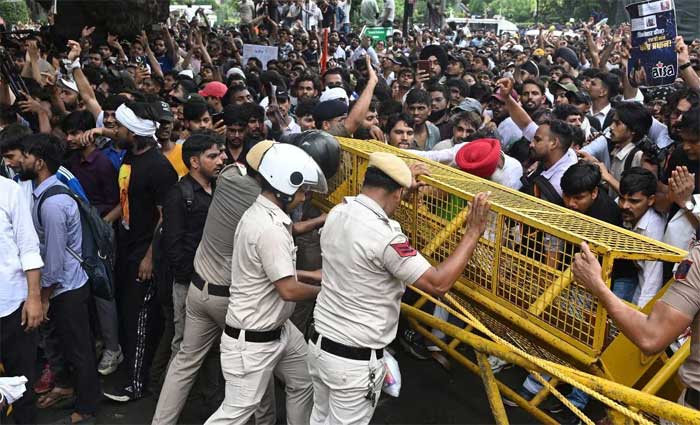
Everything about the latest round of protests at Delhi’s Jantar Mantar has changed — from the demonstrators and their demands to the scale of security arrangements. Authorities have deployed thousands of additional personnel, issued guidelines for journalists and introduced body-worn cameras amid allegations of police misconduct.
Two months ago, protesters were demanding the resignation of then education minister Dharmendra Pradhan over the NEET-UG paper leak. This time, the focus has shifted to Chief Election Commissioner (CEC) Gyanesh Kumar, with the Cockroach Janta Party (CJP) preparing for another demonstration on Saturday.
The protests have also brought multiple opposition leaders, lawyers and farmer groups into the picture, creating fresh challenges for the Delhi Police and central security forces.
Here are six key ways in which Jantar Mantar 2.0 differs from the earlier protests.
1. Largest Security Deployment In Years
More than 26,000 personnel from the Central Armed Police Forces (CAPFs) have been deployed to work alongside the Delhi Police, marking one of the largest security arrangements in the capital in recent years.
According to Hindustan Times, the Union Ministry of Home Affairs approved at least 110 additional CAPF companies, including personnel from the Central Reserve Police Force (CRPF), Border Security Force (BSF), Sashastra Seema Bal (SSB), Indo-Tibetan Border Police (ITBP) and Central Industrial Security Force (CISF).
These companies arrived from Jammu and Kashmir, West Bengal and Chhattisgarh, joining 111 companies already stationed in Delhi.
Each CAPF company has a sanctioned strength of 120-130 personnel, of whom approximately 75-80 are generally deployed. All 221 companies are expected to work alongside the Delhi Police.
A police officer recalled that fewer than 200 CAPF companies had been deployed during the February 2020 Assembly elections, which coincided with US President Donald Trump’s visit to India and the subsequent communal riots in northeast Delhi.
2. Multiple Groups Mobilise Ahead Of Saturday’s Protest
The CJP is preparing for another demonstration against CEC Gyanesh Kumar, but several other organisations have also announced plans to join the mobilisation.
Lawyers’ groups have called for a march from Patiala House Court to Jantar Mantar on October 10. Advocate Mehmood Pramod urged lawyers to assemble at Gate 4 of the court complex at 11 am before proceeding towards the protest site.
Bharatiya Kisan Union (BKU) leader and spokesperson Rakesh Tikait has also expressed support for the CJP and is expected to travel to Delhi for the demonstration.
Meanwhile, Congress leaders Rahul Gandhi, Priyanka Gandhi Vadra and other opposition figures have staged protests at multiple locations, including Jantar Mantar, the Election Commission headquarters, Akashvani Bhawan, Rajghat and Connaught Place.
With West Bengal Chief Minister Mamata Banerjee also scheduled to join the Opposition’s protest, the prospect of demonstrations spreading across different parts of the capital has added to the security challenge.
3. Police Prepare To Intercept Protesters At Entry Points
Security agencies are preparing for demonstrators to arrive in Delhi by road, rail and air, creating uncertainty over when and where prominent CJP leaders might reach the capital.
Police are considering intercepting activists at airports, railway stations and bus terminals. Protesters, however, have warned that they could demonstrate at locations where authorities attempt to stop them.
A police officer said prohibitory orders were currently in force in the New Delhi area, with the possibility of extending restrictions to locations outside airports and railway stations depending on the situation.
Authorities have also installed CCTV cameras and loudspeakers across parts of New Delhi. Recorded announcements urge people not to stage protests or gather in large numbers.
4. Rahul And Priyanka Gandhi Among High-Threat Protectees
The security arrangements have become more complex because senior political leaders participating in the protests require protection even during detention.
When opposition leaders were detained on Tuesday and taken by bus to Kingsway Camp, CRPF personnel were present inside the vehicle as part of their security detail.
Rahul Gandhi and Priyanka Gandhi Vadra receive Z-plus security from the CRPF and were previously protected by the Special Protection Group (SPG), along with their mother, Sonia Gandhi.
In 2019, the Centre replaced the Congress leaders’ SPG protection with CRPF-provided Z-plus security, reserving SPG protection exclusively for the Prime Minister.
A senior CAPF officer explained that personal security officers must accompany protected individuals during detention to ensure their safety and monitor their movement.
The officer said the security personnel must also ensure that protectees are not harmed during interactions with police or members of a crowd.
5. Police Issue Media Guidelines Amid Counter-Advisories
The Delhi Police has issued a media advisory outlining guidelines for journalists covering the protests.
Released on October 5 under the title Guidelines for Journalists, it asks reporters to carry valid identification, avoid obstructing police operations and maintain a reasonable distance during tense situations.
Journalists have also been advised to position themselves clearly apart from demonstrators while recording events.
The advisory followed police claims that many people covering the protests were social media influencers rather than accredited journalists. Police personnel have reportedly checked identification documents, with some individuals detained for not being associated with accredited media organisations.
However, the guidelines have also triggered criticism from citizens and media groups, who have issued counter-advisories urging police personnel to display their name tags and identification badges.
Critics have raised concerns about accountability, alleged assaults on peaceful demonstrators and an allegation of molestation involving a police officer. The Delhi Police has also accused some protesters of targeting women police personnel.
6. Liquor Shops Shut, Body Cameras Deployed
Authorities have introduced additional preventive measures ahead of Saturday’s demonstration, including the closure of liquor shops across Delhi for two days.
The Delhi excise department ordered the shutdown on Thursday, citing police inputs and concerns about maintaining law and order.
A senior police officer said that while liquor shop closures are common during elections and certain disturbances, a citywide closure for a single protest at Jantar Mantar was unusual.
The police are also considering whether schools in the New Delhi area should remain open on Saturday, with a decision expected to depend on the security situation.
Separately, the Delhi Police has begun deploying body-worn cameras on a larger scale following allegations of misconduct involving personnel and journalists covering the demonstrations.
At least 150 cameras are being used by forces deployed in the New Delhi district to document events, record interactions and preserve evidence.
Police officers said body-worn cameras had previously been used by traffic personnel, but their deployment on this scale for protest management was unusual.
The police have also assigned the Crime Branch to investigate a molestation allegation against an assistant commissioner of police (ACP). In addition to the cameras, police teams have engaged photographers to document events and preserve footage and photographs as potential evidence.
Why Jantar Mantar 2.0 Is Different
The latest protests have expanded beyond a single political demand, bringing together opposition leaders, lawyers and farmer organisations amid heightened scrutiny of the Election Commission.
For the authorities, the challenge extends beyond crowd control. Police must manage multiple potential protest sites, coordinate a large security deployment, protect political leaders and respond to allegations of misconduct while maintaining public order.
With more demonstrations anticipated on Saturday, the scale of mobilisation and the competing demands of security, accountability and the right to peaceful protest are likely to remain central to the situation in Delhi.
Comments are closed, but trackbacks and pingbacks are open.