
Israel Election to Test Netanyahu’s Grip on Power Amid Political Deadlock

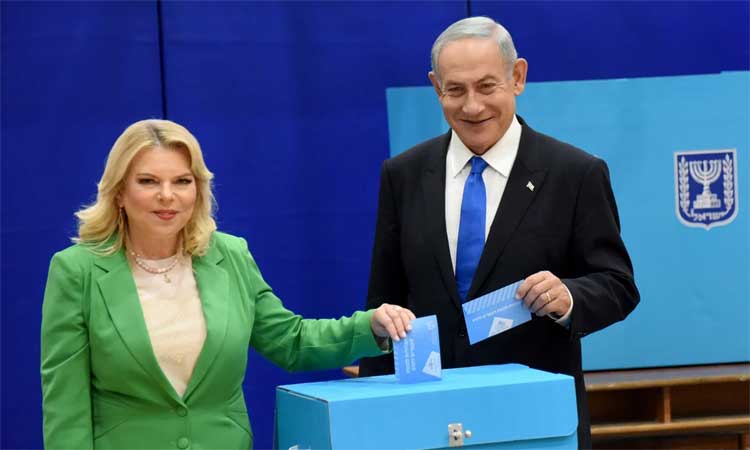
Israelis are set to vote on October 27 in an election that could determine whether Prime Minister Benjamin Netanyahu remains in power, with opinion polls suggesting that neither his governing bloc nor the opposition has a clear path to the 61 seats required to form a government.
The election, the first national vote since the Hamas-led attack on October 7, 2023, is widely seen as a referendum on Netanyahu’s handling of the security failures surrounding the attack and the wars that followed, the Associated Press (AP) reported. Even after voting concludes, coalition negotiations could take weeks, prolonging political uncertainty.
WHY THE ELECTION MATTERS FOR NETANYAHU
Voters will elect all 120 members of the 26th Knesset, Israel’s parliament. Key issues include accountability for the October 7 security failures, military service exemptions for ultra-Orthodox men, the rising cost of living and Israel’s international standing.
Netanyahu’s Likud party is aligned with far-right factions, including National Security Minister Itamar Ben-Gvir’s Otzma Yehudit, as well as ultra-Orthodox parties Shas and United Torah Judaism. Finance Minister Bezalel Smotrich’s Religious Zionist Party is another key ally.
Together, these parties form the core of Netanyahu’s governing bloc. However, their ability to retain power will depend on the election results and subsequent coalition negotiations.
WHO ARE THE MAIN CONTENDERS?
The opposition is divided among several parties and political alliances. Former military chief Gadi Eisenkot leads the centrist Yashar party and is among Netanyahu’s principal challengers.
Former prime minister Naftali Bennett leads Beyachad, an alliance combining his party with Yair Lapid’s Yesh Atid. Other opposition figures include Yair Golan of the Democrats and former finance minister Avigdor Liberman of Yisrael Beyteinu.
Smaller parties, including Amcha Yisrael and the Reservists-Economic Party, could also influence the distribution of seats if they cross the electoral threshold.
CAN NETANYAHU SECURE A MAJORITY?
Neither the governing bloc nor the opposition has a clear route to the 61 seats needed to form a government. Netanyahu would need continued support from his right-wing, far-right and ultra-Orthodox allies, while opposition leaders would have to secure backing beyond their core parties.
Arab-led parties could play a pivotal role. However, mainstream opposition leaders have been reluctant to include them in a governing coalition, while Netanyahu has criticised the prospect of relying on their support.
Ultra-Orthodox parties present another challenge because of disagreements over exemptions from compulsory military service.
Possible routes to a government include a national unity arrangement, an agreement involving Arab-led parties or support from ultra-Orthodox factions for an alternative coalition. Each option would require political compromises. If negotiations fail and the deadlock persists, Israel could be forced into another election.
HOW THE VOTING SYSTEM WORKS
Israelis aged 18 and above vote for a political party rather than an individual candidate. The 120 parliamentary seats are allocated proportionally according to each party’s share of the national vote.
A party must secure at least 3.25 per cent of the vote to enter the Knesset, a threshold that generally translates into around four seats.
After the results are announced, the president assigns the task of forming a government to the member of the Knesset considered best placed to assemble a coalition. The designated candidate has 28 days to complete the task, with a possible extension. If the attempt fails, the president can nominate another candidate or the process can return to the Knesset. If no candidate succeeds, another election may follow.
Polling stations are scheduled to open at 0400 GMT, with initial results expected overnight and final results due on Thursday. Soldiers were due to begin voting on October 20, while thousands of Israelis living abroad were reported to be flying home because Israeli law generally does not allow citizens overseas to vote in national elections.
FOREIGN POLICY AND THE IMPACT ON PALESTINIANS
Analysts Abrams and Cook expect limited changes to Israel’s broad foreign policy regardless of the outcome, citing widespread public support for a firm approach towards Iran, Lebanon and Syria, alongside opposition to establishing a Palestinian state in the near term.
An opposition-led government could, however, alter the tone of Israel’s relations with neighbouring countries and take a different approach to settler violence in the occupied West Bank.
Palestinians cannot vote in the Israeli election, but its outcome could have significant consequences for them. The war in Gaza has killed more than 74,000 people, according to the figures cited in the report, while nearly two million people have been displaced.
The election will therefore have implications beyond Israel’s domestic political landscape, potentially shaping the country’s approach to regional security, relations with its neighbours and the continuing Israeli-Palestinian conflict.
Comments are closed, but trackbacks and pingbacks are open.