
Iran war strains US Navy as final aircraft carrier leaves Asia

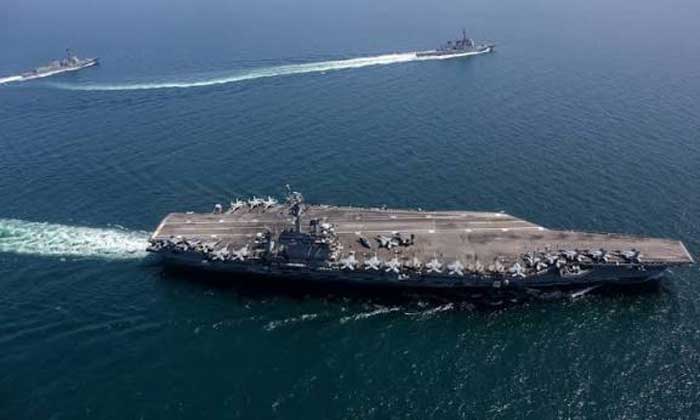
President Donald Trump’s war with Iran is stretching the US Navy’s aircraft carrier fleet, leaving the western Pacific temporarily without one of its key warships as China increases military activity in the region.
The USS George Washington is leaving the Pacific and is expected to replace the USS Abraham Lincoln in the Middle East. The Lincoln’s deployment has already been extended beyond its scheduled May return to support US operations against Iran, raising concerns over crew fatigue, mental health and supply shortages.
The Pacific could regain a US carrier if another warship is deployed in the coming months. But analysts say the temporary gap highlights the strain caused by the open-ended Iran conflict and raises questions about Washington’s ability to maintain its focus on the Asia-Pacific.
“The administration says that the Pacific is supposed to be the most important behind the Western Hemisphere,” said Greg Poling of the Center for Strategic and International Studies, arguing that the US is instead moving in the opposite direction by increasing its military involvement in the Middle East.
China could use the carrier’s absence to reinforce its regional influence, analysts said. Beijing views the US military presence as a challenge to its ambitions, including over Taiwan, while Washington has long stressed the strategic and economic importance of the Pacific.
Bryan Clark, a former Navy submariner and defence analyst, said China could use the situation to signal to countries such as Japan, the Philippines and Indonesia that the US is increasingly distracted.
China has recently conducted military activities with Indonesia and stepped up pressure involving Japan and the Philippines. It also held drills near Scarborough Shoal in the South China Sea and conducted a live-fire exercise near Japan’s Okinotori island.
US officials have sought to reassure allies. Adm. Frank Bradley, head of US Special Operations Command, visited Manila and said American special operations forces were prepared to expand joint exercises with the Philippines. He is also expected to visit Japan.
The strain on the carrier fleet has also raised concerns about the wellbeing of sailors. The USS Abraham Lincoln has spent more than 240 consecutive days at sea, while the USS Gerald R. Ford recently completed an 11-month deployment, its longest since the Vietnam War.
Experts warn that prolonged deployments can leave crews physically and psychologically exhausted. Robert Farley of the University of Kentucky said inadequate rest can reduce a crew’s ability to operate efficiently over time.
Analysts also warn that extended operations could create a maintenance backlog. The US Navy has 11 aircraft carriers and normally deploys two or three at a time, but additional deployments could further stretch the fleet and leave more carriers waiting for repairs at the Navy’s two carrier shipyards.
The situation has also revived questions about whether aircraft carriers remain central to modern warfare. Michael Swaine of the Quincy Institute said carriers could be increasingly vulnerable to drones and missiles, particularly in a potential conflict with China.
Senior Navy officials have likewise indicated interest in reducing reliance on massive carriers and increasing the use of smaller ships, submarines and other platforms.
The growing strain on the carrier fleet underscores a broader challenge for Washington: maintaining a credible military presence in the Pacific while sustaining prolonged operations in the Middle East.
Comments are closed.