
Himalayan Glaciers Under Threat: Nepal’s Deadly Floods Raise Alarm as India Records 6,119 GLOF Deaths

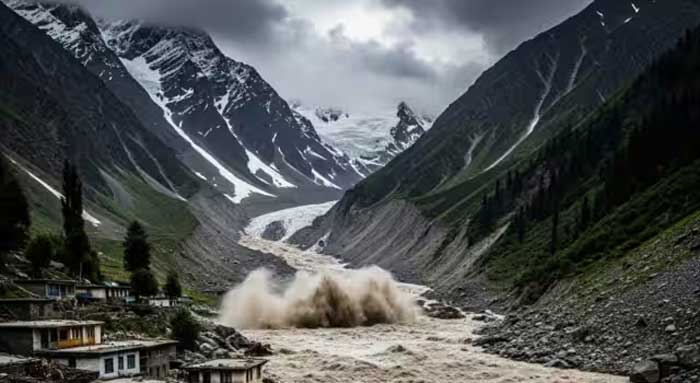
The devastating glacial floods witnessed in Nepal could be an indication of the growing climate risks facing glacier-dependent regions across the world. Rising temperatures are accelerating ice loss, increasing the threat of catastrophic glacial lake outburst floods (GLOFs) and releasing enormous quantities of carbon trapped in frozen landscapes, according to two new reports released ahead of the 31st Conference of the Parties (COP31) to the United Nations Framework Convention on Climate Change (UNFCCC).
The findings have raised concerns about the future of the Hindu Kush Himalaya and other glacier-rich regions, where communities living downstream face mounting threats from unstable glacial lakes, extreme rainfall and melting permafrost.
Two reports, Overshoot and the Cryosphere: Averting Global Meltdown and State of the Cryosphere 2026: The Cost of Overshoot, were released on November 2, 2026, approximately a week before COP31 begins in Antalya, Turkey. The reports were published by the International Cryosphere Climate Initiative (ICCI) and the United Nations Environment Programme (UNEP).
Rising temperatures threaten glaciers and permafrost
The Overshoot report warns that glaciers, ice sheets and permafrost regions are particularly vulnerable to global warming. Changes in these frozen environments could have consequences extending far beyond the polar regions and high-altitude mountain landscapes.
According to the report, approximately 15 per cent of the Northern Hemisphere, covering around 14 million square kilometres, is underlain by terrestrial permafrost. These permanently frozen or seasonally thawing ground systems contain at least 1,700 billion tonnes of carbon.
“Taken together, terrestrial and submarine permafrost on the continental shelves offshore of Siberia and North America are estimated to hold several times the amount of carbon currently stored in the atmosphere,” an ICCI media summary stated.
The report cautions that temporarily exceeding the Paris Agreement’s 1.5°C warming threshold could trigger extensive and, in some cases, irreversible damage to the Earth’s frozen regions.
“Overshooting the 1.5°C Paris Agreement target will bring large-scale, and in many cases irreversible, impacts from the Earth’s melting ice sheets, permafrost, glaciers, sea ice and polar oceans,” the summary said.
A recent analysis by the World Meteorological Organization (WMO) has also warned that global temperatures could remain above the 1.5°C threshold for much of the century.
The Arctic has warmed up to four times faster than the global average over the past decade, according to the report. Mountain regions are also experiencing accelerated warming.
In the Hindu Kush Himalaya, a global temperature increase of 1.5°C could translate into regional warming of between 1.8°C and 2.2°C.
The Greenland and Antarctic ice sheets are also losing ice at approximately six times the rate recorded during the 1990s, highlighting the accelerating changes taking place across the world’s frozen landscapes.
India records 6,119 deaths from glacial lake outburst floods
A separate UN-led study has highlighted India’s vulnerability to glacial lake outburst floods, finding that the country recorded the highest number of GLOF-related deaths among eight Hindu Kush Himalaya nations between 1835 and 2025.
The study, titled Glacial Lake Outburst Flood Risks, Response Strategies and Adaptation Gaps in the Hindu Kush Himalaya Region, examined historical flood events across a 4.2-million-square-kilometre region covering Afghanistan, Pakistan, India, China, Nepal, Bhutan, Bangladesh and Myanmar.
Interestingly, India ranked third in the number of recorded GLOF events but had the highest reported death toll.
China recorded 199 glacial lake outburst floods during the period, followed by Pakistan with 152, India with 62 and Nepal with 58.
However, India reported 6,119 deaths, significantly higher than Pakistan’s 1,991 and China’s 625. The study also found that India experienced the largest displacement associated with these floods, followed by Nepal and Pakistan.
Dipesh Chapagain, a glacial scientist at the United Nations University Institute for Environment and Human Security (UNU-EHS) in Bonn and the study’s lead author, said GLOF events had increased rapidly in recent decades, largely because of climate change.
The research identified a significant rise in the frequency of these floods after 1950, reaching approximately 34 events per decade. This represented a fivefold increase compared with the pre-1950 period.
Ice avalanches and monsoon rainfall trigger GLOFs
The study identified ice avalanches as the primary trigger in approximately 50 per cent of recorded glacial lake outburst floods. Intense rainfall accounted for another 25 per cent.
Around 70 per cent of the floods occurred during the summer monsoon months, when temperatures and precipitation levels are generally at their highest.
These findings underline the connection between changing climatic conditions and the increasing threat of glacial disasters in the Himalayan region.
As glaciers retreat, meltwater can accumulate in lakes held back by unstable natural barriers made of ice and rock debris. When these barriers collapse or are breached, enormous volumes of water can rush downstream, destroying settlements, roads, bridges and other infrastructure.
Such events can occur with little warning, making early detection and disaster preparedness particularly important for communities living in vulnerable mountain valleys.
Experts call for urgent emission cuts and adaptation measures
James Kirkham, chief scientist at ICCI and coordinating lead author of the Overshoot report, which was produced with UNEP, described the findings as deeply concerning.
“The Overshoot report does paint a very gloomy and scary picture,” he said.
Kirkham emphasised the need for greater investment in climate adaptation, alongside immediate action to limit global warming and minimise the duration and extent of any temperature overshoot beyond 1.5°C.
“We need to increase finance and efforts towards adaptation,” he said, stressing that countries must work to keep peak warming as close to 1.5°C as possible and for the shortest possible period.
“The loss of ice will have impacts globally that do reverberate around the whole planet. It’s all connected,” he added.
An Indian climate expert, who spoke on November 2 on condition of anonymity, described the findings as an “eye-opener” and called for stronger preparedness against glacier-related disasters.
The expert said India needed to accelerate climate adaptation efforts across its Himalayan states to protect vulnerable communities, infrastructure and ecosystems.
Why the Himalayan region needs stronger disaster preparedness
The findings highlight the growing risks facing countries that depend on Himalayan glaciers for water resources and ecological stability.
For India, the combination of glacier retreat, expanding glacial lakes, intense monsoon rainfall and unstable mountain slopes presents a complex disaster-management challenge.
Strengthening early-warning systems, monitoring vulnerable glacial lakes, improving downstream evacuation plans and investing in climate-resilient infrastructure will be essential to reducing the impact of future disasters.
The reports also underline that adaptation alone cannot address the problem. Limiting greenhouse gas emissions and keeping global warming as close to the Paris Agreement’s 1.5°C target as possible remain critical to slowing the long-term deterioration of the world’s frozen regions.
As COP31 approaches, the warnings from the cryosphere reports put the spotlight on the urgent need for coordinated climate action, particularly in mountain regions where the consequences of melting ice are already being felt.
Comments are closed, but trackbacks and pingbacks are open.