
Haridwar battles 7,000 tonnes of post-Kanwar garbage as pollution, disease fears grow

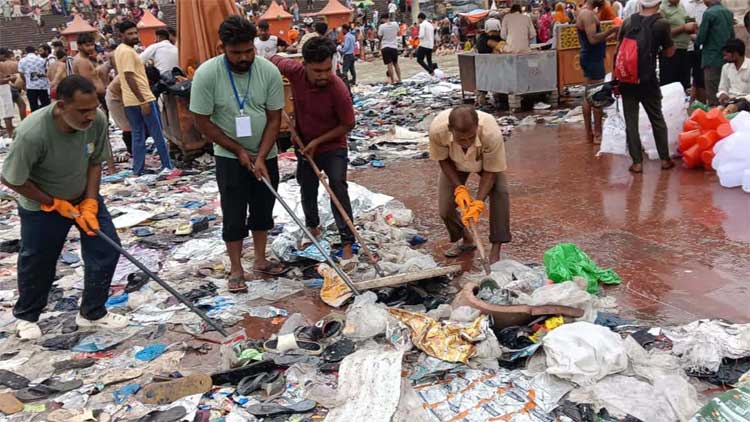
Haridwar is racing to clear more than 7,000 tonnes of garbage generated during the two-week Kanwar Yatra, which drew nearly 48 million pilgrims to the holy city this year — the highest turnout on record.
With heaps of plastic, discarded clothes, Kanwars and non-degradable polythene piling up across the city, experts have warned that delayed disposal could worsen pollution and increase the risk of disease.
The worst-affected areas include several ghats along the Ganga, markets where pilgrims stopped to eat and rest, roads leading into the city from national highways and designated parking areas.
Hundreds of sanitation workers have been deployed since the last pilgrims began leaving Haridwar after the Shravan Shivratri Ganga Aarti. Officials said the clearance operation is expected to take several days.
“Approximately 7,000 tonnes of garbage was generated during the two weeks of Kanwar Yatra. It is being cleared since Tuesday evening as Kanwariyas started leaving the city,” municipal corporation town commissioner Nandan Kumar said.
He said waste collection and disposal were being carried out on a war footing across markets, lanes, roads and parking lots.
Officials said discarded clothes left behind by Kanwariyas alone amounted to several metric tonnes and would be sent for recycling.
Haridwar launches mega cleanliness drive
The district administration has launched a mega cleanliness drive from August 12 to 18 to restore the city to its pre-Kanwar fair condition.
“Heaps of garbage and waste are lying at Ganga ghats, in the Kanwar Mela zone, along the Kanwar patri and throughout the pedestrian routes used by Kanwariyas,” Chief Development Officer Lalit Narayan Mishra said.
Municipal corporations, local authorities, district and village panchayats have been working round the clock to collect and dispose of the waste, with senior officials monitoring the operation both on the ground and online.
More than 1,000 sanitation workers, along with 100 outsourced personnel, have been deployed for the drive. Around 80 vehicles are being used for garbage collection, transportation and disposal.
The seer community has also backed the administration’s initiative, with the Akhil Bharatiya Akhara Parishad saying monks and office-bearers of various akhadas would participate in the cleanliness campaign.
“Kanwar pilgrimage is an ancient tradition and in recent years the number of Kanwariyas has crossed the four-crore mark, so waste generation is bound to increase manifold,” said Akhara Parishad president Mahant Ravindra Puri of Niranjani Akhada.
Environmentalists warn of Ganga pollution
Environmentalists have warned that pollution levels in the Ganga could rise if the waste is not cleared quickly, particularly if rain carries garbage into the river.
“Such a large floating population of Kanwariyas certainly has a bearing on pollution levels in the Ganga,” said Gagan Matta, assistant professor in the department of environmental science at Gurukula Kangri University.
He said the entry of garbage, sewage, plastic, polythene and human waste into the river could increase bacterial contamination, while microplastics were another major concern. He called for greater restrictions on plastic sheets, bottles and cans and the dumping of clothes and bamboo in the river.
The saint community has also urged pilgrims and visitors not to leave plastic, polythene, clothes or other waste along the Ganga ghats.
“Kanwariyas, pilgrims, tourists and local people should be sensitised against littering,” said Mahamandaleshwar Swami Harichetnanand of Bada Udasin Akhada.
Har-ki-Pauri gets special attention
Ganga Sabha, which manages Brahmakund Har-ki-Pauri, has launched its own cleanliness campaign to ensure that pilgrims can bathe in the Ganga and attend the evening Ganga Aarti without inconvenience.
Its volunteers are helping civic workers clear waste from Har-ki-Pauri, while public-address announcements are being used to urge pilgrims to keep the ghats clean.
“We regard Ganga as a deity and mother, but through such acts, knowingly or unknowingly, we pollute the sacred river,” said Ganga Sabha teerth purohit Ujjwal Pundit.
Comments are closed.