
France Protests Turn Violent: 143-Year-Old Limoges Town Hall Gutted, Over 1,200 Arrested

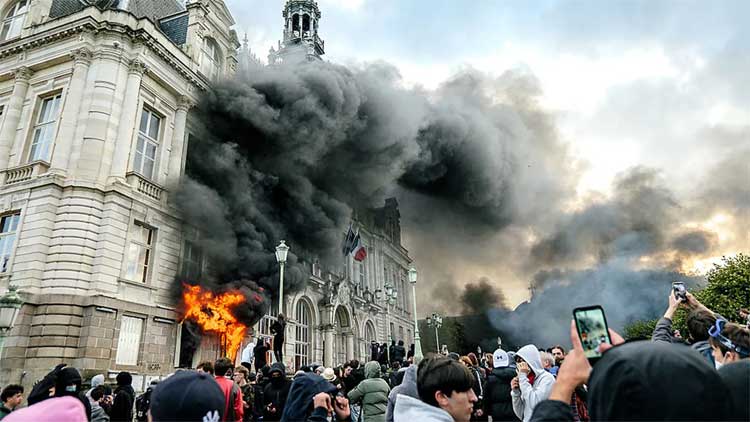
A historic 143-year-old town hall in the French city of Limoges was “largely lost” to a fire allegedly started by masked protesters on Saturday as demonstrations against rising living costs and declining public services turned violent in several parts of France. French Prime Minister Sebastien Lecornu said around 1,200 people had been arrested during the unrest.
Hundreds of thousands of people participated in demonstrations across dozens of French cities, with many demanding higher wages, lower prices and better public services. However, violent groups allegedly attacked public buildings, set fires, clashed with police and looted shops.
Smaller demonstrations were also reported in Belgium, Portugal and Italy over rising living costs. In Albania, protesters took to the streets over alleged government corruption, unemployment and poor educational standards.
Historic Limoges Town Hall ‘Largely Lost’ In Fire
The historic town hall in Limoges suffered extensive damage after a fire broke out on Saturday. Regional prefect Maurice Barate described the destruction as a “catastrophe for heritage” and condemned it as a deliberate act by rioters.
“The roof has collapsed onto lower floors, except the west wing, and two-thirds of the exterior has already disappeared,” Barate told AFP.
According to eyewitnesses, a group of masked protesters first set a police vehicle on fire outside the building before smashing windows and entering the town hall, where they allegedly started the blaze.
Firefighters were deployed late on Saturday to bring the fire under control. As crowds watched the historic building burn, a municipal employee was seen crying while a local councillor attempted to comfort them.
The damage to the building became one of the most striking images of the unrest, which has raised concerns about public safety and the protection of historic landmarks.
More Than 1,200 Arrested As Protests Spread Across France
French Interior Minister Laurent Nunez said around 550,000 people had participated in demonstrations across the country, while the CGT labour union estimated the turnout at 800,000, Reuters reported.
Lecornu said approximately 1,200 people had been arrested as the demonstrations escalated.
While many protesters marched peacefully, violent groups targeted public buildings, attacked police vehicles and officers, and looted businesses.
In Marseille, demonstrators dressed in black reportedly entered the town hall and defaced it with graffiti. In Lyon, protesters set fire to the tourist office.
Police fired tear gas in parts of Paris as officers confronted groups of predominantly young demonstrators. Many protesters wore black clothing, hoodies, masks and goggles, with some using the protective equipment to shield themselves from tear gas.
Demonstrators said the violence was caused by troublemakers rather than the wider protest movement, insisting that most participants had gathered peacefully to express their grievances.
Shops Looted In Paris, Marseille And Other Cities
The demonstrations were accompanied by widespread reports of vandalism and looting across several French cities, including Paris, Marseille, Nice, Nantes, Bordeaux, Limoges, Lille, Toulouse and Strasbourg.
Businesses targeted included supermarkets, pharmacies, luxury boutiques, clothing stores, opticians, cosmetics outlets and consumer electronics retailers.
AFP reported that groups of around six young men were sometimes seen targeting shops in an organised manner. Wearing masks and gloves, they allegedly disconnected security cameras before smashing windows and entering the premises.
The looting added to the destruction reported during the demonstrations, with public buildings and town halls also coming under attack.
JD Vance Blames Immigration For Violence In France
US Vice President JD Vance blamed immigration and what he described as failures of assimilation for the violence, sharing a video showing the Limoges town hall engulfed in flames on X.
“Western liberals imported the third world into France and other countries in the name of diversity and compassion. They ignored fundamental questions of assimilation and compatibility. They were told it would lead to this and they didn’t listen,” Vance wrote.
He also expressed concern over the damage to France’s historic landmarks.
“I pray that France, a beautiful country of amazing people, will stop this madness before more of its landmarks burn,” he added.
Vance linked the unrest to the US congressional midterm elections scheduled for November 3, arguing that Americans should pay attention to developments in France.
“And I hope Americans are paying attention. This is the future congressional Democrats seek for your country,” he said.
His comments brought immigration and political divisions into the international debate surrounding the French unrest.
Cost-Of-Living Crisis Fuels Public Anger
The demonstrations come as President Emmanuel Macron’s government faces pressure to address rising living costs while attempting to bring France’s public finances and debt under control.
Opposition groups have resisted the government’s budget plans, contributing to political instability that has seen two prime ministers toppled over budget disputes in the past two years.
Protesters responded to calls on social media to revive the “yellow vest” movement, which emerged in 2018 amid anger over social inequality and the cost of living.
The latest demonstrations reflected concerns over rising petrol, energy and food prices, as well as dissatisfaction with public services and the government’s economic policies.
Many demonstrators carried placards criticising the police, the president and wealthy sections of society.
The CGT, one of France’s major labour unions, backed the protests and called for “higher wages and pensions, lower prices and the protection of public services that meet people’s needs”.
Student groups that have organised school blockades since mid-September also urged supporters to join the demonstrations.
Macron, Lecornu Vow Action Against Rioters
The French government condemned the violence and said those responsible would face legal consequences.
Lecornu blamed the unrest on what he described as the “ultra-left” and criminal elements, warning that violence would not be allowed to dictate the country’s political agenda ahead of next year’s presidential election.
“To those who clearly want to use this violence as a ‘warm-up’ before the presidential election, I say clearly: We will not let ourselves be intimidated. No one will impose their political agenda through violence,” he wrote on X.
Macron also vowed to prosecute and punish those responsible for attacks on public institutions and businesses.
“We will all stand united against the sowers of chaos, who only seek to undermine our institutions and prevent those who peacefully express their demands from doing so,” he posted on X.
Europe Faces Wider Discontent Over Living Costs
The protests in France formed part of a wider wave of public discontent across Europe, where households continue to face pressure from living costs and concerns about employment, public services and government accountability.
Although the demonstrations in Belgium, Portugal and Italy were smaller, they reflected similar economic anxieties. In Albania, protesters focused on alleged corruption, job shortages and shortcomings in education.
In France, the immediate challenge for the authorities is to restore public order while responding to protesters’ economic demands.
The extensive damage to the Limoges town hall has also highlighted the impact of the violence on cultural heritage and public institutions.
With the government under pressure over its budget plans and a presidential election approaching, the protests are likely to remain a significant test of Macron’s administration as it seeks to balance economic reforms, public spending and social demands.
Comments are closed, but trackbacks and pingbacks are open.