
Delhi AQI Turns ‘Severe’ Day After Diwali, Capital Chokes on Thick Smog

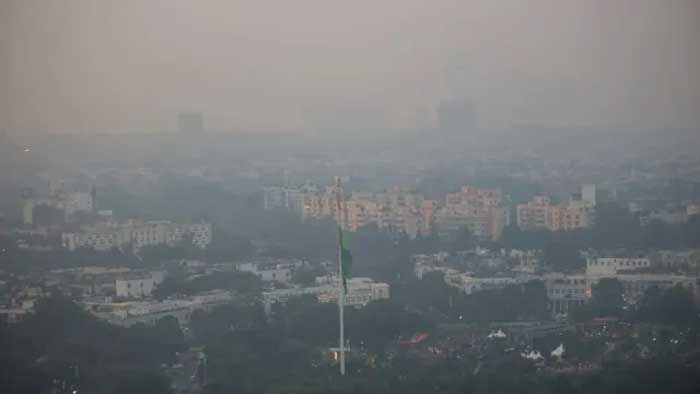
New Delhi woke up to a thick blanket of smog on Monday, November 9, as air pollution levels surged across the national capital a day after Diwali celebrations. Several monitoring stations recorded air quality in the ‘Severe’ category, while reduced visibility and rising pollution raised concerns over public health.
According to the Central Pollution Control Board (CPCB), Delhi’s average Air Quality Index (AQI) stood at around 366-368 on Monday morning, placing the city in the ‘Very Poor’ category. However, several neighbourhoods recorded readings above 400, entering the ‘Severe’ category.
Jahangirpuri recorded an AQI of 433, while Chandni Chowk registered 418 and Mundka recorded 417. The ITO monitoring station also reported an AQI of 406 at around 4:20 am. Other areas, including RK Puram and Lodhi Road, continued to experience very poor air quality.
A dense layer of smog covered several parts of Delhi during the early morning hours, significantly reducing visibility. Areas such as Inderlok witnessed particularly hazy conditions as pollutants accumulated over roads and residential neighbourhoods.
Firecracker Smoke Adds to Pollution
The deterioration in air quality followed widespread firecracker use during Sunday’s Diwali celebrations, despite restrictions on the sale and bursting of fireworks.
Smoke from firecrackers added to the pollution already generated by vehicular emissions, industrial activity, construction dust and seasonal crop-residue burning in neighbouring states.
According to reports, fireworks were set off in several parts of the capital, including Pitampura, Burari, Mayur Vihar and areas of Lutyens’ Delhi.
The city’s average AQI had already reached 376 on Sunday, compared with 369 on Saturday, indicating that pollution levels were elevated even before the festival celebrations intensified.
Data from monitoring stations showed that pollution worsened as firecracker activity increased during the evening. Sonia Vihar recorded an AQI of 463, while Jahangirpuri registered 450 in late-night readings.
Residents in several neighbourhoods reported a strong smell of smoke, reduced visibility and breathing discomfort.
GRAP Stage III Restrictions Remain in Force
Amid worsening pollution, Stage III of the Graded Response Action Plan (GRAP) remained in force across Delhi-NCR.
The restrictions include additional controls on construction and demolition activities, limitations on certain polluting industrial operations and restrictions on older vehicles, alongside other pollution-control measures.
The Commission for Air Quality Management (CAQM) had invoked Stage III restrictions on November 6, ahead of Diwali, anticipating a further deterioration in air quality.
The Supreme Court had permitted the use of certified green firecrackers in Delhi-NCR during limited time windows on November 7 and 8, while making clear that the restrictions would be reinstated from November 9.
However, reports of firecracker use beyond permitted conditions raised concerns about compliance and enforcement.
Weather Conditions Likely to Worsen the Situation
Unfavourable weather conditions have also contributed to the accumulation of pollutants across the capital.
Low wind speeds, cooler temperatures and stagnant atmospheric conditions have reduced the dispersal of harmful particles, allowing smoke and other pollutants to remain trapped close to the ground.
The winter pollution crisis in Delhi is driven by multiple sources, including transport emissions, industrial pollution, construction dust and agricultural stubble burning in neighbouring Punjab and Haryana.
Although firecrackers contributed to the immediate post-Diwali pollution spike, experts have repeatedly highlighted the need to address these year-round sources to achieve sustained improvements in air quality.
Health Concerns as Delhi Continues to Breathe Polluted Air
The deteriorating air quality has renewed concerns about the health risks facing residents, particularly children, older people and individuals with existing respiratory or cardiovascular conditions.
Fine particulate matter such as PM2.5 can penetrate deep into the lungs and enter the bloodstream, increasing the risk of respiratory and cardiovascular problems.
The CPCB classifies AQI readings between 301 and 400 as ‘Very Poor’, while readings between 401 and 500 fall under the ‘Severe’ category. Prolonged exposure to severe pollution can affect even healthy individuals.
With smog continuing to blanket several parts of Delhi, authorities face renewed pressure to enforce pollution-control measures and prevent further deterioration in air quality.
Comments are closed, but trackbacks and pingbacks are open.