
Costa Rica’s new president vows hardline crackdown on drug crime at inauguration

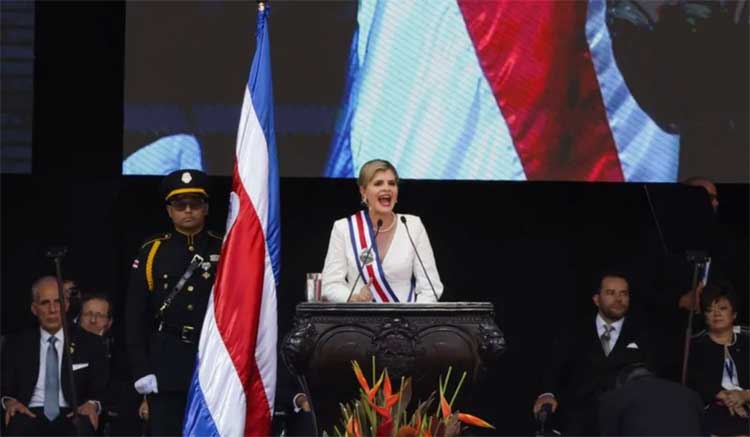
Laura Fernandez pledged a tough new offensive against drug trafficking as she was sworn in as Costa Rica’s president, promising a “firm hand” against organized crime in the Central American nation.
The 39-year-old leader succeeds her political mentor Rodrigo Chaves, who weathered two impeachment attempts over corruption allegations during his term.
Fernandez secured a comfortable victory in the February 1 election after campaigning on a law-and-order platform, capitalizing on growing public anxiety over crime in a country once regarded as one of the safest in the Americas.
Wearing a cream blazer dress, she took the oath of office before thousands of flag-waving supporters at the National Stadium of Costa Rica in the capital, San Jose.
“A firm hand is what you expect,” Fernandez told the crowd. “My hand will not tremble when confronting organized crime.”
A former minister of the presidency under Chaves, Fernandez had long been seen as his chosen successor. Though barred by Costa Rica’s constitution from seeking back-to-back terms, Chaves remains a powerful political figure and has now been appointed to a senior “super-minister” role in what Fernandez has branded a “government of continuity.”
The appointment has fueled speculation that Chaves could retain significant influence behind the scenes.
Known globally for its white-sand beaches and eco-tourism, Costa Rica has increasingly become a strategic transit hub for regional drug trafficking networks. The resulting turf wars have driven a sharp rise in violence and pushed security to the forefront of national politics.
Fernandez has vowed sweeping judicial reforms, arguing the current system is too lenient on criminals, and has pledged tougher prison sentences.
She has openly praised the hardline security model of Nayib Bukele, whose aggressive anti-gang crackdown in El Salvador has drawn both international praise and criticism over human rights concerns.
Costa Rica is already constructing a maximum-security prison modeled on El Salvador’s controversial mega-prison for suspected gang members.
Like Chaves, Fernandez is also viewed as an ally of Donald Trump, and her victory adds to a broader rightward political shift across Latin America following recent conservative gains in countries including Chile, Bolivia and Honduras.
Political analyst Constantino Urcuyo warned against embracing Bukele-style governance, saying Costa Rica’s democratic institutions remain resilient despite growing authoritarian tendencies in the region.
Comments are closed, but trackbacks and pingbacks are open.