
ASEAN Summit Opens in Manila Amid Trade, Security and Energy Tensions

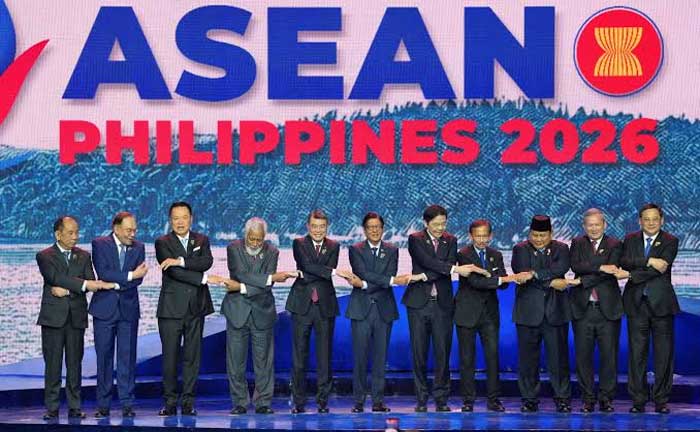
A major regional summit opens in Manila on Sunday, bringing Southeast Asian leaders together to address mounting challenges over trade, security and energy supplies, while hosting several prominent global leaders.
US President Donald Trump is expected to arrive on Tuesday, shortly before the summit concludes. His visit is likely to include a meeting with the leaders of India, Japan and Australia under the Quad framework — the first such gathering of his second presidential term.
The Quad, which aims to counterbalance China’s growing influence in the Indo-Pacific, is expected to meet just days before a historic engagement involving Chinese President Xi Jinping and Russian President Vladimir Putin in Shenzhen.
Brazilian President Luiz Inácio Lula da Silva is also scheduled to attend Sunday’s plenary session of the 11-member Association of Southeast Asian Nations (ASEAN). Meanwhile, Australian Prime Minister Anthony Albanese is expected to sign a new defence agreement with the Philippines.
Security has been tightened across Metro Manila, with nearly 20,000 police officers deployed for the summit. Progressive groups are anticipating thousands of demonstrators at an anti-Trump march scheduled for Tuesday near the summit venue.
Much of the protest centres on the US-backed Pax Silica programme, an initiative aimed at strengthening supply chains and reducing China’s dominance in semiconductors and rare earth minerals.
Its flagship Philippine project involves a proposed 1,620-hectare artificial intelligence manufacturing hub north of Manila, which critics say could displace Indigenous communities.
US Ambassador to the Philippines Lee Lipton said last week that reports suggesting a deal would be signed during Trump’s visit in November were inaccurate, adding that no such signing had been planned.
Unresolved Challenges Facing ASEAN
Preliminary meetings began on Saturday, with Canadian Prime Minister Mark Carney announcing a trade agreement with the Philippines.
ASEAN leaders also discussed pressing regional concerns, including cross-border haze pollution from Indonesia and possible fuel-sharing arrangements as member states struggle with energy shortages linked to the war involving Iran.
However, two longstanding challenges — negotiations over a South China Sea Code of Conduct and ASEAN’s approach towards Myanmar — remain unresolved and are likely to confront Singapore when it assumes the bloc’s rotating chairmanship in 2027.
Myanmar has been excluded from high-level ASEAN meetings since the military coup in 2021, which ousted the elected government of Aung San Suu Kyi and plunged the country into a prolonged civil war.
Thailand, which shares a border with Myanmar, has advocated closer engagement and called last week for Myanmar’s foreign minister to be readmitted to ASEAN meetings.
The Philippines, however, has signalled no change in its position. Foreign Secretary Theresa Lazaro told reporters on Saturday that there would be no relaxation of the bloc’s existing approach.
Myanmar is also facing an international legal ruling later this week over allegations of genocide against its Rohingya Muslim minority.
Meanwhile, hopes of finalising a Code of Conduct governing disputes in the South China Sea between China and ASEAN members during the Philippines’ chairmanship have diminished.
A Southeast Asian diplomat involved in summit preparations told AFP that an agreement was unlikely to be signed during the gathering.
Lazaro indicated that negotiations were approximately 80 per cent complete.
Siew Mun Tang, former head of the ASEAN Studies Centre at Singapore’s ISEAS-Yusof Ishak Institute, described a successful agreement as a possibility requiring a small miracle.
China’s Growing Shadow Over the South China Sea
China claims sovereignty over most of the South China Sea, despite an international tribunal ruling that its expansive claims have no legal basis. Its coast guard has repeatedly clashed with Philippine vessels in the disputed waters.
The tensions have disrupted several regional diplomatic engagements over the past year.
In July, an ASEAN foreign ministers’ meeting began less than a day after Chinese and Philippine sailors were involved in a confrontation.
Last month’s ASEAN defence chiefs’ meeting also exposed diplomatic divisions, with Beijing sending only a defence attaché from its embassy. China blamed what it described as reckless statements by Philippine politicians.
A week later, Manila issued an unusual public rebuke to its own officials over remarks concerning China, emphasising the importance of maintaining a consistent national position while negotiations continue.
As ASEAN leaders gather in Manila on Sunday, a separate annual seminar less than five kilometres from the summit venue will focus on challenging China’s claims in the South China Sea.
Philippine Defence Secretary Gilberto Teodoro, who was sanctioned by Beijing earlier this year over what China described as irresponsible remarks, is scheduled to deliver the keynote address.
The summit therefore comes at a critical moment for ASEAN, as its members attempt to balance economic cooperation, regional security and diplomatic relations with major global powers amid intensifying geopolitical competition.
Comments are closed, but trackbacks and pingbacks are open.