
EU Weighs Major Reset in Ties With Syria, Seeks to Curb Russian Influence

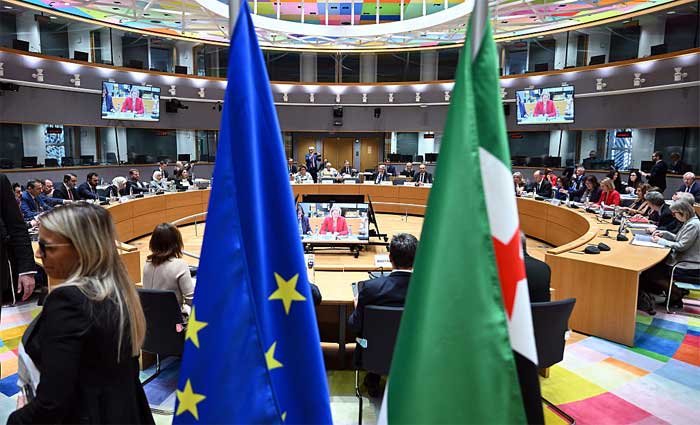
The European Union is considering a major expansion of its engagement with Syria, including security sector reforms, increased investment and the revival of a long-stalled trade agreement, as Brussels seeks to strengthen ties with Damascus and limit Russia’s influence in the country following the ouster of Bashar al-Assad.
According to an EU discussion paper seen by Reuters, the proposals outline one of the bloc’s most ambitious efforts to normalise relations with Syria since Assad’s removal ended decades of authoritarian rule and reshaped the regional political landscape.
The document was prepared by the EU’s diplomatic service ahead of a November 16 meeting of the bloc’s foreign ministers.
While acknowledging progress in Syria’s political transition, the EU said significant challenges remained, calling for faster action on economic recovery, national reconciliation and the reintegration of internally displaced people and refugees.
Security cooperation is a key element of the proposed engagement. The EU is considering support for security sector reforms, including cooperation with Jordan to train Syrian police recruits.
The bloc also wants to strengthen its presence in Syria to counter what the document describes as the “malign influence of Russian and other foreign actors”.
Russia intervened in Syria’s civil war to support Assad’s government, securing a longstanding military presence and strategic access to the Mediterranean. Following Assad’s overthrow, Moscow has sought an agreement with Syria’s new authorities to retain access to its naval facility at Tartous and Hmeimim air base.
Although Russian influence has declined since Assad’s fall, the EU document warns that Moscow’s continued military presence and economic leverage remain concerns for the bloc.
EU Seeks to Revive Trade Agreement and Attract Investment
Syria faces enormous reconstruction requirements after nearly 14 years of civil war that devastated its infrastructure and weakened its economy. The country’s new authorities are seeking international investment and expanded trade to support reconstruction and economic recovery.
One of the most significant proposals under consideration is the revival of an association agreement initialled in 2008 but never formally concluded.
The proposed agreement would establish a framework for free trade, political dialogue and wider cooperation between the EU and Syria.
European diplomats are expected to seek a fresh mandate from member states to negotiate revisions to the existing agreement, which the discussion paper describes as a potential foundation for rapidly expanding bilateral relations.
The EU also wants to reintegrate Syria into Euro-Mediterranean cooperation initiatives and international trade networks, with particular emphasis on transport, energy and digital connectivity.
As part of its economic engagement, the bloc is encouraging the European Investment Bank to resume operations in Syria. It is also supporting Damascus’ efforts to become a shareholder in the European Bank for Reconstruction and Development, potentially opening the door to additional reconstruction financing.
An EU-led coordination forum scheduled for November 17 in Damascus will focus on investment opportunities and private sector participation. The discussions are expected to lay the groundwork for a possible EU-Syria investment conference in 2027.
EU Steps Up Financial and Diplomatic Engagement
The proposed initiatives build on the EU’s recent efforts to restore diplomatic and economic engagement with Syria.
These include the resumption of the bloc’s 1978 cooperation agreement with Damascus and the first high-level political dialogue between the two sides in May.
The EU has also pledged 620 million euros (approximately $718 million) in assistance to Syria for 2026 and 2027, covering humanitarian aid and socio-economic recovery.
The latest proposals signal Brussels’ intention to play a larger role in Syria’s political and economic reconstruction while strengthening its strategic position in the region and reducing the influence of external powers, particularly Russia.
Comments are closed, but trackbacks and pingbacks are open.