
US and Japan to Jointly Produce Advanced Air-to-Air Missiles Amid Regional Tensions

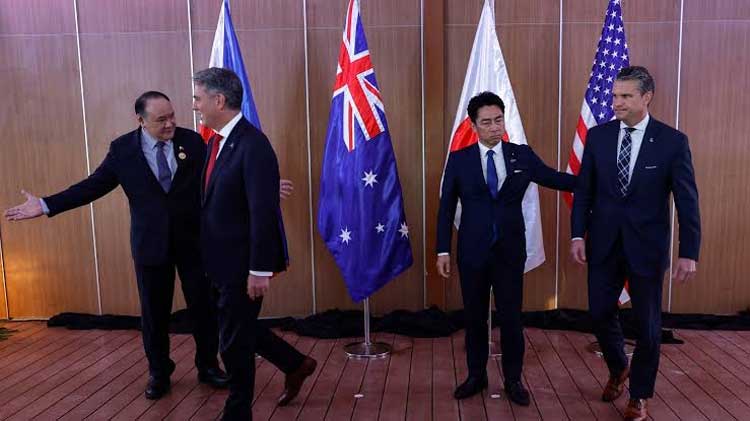
The agreement, announced by Japanese Defense Minister Shinjiro Koizumi, aims to strengthen the military capabilities of the US-Japan alliance as security concerns grow across the Indo-Pacific.
CEBU, Philippines: The United States and Japan have agreed to establish a facility in Japan to jointly produce advanced medium-range air-to-air missiles, Japanese Defense Minister Shinjiro Koizumi announced Wednesday, marking another step in strengthening the allies’ defense cooperation amid rising security concerns in Asia.
Koizumi made the announcement following a meeting with US Defense Secretary Pete Hegseth in Cebu, the Philippines, on the sidelines of an annual gathering of Southeast Asian defense ministers and their counterparts from major regional and Western powers.
The joint production initiative, named “Operation Supercharge,” will focus on missiles that Koizumi described as essential for the US-made F-35 fighter aircraft, which is also operated by Japan’s military. He did not disclose further details about the facility, production capacity or the agreement’s timeline.
The announcement comes as Washington and Tokyo seek to strengthen their military deterrence and response capabilities amid concerns over China’s expanding military presence and increasingly assertive actions in the region.
US-Japan Alliance Seeks Stronger Deterrence
Following his meeting with Hegseth, Koizumi said the two countries shared concerns about the deteriorating regional security environment and agreed to accelerate efforts to reinforce their alliance.
“We shared a sense of crisis … regarding the increasingly severe regional situation and we agreed to strengthen the deterrence and response capabilities of the Japan-US alliance with greater speed and intensity than ever before,” Koizumi said.
He added that both sides reaffirmed their commitment to a free and open international order based on the rule of law, opposing attempts to change the status quo through force or coercion.
Koizumi emphasized that their discussions were not directed against any particular country.
The annual defense meetings are intended to strengthen cooperation among regional partners and reduce the risk of a major conflict. However, tensions between the United States and China, along with disagreements involving their respective partners, have frequently surfaced during such gatherings.
Hegseth Reaffirms US Security Commitments
Hegseth also reiterated Washington’s commitment to deterring aggression in the Indo-Pacific during a separate meeting with defense ministers from the Association of Southeast Asian Nations (ASEAN), led by Philippine Defense Secretary Gilberto Teodoro Jr.
Without directly naming China, Hegseth outlined the Trump administration’s approach to regional security.
“The approach we’re taking, we describe as strong, quiet and clear,” he told the ASEAN defense chiefs.
He said the strategy was intended to deter coercion and aggression while avoiding unnecessary escalation, adding that the United States would defend its interests and those of its allies and partners.
Washington has repeatedly assured the Philippines, its oldest treaty ally in Asia, that it remains committed to strengthening deterrence against potential threats in the disputed South China Sea.
China claims sovereignty over almost the entire waterway, a major international shipping route. The Philippines, Vietnam, Malaysia and Brunei, all ASEAN members, as well as Taiwan, have overlapping territorial claims in the region.
Confrontations between Chinese and Philippine coast guard and naval vessels have intensified in disputed areas, including shoals and surrounding waters.
The United States has warned that its mutual defense treaty with the Philippines applies to armed attacks against Philippine armed forces, public vessels and aircraft, including those operating in the South China Sea.
Territorial Disputes Continue to Strain Regional Relations
Beyond the South China Sea, Japan and China remain locked in a separate territorial dispute over Japanese-administered islands in the East China Sea. Both countries have repeatedly accused each other of violating their maritime claims.
The missile production agreement reflects the broader effort by Washington and Tokyo to deepen defense cooperation as regional governments respond to an increasingly complex security environment.
By expanding joint weapons production, the two allies aim to reinforce their military readiness and strengthen the capabilities underpinning their security partnership.
The agreement was announced as defense officials from Southeast Asia and their international counterparts gathered in the Philippines to discuss regional security, military cooperation and ways to prevent disputes from escalating into wider conflict.
Comments are closed, but trackbacks and pingbacks are open.