
Rahul Gandhi Alleges Tata Group Is Being ‘Criminally Destroyed’, Questions Business Leaders’ Silence

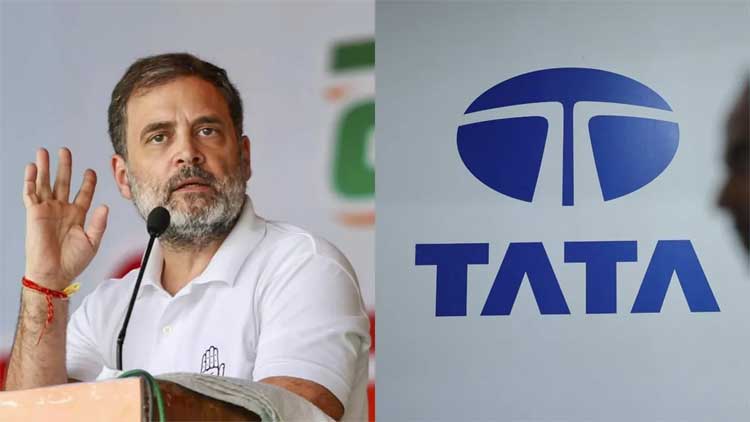
Congress leader and Lok Sabha Leader of Opposition Rahul Gandhi on Wednesday alleged that the Tata Group was being “criminally destroyed” and accused business leaders of remaining silent over the controversy. He asserted that Indian businesses should not be treated as the “plaything” of Prime Minister Narendra Modi and Home Minister Amit Shah.
In a post on X, Gandhi wrote: “Tata is being criminally destroyed, and no business leader dares say a word.”
Questioning the silence of industry leaders, he added: “How long will you stay silent? Until they own you? Indian business is not Modi and Shah’s plaything. You lack courage. We don’t. We will ensure justice for these crimes.”
Governance Dispute at Tata Group
The remarks come amid a reported governance dispute involving Tata Trusts Chairman Noel Tata and the board of Tata Sons, the principal holding company of the Tata Group. The disagreement has brought questions of ownership, corporate authority and strategic decision-making into focus.
The conflict reportedly intensified in September 2026 after the Tata Sons board approved a fresh five-year term for Chairman N Chandrasekaran and moved towards considering a stock market listing. Noel Tata opposed both decisions, arguing that they conflicted with the position of Tata Trusts and raising concerns about the board’s decision-making process.
Tata Trusts trustees Venu Srinivasan and Vijay Singh have also reportedly approached the Charity Commissioner over governance-related issues. Meanwhile, the Tata Sons annual general meeting was postponed after a lack of quorum.
Tata Trusts collectively hold approximately 66% of Tata Sons, giving them a substantial ownership stake and considerable influence over the conglomerate. Noel Tata assumed leadership of Tata Trusts following Ratan Tata’s death in October 2024. Since then, differences have emerged over trustee appointments, board representation and the group’s future direction.
Disagreement Over Proposed Stock Market Listing
A central issue in the dispute is whether Tata Sons should remain privately held or list its shares on stock exchanges.
In March 2024, the Tata Sons board unanimously supported keeping the company unlisted. The two principal Tata Trusts subsequently reaffirmed that position through resolutions passed in 2025.
The issue resurfaced after the Reserve Bank of India reportedly rejected Tata Sons’ application to surrender its registration in September 2026. Tata Sons’ classification as an upper-layer non-banking financial company carries regulatory implications, including a potential stock market listing requirement.
Noel Tata has argued that the RBI communication did not explicitly mandate a listing and that alternative solutions should be considered.
Dispute Over Chandrasekaran’s Reappointment
The reappointment of N Chandrasekaran has emerged as another point of contention. Tata Trusts questioned the validity of the board’s decision, particularly the use of the chairman’s casting vote after Noel Tata opposed the proposal and fellow Trusts nominee Venu Srinivasan supported it.
The Trusts argued that affirmative support from their nominees was necessary under Tata Sons’ Articles of Association. Tata Sons, however, maintained that Chandrasekaran’s reappointment had been approved by a majority of the board.
Business Losses Add to Tensions
Concerns over business performance have further complicated the situation. Noel Tata has reportedly raised questions about mounting losses at unlisted ventures, including Air India and Tata Digital, alongside issues involving capital allocation and executive remuneration.
Disagreements among trustees have also spilled into formal complaints and public exchanges, intensifying the governance dispute.
The confrontation has consequently extended beyond questions of business strategy to a broader debate over the relationship between majority ownership, board independence and the governance structure that has shaped the Tata Group for generations.
Gandhi’s comments have added a political dimension to the controversy, although his allegations about the reasons behind the dispute remain his own claims.
Comments are closed, but trackbacks and pingbacks are open.