
Nepal Flood Disaster Must Spur Global Climate Action, Says UN Official

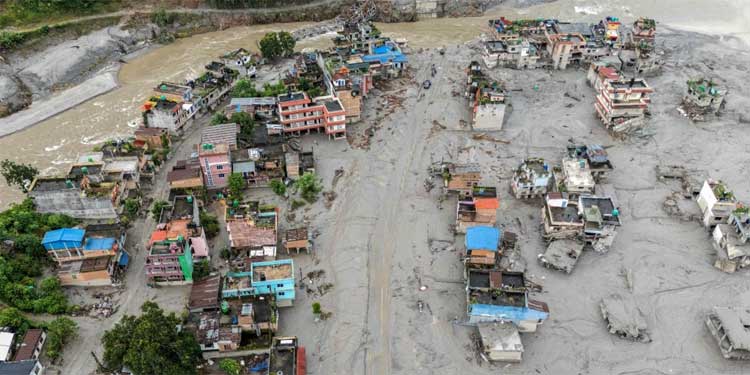
Nepal’s devastating floods should serve as a turning point for global climate action, with the international community stepping up support to help the Himalayan nation recover, a senior United Nations official told AFP on Saturday.
The country experienced one of the worst disasters in its history on August 26, when a mountain collapse near the Chinese border triggered catastrophic flooding that killed more than 1,400 people and left over 5,000 missing. Scientists said climate change played a significant role in the disaster.
Jorge Moreira da Silva, executive director of the UN Office for Project Services (UNOPS), which implements humanitarian and development projects, said he witnessed “massive devastation” during a visit to affected communities.
Nepal, a largely rural country of around 30 million people that contributes little to global greenhouse gas emissions, estimates that reconstruction will cost $4.78 billion.
“This is a defining moment not only for Nepal, this is a defining moment for the international community,” Moreira da Silva told AFP in Kathmandu.
“It’s not fair to ask a country that emits almost nothing of CO2 to suddenly pay alone the consequence of something that was not generated by the country,” he added, stressing the importance of international solidarity.
Climate Justice and Global Responsibility
Moreira da Silva said Nepal’s reconstruction and resettlement efforts must account for future climate risks. He also urged the international community to renew its commitment to tackling climate change.
“It’s also about climate justice and climate responsibility,” he said, warning that countries with low greenhouse gas emissions would continue to face severe climate impacts.
“This is going to happen unless those countries that emit the most… change their pathway,” he added.
His remarks highlighted growing concerns over the disproportionate burden climate change places on vulnerable countries that contribute relatively little to global emissions but face significant risks from extreme weather events.
Global Disruptions Pose Food Security Risks
As Nepal works to rebuild communities devastated by the floods, wider global disruptions are creating additional challenges for food security.
Moreira da Silva, who also leads the UN task force for the Strait of Hormuz, warned that simultaneous disruptions affecting three major maritime chokepoints could have serious consequences.
“The simultaneous disruption of the three maritime shock points… the Strait of Hormuz, in the Black Sea and in the Red Sea, poses a significant challenge, particularly on food security,” he said.
Disruptions to these critical shipping routes can affect the movement of essential goods and put additional pressure on vulnerable countries already struggling with humanitarian emergencies.
UN Launches $49.6 Million Emergency Appeal
The United Nations and its humanitarian partners launched a $49.6 million appeal last month to provide emergency assistance to people affected by the floods.
The funding is intended to support relief efforts as Nepal confronts the enormous task of rebuilding damaged communities and helping displaced residents recover.
Nepal’s Prime Minister Balendra Shah also raised the issue at the United Nations last month, describing the flooding as “a warning to the world” about the growing dangers of climate change.
The disaster has renewed calls for greater international cooperation, climate financing and stronger adaptation measures to help vulnerable nations prepare for the consequences of a warming planet.
Comments are closed, but trackbacks and pingbacks are open.